Some brands earn your trust before a single patch cable goes in. Xaoc Devices is one of them. The Polish maker is lifting the lid on two releases that neatly sum up its split personality: the Skopje, a dual quantizer so effective it vanishes into the patch, and the Budapeszt, a stereo spectral processor built to send harmonics off the rails. The first is already available; the second is on its way.
Skopje: a quantizer that refuses to cut corners
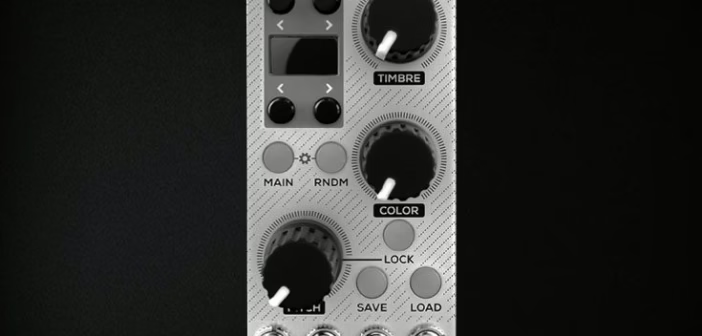
On paper, a quantizer is a humble utility: it snaps control voltages to the notes of a scale. But in a modular system, the quality of that utility changes everything — a sloppy quantizer and the whole patch sounds out of tune. The Skopje tackles the problem head-on. In just 6 HP, it packs two fully independent channels, each able to quantize to a different scale drawn from a different bank.

Storage lives on a microSD card and opens up a staggering range: up to 100 banks of 100 scales each. Xaoc doesn’t lock you into a closed format — the module reads its own dead-simple text format as well as Scala files, the universal reference for microtonality. Anyone into exotic temperaments, just intonation or non-octave systems has plenty to dig into here.
The detail that seals the deal is per-channel calibration. Each output can be trimmed to track a given VCO perfectly — the nightmare of every modularist who has ever heard an oscillator drift in the high end. Add a small OLED display dedicated purely to picking banks and scales (no menu diving), built-in glide, transposition — including an unquantized position to let vibrato through — plus scale changes driven by trigger or CV, and you get a module that thinks of everything without ever getting in the way of the music.
Skopje at a glance
| Spec | Detail |
|---|---|
| Format | Eurorack 6 HP |
| Channels | 2 independent quantizers |
| Scales | Up to 100 banks × 100 scales |
| Formats | Xaoc text format + Scala, on microSD |
| Highlights | Per-channel calibration, glide, transposition, OLED display |
| Price | Around $419 / £369, available now |

Budapeszt: stereo as a spectral playground
The mood flips completely with the Budapeszt. Here we leave utility behind for pure experimentation. This stereo spectral processor is built around the interference of resonant structures: two independently tunable comb-type filters, with six distinct modes that approach the frequency domain via delay, phase or filterbank. The first mode borrows the signal model inherited from the Samarkanda, Xaoc’s in-house delay line, for artifact-free pitch behavior across the full range.
As Xaoc puts it, “the real magic happens in the interference between the stereo filters.” Two triangle LFOs (free, synced or in envelope-follower mode) animate the whole thing, and above all multiple feedback paths — including cross-coupled feedback between the two filters — turn the module into a generator of unstable harmonic lattices. A feedback phase-inversion switch per filter widens the palette further. This is firmly in the camp of tools that reward exploration over recipes.

Scale handling, at Xaoc, is never a gimmick: the Skopje belongs to a family of high-end utility modules that make a system worth keeping — think alongside other equally thoughtful Eurorack building blocks like the Jasmine & Olive Trees Doppler. The Budapeszt plays in a different league, closer in spirit to the offbeat boutique synths we’ve seen lately, such as the Tom Horn SinTH2.
Two philosophies, one signature
What stands out is the consistency of intent. The Skopje sweats the invisible — tuning, tracking, ergonomics you never notice — while the Budapeszt embraces the spectacular. I’ve always had a soft spot for makers who can do both: real hardware chops show as much in a flawless utility as in a showpiece module. You don’t hear a good quantizer; you just hear that the patch is in tune. That’s exactly the kind of detail that separates a system you keep from one you flip six months later.
Price and availability for the Budapeszt are still to be confirmed. The Skopje, though, is here now at around $419, and ticks just about every box you can ask of a modern quantizer. For anyone building a serious Eurorack system, it’s the kind of purchase you don’t regret — even in a market that hardly lacks flashier temptations.