Isla Electronics’ Caladan is finally real: the multitimbral hybrid synth with hot-swappable voice cards is heading into production for a Summer 2026 launch. One chassis, eight parts, and a rack of analogue and digital engines you swap like cartridges.
Most people know Isla Electronics (formerly Isla Instruments) for the S2400, the sampler that dragged the SP-1200 vibe into a modern, open-minded box. The Caladan is a different animal entirely — one of those instruments that flat-out refuses to pick a side between analogue and digital, or between one sound and another. Announced ages ago and repeatedly pushed back, it has now cleared the decisive hurdle: a production-ready revision, with pre-orders set to reopen. Time to talk about what it actually is, not what it once promised.
One chassis, eight parts, as many synths as you have cards
The Caladan boils down to a single idea: eight-part multitimbrality, with each part running its own synthesis engine — and you choose those engines. A trap door on the underside gives access to eight slots for interchangeable voice cards. Isla already lists a full roster: a Minimoog-style analogue voice, an SEM/OB-X, an SH-101, a TB-303, an analogue percussion card, a string machine, and an FM engine with analogue filters. You literally build your instrument to fit the project.

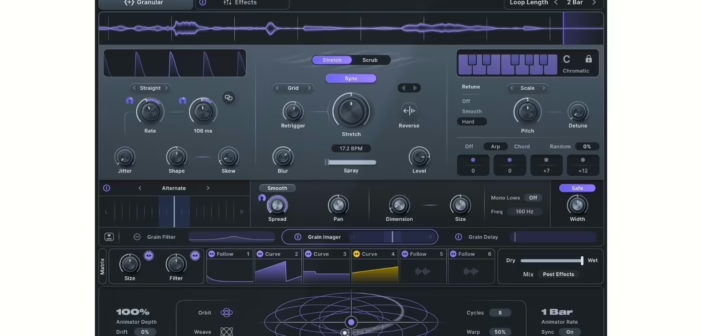
Even with no cards fitted, the Caladan isn’t silent. Its internal digital engine plays SoundFont (.sf2) banks and the SFZ multisample format, and — crucially — it hosts plugins: VST3, LV2 and CLAP run inside the machine, no computer required. On top of that sit Isla’s own digital engines: a six-voice OPL3 hybrid that revives 90s soundcard FM, a four-voice Quadrowave wavetable, and a 16-voice Callisto virtual analogue. Each part also gets four insert effects (LV2/VST3), two shared aux sends, plus its own arpeggiator, step sequencer and trance gate.
Caladan at a glance
| Item | Detail |
|---|---|
| Architecture | Hybrid analogue/digital, 8-part multitimbral |
| Voice cards | Minimoog, SEM/OB-X, SH-101, TB-303, FM with analogue filters, percussion, string machine… |
| Internal engines | OPL3 6-voice, Quadrowave (wavetable) 4-voice, Callisto VA 16-voice, SoundFont/SFZ playback |
| Plugin hosting | VST3 / LV2 / CLAP, up to 4 inserts per part |
| Connectivity | HDMI Full HD display out, MIDI USB + DIN, 4 CV/Gate, USB host, MPE |
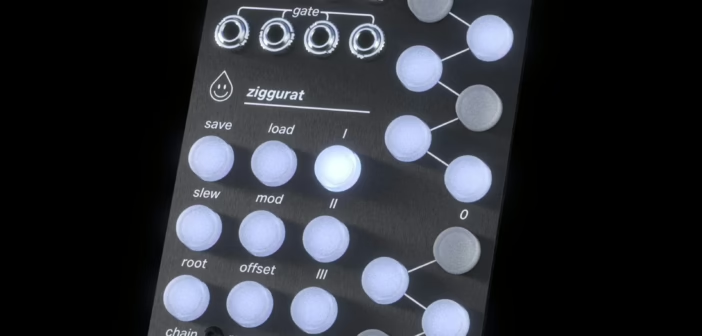
The front panel follows a matrix layout: each row of encoders, ringed with RGB LEDs, shows the parameter tied to the active line. It all extends onto an external screen via a Full HD HDMI output — a pragmatic call that skips the cost of a fancy built-in display while still giving you a proper overview. For control there’s class-compliant USB MIDI and DIN, four CV/Gate channels to talk to your modular, a USB host port, and MPE support.

A “meta-instrument” rather than just another synth
What sets the Caladan apart isn’t any one voice — plenty of boxes do analogue, FM or wavetable better or cheaper. It’s the idea of pulling all of that under one multitimbral architecture and letting the user decide the make-up. Where a 2000s workstation locked you into a fixed sound bank, the Caladan is an upgradeable platform: add a card when you need it, load a plugin when no card fits. That’s the promise of an instrument that ages more slowly than the rest.
There’s still the matter of who it’s for. This isn’t a beginner’s box: the depth of the architecture assumes you know why you want eight parts and how to route them. Historically, the base pre-order — the chassis plus two Parva voice cards — sat around £949 / roughly $1,199. Isla says pre-orders will reopen once the production version is signed off, so final pricing is still to be confirmed — but make no mistake, this is a high-end instrument, not a toy.

Having lived through the shift from analogue to computer-based production, I’ve landed on a simple conviction: dogma never made a good record, the sonic result does. Fully in-the-box is perfectly viable — I adopted it early — but a good piece of hardware earns its place when it brings something audible. The Caladan interests me precisely because it refuses that divide: it puts analogue, FM and plugin hosting on the same footing and lets the musician decide case by case. That’s the right way to frame the problem. The risk with a do-everything machine like this is dispersion — an instrument you admire more than you use. The real verdict will come from day-to-day ergonomics, not the spec sheet.
To place the Caladan among recent boutique and hybrid designs, compare it with the Tom Horn SinTH2 polysynth, the multi-engine Jamstik Loon, or the Analogue Solutions Filtopia monosynth. Full card details and the pre-order window are posted on Isla Electronics’ product page.