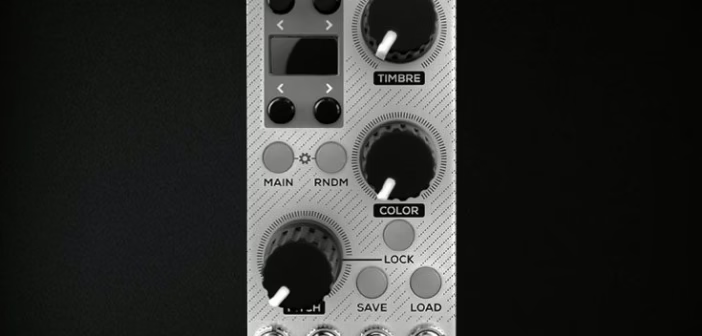
Modular racks have never been short of drum modules, but few have built percussion out of whatever you feed them. Jasmine & Olive Trees’ Doppler takes any source — an oscillator, a loop, a synth voice — and shapes it into a kick, a snare, a hi-hat, or something in between. Two ideas set it apart: a pitch engine built on a delay line, and a firmware system that swaps the moment you drop a physical overlay onto the panel. It costs €270 for 6 HP and it’s shipping now.
A kick built on the Doppler effect
The name isn’t decoration. The core writes the incoming signal into a delay line, then reads it back from a moving position — the exact mechanism that makes a passing siren rise and fall in pitch. A trigger resets the read head, which then sweeps toward a target depth, and that sweep draws the falling pitch envelope of a kick. Five depths are on offer, from −1 to −3 octaves, covering everything from a short, tight thud to a long, cinematic drop.
Past the kick, it’s all a continuum: from a clean signal you slide into a pitch envelope, then into harmonic FM where the modulator tracks the spectral peak of your input — with cross-modulation chaos waiting at the top of the range. That’s where Doppler stops being a kick box and turns into a generator of metallic hits, clicks and noisy textures.
The specs that actually matter
- Two separate inputs: Body for the main signal, Trans for a transient channel with an auto-tuned band-pass — feed the attack separately from the body.
- 13 chord voicings (major, minor, sus, 6ths, 7ths, 9ths, 11ths) via four pitch-shifted taps: the percussion can go harmonic.
- VCA and LPG modes, toggled by long-press and saved to memory, to pick between a hard dynamic and the more organic behaviour of a low-pass gate.
- Independent noise output driven by a “dust” oscillator whose density tracks the character of your input — a hi-hat or a grainy layer alongside the body.
- Smart Attack on a single knob: noise decay to the left, a long swell to the right.
- CV over attack, decay, mod and amount; 6 HP, 23 mm deep, ±12 V power.
The real news: swapping firmware by dropping an overlay
This is what separates Doppler from the rest of the eurorack crowd. The module runs on Jasmine & Olive Trees’ in-house DSP platform and ships with three free overlays — Door, Rubin and Lichen. Place one on the panel and the firmware switches automatically. No computer, no file wrangling, no reboot: roughly a second, and the module changes both its personality and its labelling at once.

It’s more than a gimmick. It’s an elegant fix for the multi-mode firmware problem: normally a “many modes” module forces you to memorise button combos or run a utility. Here each overlay is both the firmware selector and the new control panel, with its own legends. Future firmwares in the family will load for free over a plain USB cable and the maker’s web tool — no extra hardware required.
The physical gesture versus the all-screen box
I moved to the box early and I’ve never felt any knee-jerk nostalgia for hardware: when an all-digital chain does the job, it does the job. But there’s a class of objects where hardware brings something a screen can’t replace — the gesture. Dropping a plate to transform an instrument is an interaction no drop-down menu matches, and that kind of considered design is exactly what earns a module its HP in the rack. At €270 Doppler isn’t playing the budget game; it’s playing on a genuine idea, which is rarer.
There’s a catch, and it’s the source. The module doesn’t sound on its own: it transforms what you send it, and its richness depends on the quality and character of the input. That’s a strength for anyone who loves sound design and generative patching; it’s a constraint for anyone after a ready-to-go drum machine. Doppler is squarely aimed at the former.
Turning any signal into drums isn’t a modular-only idea, either — it landed on the plugin side over the past few months, as our round-up of plugins that turn any sound into drums shows. Doppler is the tactile version, patched between two modules. And for anyone following the boutique scene, it joins the wave of hand-built instruments we covered with the Tom Horn SinTH2 polysynth. Full details and the overlay manuals are on the maker’s product page.