Picture a TV panel with six guests, each on their own mic. As long as one person talks, all is well. But the moment the mics stay open together, background noise stacks up, the room “comes up”, and feedback is never far. The manual fix would be to ride the faders open and closed as the conversation flows, which is impossible to sustain live across six voices. That is exactly the problem automatic microphone mixing solves on its own, and it is one of the most useful, and most misunderstood, tools in broadcast production.
The problem: the number of open mics
One principle governs all multi-mic work: every time you double the number of open mics, captured background noise rises by about 3 dB and your margin before feedback drops by the same amount. Six mics open all the time is a far noisier, less stable system than a single mic. So the automixer’s goal is simple to state: keep open only the mics actually in use, at every instant, with no human intervention.
The quantity that matters is called NOM (number of open mics). A good automixer constantly tracks NOM and applies attenuation to compensate: the more active mics, the more it reduces overall gain to hold level and margin constant. That NOM management is what separates a real automixer from a bank of noise gates.
Two schools: gating and gain-sharing
Historically, two approaches coexist.
The first is threshold gating: each mic has a threshold and opens when the level exceeds it. It is simple and effective for well-separated, loud sources, but it has known flaws: phrase starts get clipped if the threshold is too high, a soft voice fails to trigger, and a sudden noise opens a mic at the wrong time. Setting it quickly becomes a permanent compromise.
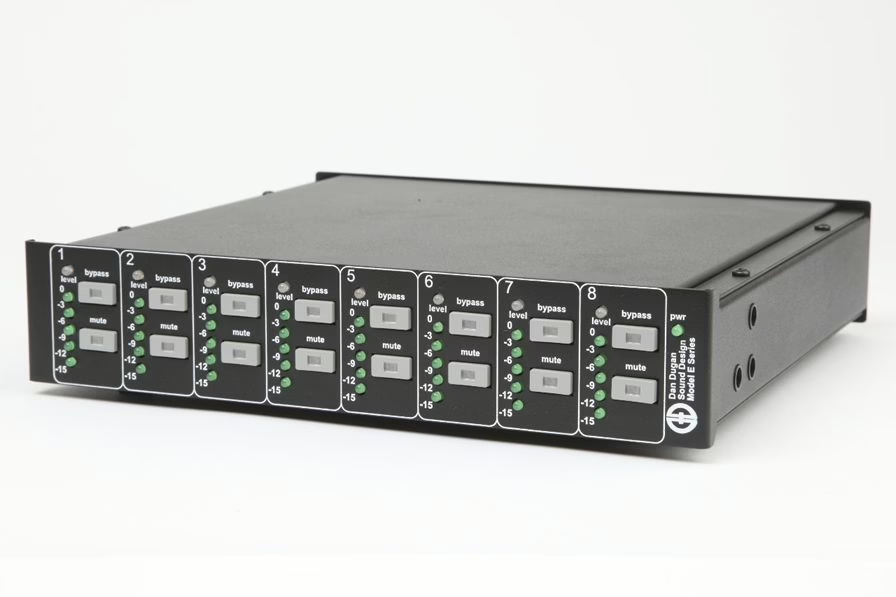
The second, invented by engineer Dan Dugan in the 1970s, is gain-sharing. Here there is no threshold. The system continuously compares each mic’s level to the sum of all mics, and shares a constant total gain in favour of the loudest mic. In effect the whole array behaves as if a single mic were picking up the person speaking, but without ever cutting the others abruptly: transitions are smooth, phrase starts preserved, and the room ambience stays natural. It is the reference for speech production, and the principle you now find in consoles and plugins alike.
Where you find it, from the radio studio to the podcast
Automixing is not just for big panels. You meet it wherever several speech mics share a space:
- Radio: studio shows, multi-host breakfast programmes, debates.
- Television: talk shows, news panels, multi-voice sports commentary.
- Conference and corporate: round tables, political debates, meeting rooms and distance learning.
- Pro podcasting: from three or four people around a table, the automixer cleans up bleed and stabilises level.
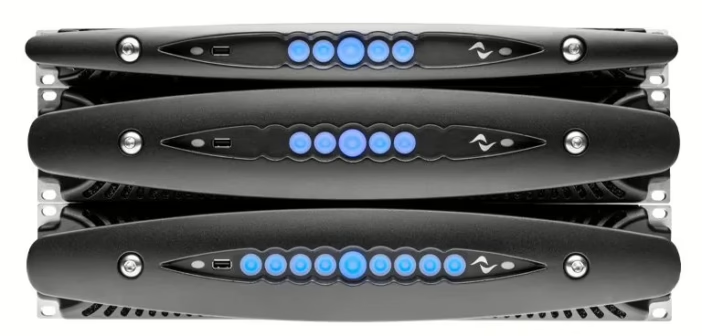
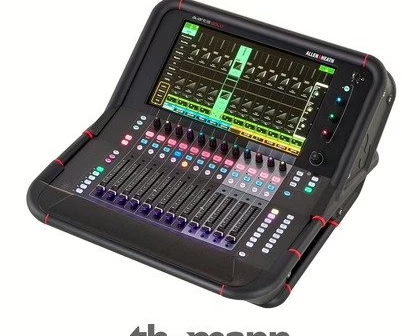
Technically it comes in three forms: as dedicated hardware (Dan Dugan’s classic controllers, often inserted into a console), as a built-in function on most modern broadcast and live digital consoles, and as a software plugin for workstations. The principle stays the same; only the implementation changes.
Setting it up: what works, what trips you up
A poorly used automixer is heard immediately. A few field pointers:
- Set your gains first. Automixing shares gain, it does not fix a badly set preamp. Balance input levels before engaging the automation.
- Group the mics of one scene. Most systems handle groups: mics on the same set must share the same gain-sharing calculation, otherwise NOM attenuation is skewed.
- Keep non-speech out of it. An ambience mic, a music source or a remote return has no place in the calculation: they would distort the sharing.
- Do not expect a feedback miracle. It lowers NOM and so improves margin, but a badly tuned system stays fragile. Gain before feedback is also won upstream.
The right mindset is to treat automixing as a layer that assists the mixer, not an autopilot. It handles the repetitive open-and-close work; the mixer keeps control of intent.
Its place in the chain
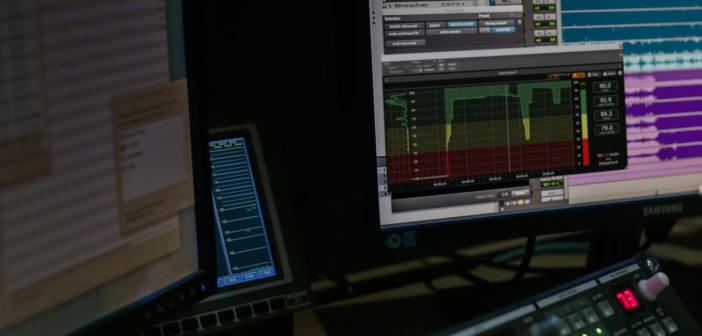
Automixing sits ahead of the rest of the broadcast chain. Once the mics are handled cleanly, the signal moves to on-air processing and then to loudness management to meet EBU R128 targets. On a set, it coexists with the intercom that keeps the crews talking. And for podcasting, it complements the voice-capture methods we detail in our guide to recording a remote podcast.
My take
Automixing is one of those tools you only notice when it is missing: set well, it makes a multi-voice conversation effortless without anyone knowing why. Dugan’s gain-sharing remains the best idea in the field, because it never cuts and lets the room breathe, where gating is always a little audible. The real trap is not technical, it is expecting automation to rescue sloppy gains or a badly tuned system. Set things cleanly upstream, group intelligently, and let the machine do the thankless work. You gain comfort and clarity, live and in the edit alike.