


RME HDSPe MADI FX
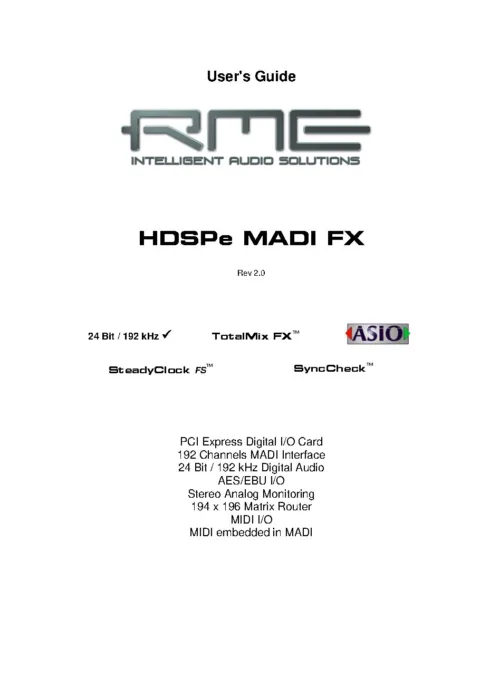
390-channel PCI Express card with three MADI ports, AES, headphone output and TotalMix FX mixer
Description
Technical
Specifications
Inputs / Outputs
| Total inputs | 194 |
|---|---|
| Total outputs | 196 |
Processing
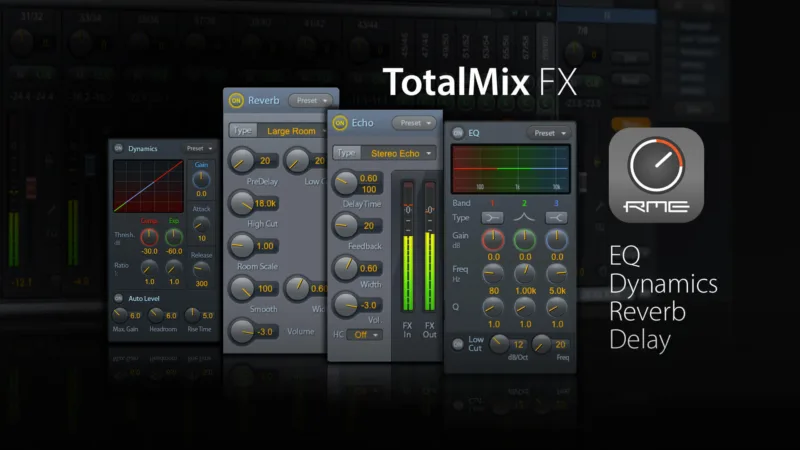
| DSP engine | 4,096-channel TotalMix FX DSP (EQ, compressor, reverb, echo) |
|---|---|
| Max sample rate | 192 kHz |
| Bit depth | 24 bits |
Networking
| Networking & protocols | MADI / AES/EBU |
|---|---|
| Redundancy | SRO mode: 64-channel recording with seamless switchover between the three MADI inputs |
Other
| Connexion | 1-lane PCI Express card (revision 1.1), expansion board on a second slot |
|---|---|
| Pilotes | Windows 10 and 11 (x64 and Arm, WDM, ASIO), macOS 12 and later (DriverKit) |
| Es Total | 194 inputs and 196 outputs, 390 channels in all |
| Madi | 3 MADI ports (2 optical, 1 coaxial BNC, or 3 optical with the OPTO-X board), 64 channels per port, virtual MIDI over MADI |
| Autres | AES, stereo analogue headphone output, word clock with switchable termination, 4 MIDI ports |
| Horloge | MADI from 32 to 96 kHz, word clock from 27 to 200 kHz, SteadyClock, sync to MADI, AES, word clock or internal |
| Dsp | 4,096-channel TotalMix FX on DSP (EQs, compressors, reverb, echo), 98 stereo submixes, DIGICheck, latency down to 32 samples |
Software
Documents
Editorial & artists
Our take
History & design
The HDSPe MADI FX is a single-slot PCI Express card, introduced by RME at Musikmesse in Frankfurt in March 2012 and shipping from May that year. It introduced a new Hammerfall Pro Audio core, which handles three times as many channels as the brand's previous MADI card while lowering system load, with latency down to 32 samples on a recent computer.
Three MADI ports, two optical and one coaxial on BNC, are joined by AES, a reference-quality stereo analogue output also designed for headphones, word clock with switchable termination and four MIDI ports. The total reaches 390 channels, 194 inputs and 196 outputs. An expansion board takes a second slot at the back of the computer, and the OPTO-X version replaces coaxial MADI with a third optical port.
MADI runs from 32 to 96 kHz, the internal clock and word clock up to 192 kHz. SteadyClock extracts the clock from the MADI signal, with no extra sync cable. SRO seamless redundancy mode records 64 channels from one input and switches to one of the other two if the signal drops. Each MADI port also carries a virtual MIDI port, used to remote-control other RME MADI devices.
A card-specific version of TotalMix FX runs a 4,096-channel mixer on DSP, with EQs, compressors, reverb and echo. Drivers cover Windows 10 and 11 (x64 and Arm, WDM and ASIO) and macOS 12 and later through a DriverKit driver. RME does not publish a list price for the card.
Links
More audio interfaces
Some merchant links are affiliate links. Purchases may support Digital Mixing at no extra cost.
Documents are archived locally for preservation. Source credited. Takedown requests: [email protected]