Since 1997, the complaint about pitch correction has been the same: it flattens what makes a voice feel alive. With Auto-Tune Advanced, Antares tackles that head-on with a new engine called DVA, described as the biggest engineering investment in Auto-Tune since it launched.
DVA: hearing vibrato so it isn’t crushed
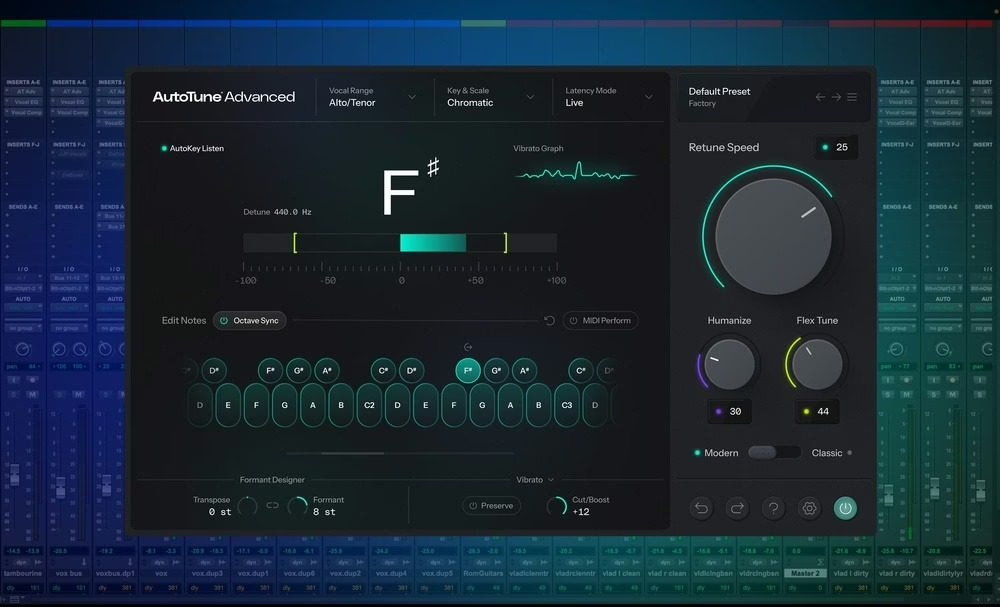
The patent-pending DVA engine is built to recognise the singer’s intentional vibrato and leave it untouched, whether you work at transparent settings or at the hardest correction. In practice the plug-in tells the difference between a tuning error to fix and a performance choice to respect, with a real-time display of that vibrato. It is the most interesting promise here: keep the human grain of a take while locking the pitch.
A rebuilt Auto-Mode, four characters
At the core, the Auto-Mode algorithm has been rewritten. The two expected colours are here: Classic mode, delivering the pronounced, instantly recognisable Auto-Tune effect, and Modern mode, designed for more transparent correction. Live mode targets stage and monitoring with a stated latency of 0.84 ms at 44.1 kHz, split into low-latency or high-quality profiles depending on whether you track or mix.
| Mode | What it is for |
|---|---|
| Classic | The bold, obvious Auto-Tune effect on a lead vocal |
| Modern | Transparent correction that keeps the natural feel |
| Live | Real time at 0.84 ms for stage and tracking |
| Graph | Manual note-by-note editing, inherited from Auto-Tune Pro 11 |
The toolkit is complete: Creative Vibrato FX to add synthetic vibrato (sine, square, sawtooth, triangle, with adjustable rate and intensity) when a take lacks it, Formant Designer for timbre, a 78-note visual keyboard, custom scale handling, MIDI Perform for real-time control, plus the familiar Flex-Tune and Humanize. The new architecture is also presented as more stable in session.
Price and positioning
Auto-Tune Advanced launches at $450 perpetual, in the usual plug-in formats (VST3, AU, AAX). It sits at the top of the range, above Auto-Tune Pro 11, whose Graph editing it carries over. For anyone who lives on vocals — pop, rap, production lines — the argument is no longer just accuracy, but the ability to correct without dulling the voice.
On the processing that surrounds a corrected vocal, revisit our guide to the de-esser, our article on Mid/Side processing, and, for transformed voices, our explainer on the vocoder.
Who it is for, and why
Auto-Tune Advanced is not for someone tuning three vocals a month. It targets the studio and the producer running vocal session after session, where every minute of editing counts. Live mode also opens the door to stage and broadcast, where latency often ruled out a genuinely discreet real-time correction. And because vibrato is preserved, the tool becomes relevant far beyond calibrated pop: on a soul vocal, a jazz performance or a very expressive take, you can now reframe pitch without erasing what gives the singer their character. That is where the real value of the DVA engine lies.
My take
Preserving vibrato is exactly where Auto-Tune needed to improve: it is the tell of an over-corrected voice. If the DVA engine delivers, you save precious minutes of manual editing and, above all, get a more believable result on expressive takes. The $450 clearly aims at studios and producers running vocals back to back, not the weekend hobbyist. The real question is detection finesse on unstable or heavily ornamented voices — the ones that trip up correctors in the first place. That is where it will be judged.