The question comes back with every equipment refresh, and it is almost always framed wrongly. People pose it as a trade-off about sound, when sound stopped being the issue fifteen years ago. What separates an analogue console from a digital one today is two very concrete things: how the stage is cabled, and what happens to your settings when you load the van. The rest is comfort and budget.
- The sound-quality debate is closed: at equal budget, preamps and converters make the difference, not the console technology.
- Latency on current digital consoles is around one millisecond — the equivalent of a foot of air.
- The real shift is moving from a multicore to a stagebox on a network cable: a logistical revolution far more than a sonic one.
- Analogue still makes sense for light stages, venues with rotating operators, and tight budgets at equal input count.
Two signal paths, two philosophies
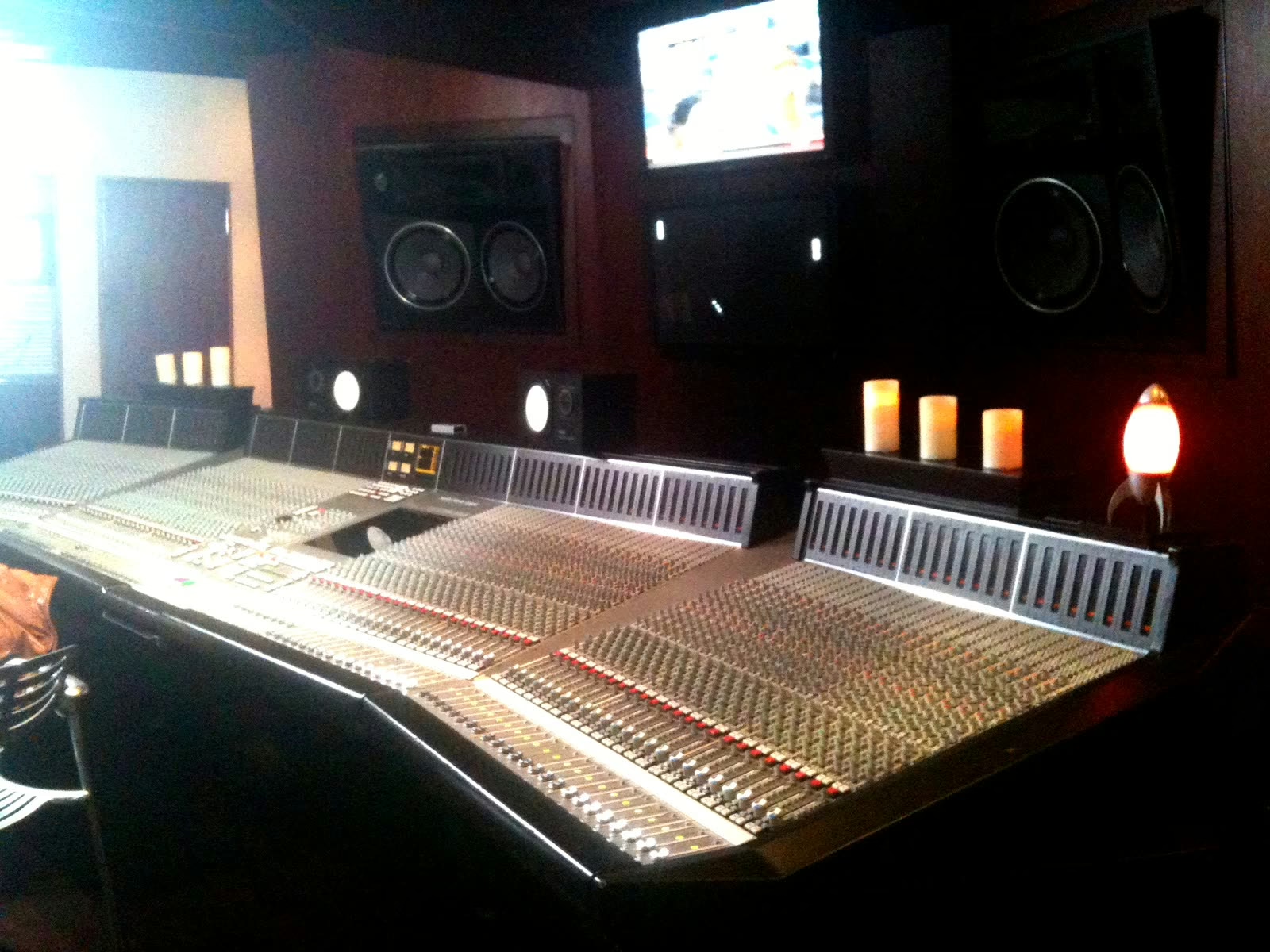
On an analogue console, signal stays a voltage from the first centimetre to the last. The preamp lifts it, the equalisers shape it through active filters, the buses sum it, and it leaves through a socket. Every function occupies a physical circuit: which is why input count directly dictates chassis size and weight.
On a digital console, signal is converted into numbers at the input. Everything after that — EQ, dynamics, summing, effects — becomes calculation, and the control surface only steers that calculation. Hence the property that changes everything: since settings are numbers, they can be stored, copied and recalled.
Latency: an argument that has aged badly
This is the historic objection, and it deserves rescaling. Current digital consoles quote input-to-output latency around one millisecond, rarely beyond two. Sound travels roughly thirty-four centimetres per millisecond, so a modern console’s full conversion costs the musician the equivalent of one step back from their wedge. No player perceives a delay of that order, and nobody complains about standing a foot from their monitor.
The problem is never the console on its own: it is stacking. A stagebox, an audio network, an outboard processor, a PA system with its own processing, and possibly a workstation inserted in the chain — each link adds its share. The same applies to hybrid setups where signal makes a round trip to the computer. The useful habit is to count conversions rather than worry about a single figure: four conversions at one millisecond are worth far more than one console at two.
The real shift: what links stage to mix position
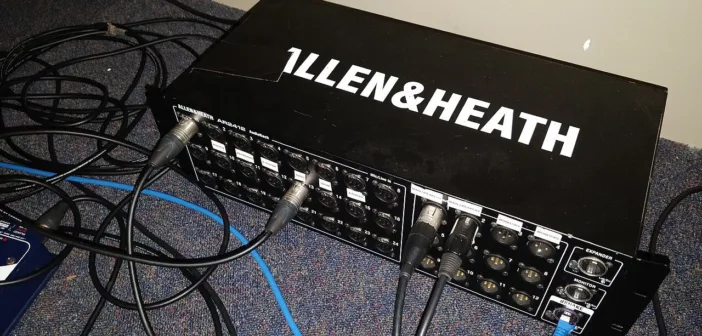
If only one difference were worth keeping, this would be it. An analogue console requires a multicore: one conductor per input, a heavy and expensive cable, fragile at the connectors, to unroll and re-roll for every job. A digital console pushes its preamps out into a stagebox connected by one or two network cables — Dante, AES50, MADI or a manufacturer’s own protocol.
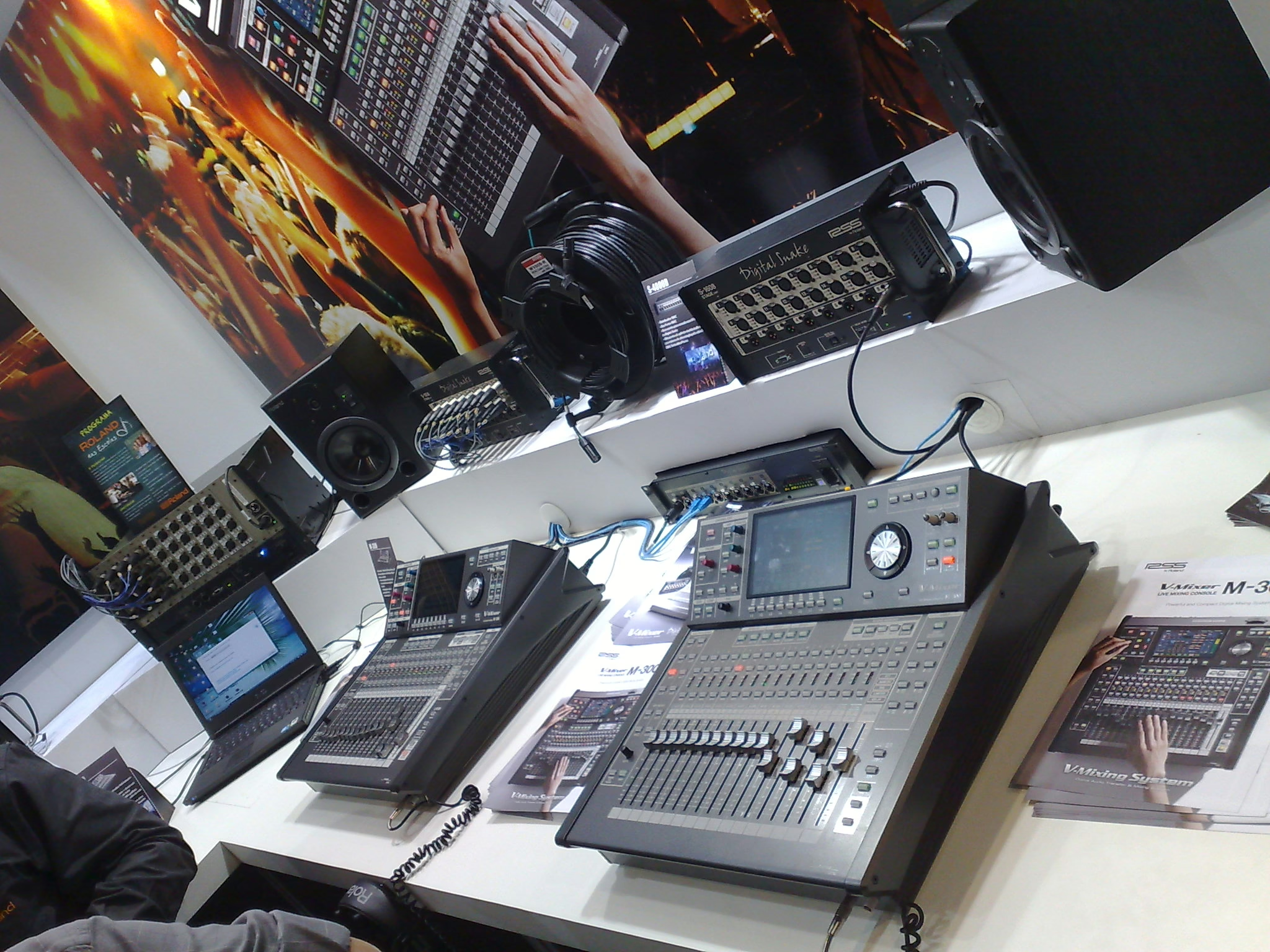
The consequences go far beyond an easier get-in. Preamps now sit three metres from the microphones instead of thirty, which genuinely improves signal-to-noise. A second console can join the same network for monitors while sharing those preamps. Multitrack recording of the night becomes a checkbox rather than a project. And a cable failure is solved by swapping a network link that any local supplier stocks. That shift — far more than sound quality — is what settled the argument in the field.
What analogue keeps for itself
It would be dishonest to conclude the question no longer arises. Analogue retains three advantages nothing has replaced.
First, immediate readability. One function, one control, one position: the complete state of the system reads at a glance, with no layer to navigate and no channel to select. In a venue hosting different operators every week — village hall, music school, small club, volunteer-run space — that legibility is worth more than every advanced feature in the world. A digital console left badly configured by the previous user is a trap; an analogue one with every knob visible fools nobody.
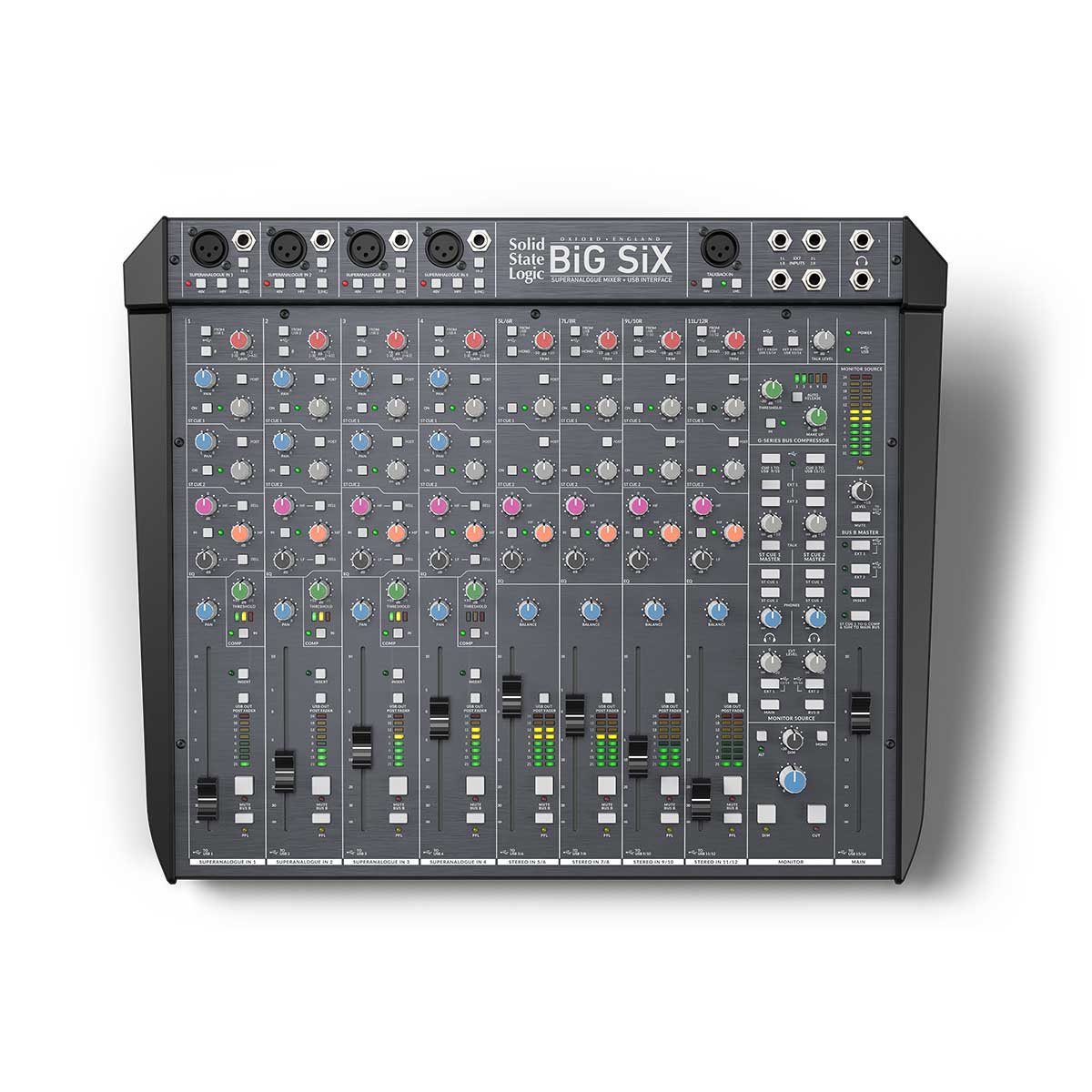
Then operational robustness. No boot time, no firmware update the day before a show, no corrupted scene, and repairs that stay within reach of a soldering iron. Finally the entry cost at comparable input counts on small formats — although the gap has narrowed considerably and reverses as soon as you add up the outboard a digital console includes as standard.
What digital brings and nobody gives back
Scene recall first, which transforms life in a venue: a recurring stage comes back in seconds instead of half an hour. Full processing per channel next — filter, parametric EQ, gate, compressor on every input — which would make an equivalent analogue rack more or less unaffordable. Remote control by tablet, which lets you set a monitor from the stage, standing next to the musician, instead of shouting across a room. And multitrack capture that is effectively free.
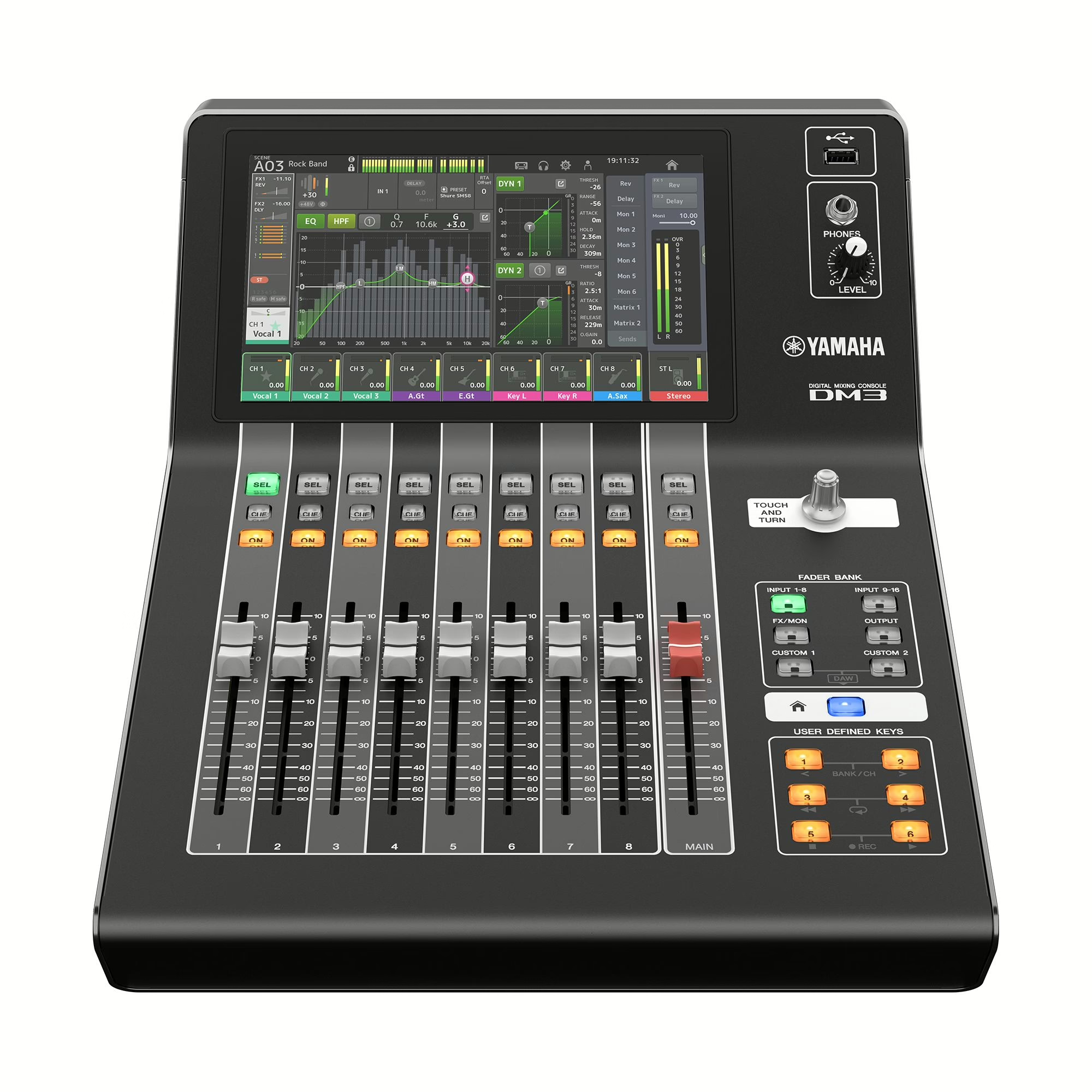
Add everything digital makes possible downstream: complex matrixing, PA zones, delay rings, fine routing control. Those mechanisms, which once required a patchbay and hardware, now take a few screens — our guide to routing and buses on a digital console sets out the logic.
Sound: a debate with no remaining substance
The objection had a foundation in the late 1990s: first-generation converters and the DSP of the day had an audible signature, particularly in the top end. That has not been true for a long time.
On contemporary equipment, a console’s sound quality no longer turns on technology but on three specific items: preamp quality, converter quality, and the care taken over power supply and internal routing. A mediocre preamp stays mediocre in both worlds, and a good converter costs money in both as well. Comparing a three-thousand-euro analogue console with a digital one at the same price does not compare two technologies: it compares two ways of allocating a budget.
And hybrid consoles?
A third family has settled between the two: consoles with an analogue signal path, fitted with a multitrack digital interface and sometimes a few controllable processors. You keep a fully readable surface, analogue preamps and summing, and you gain multitrack recording plus software return into the console.
It is a relevant answer for the small studio, podcasting and rehearsal capture, where ergonomics count as much as function. It is far less so on tour: a hybrid brings neither scene recall, nor a stagebox, nor remote control — that is, none of the three arguments that actually push an operator towards digital. Put differently, the hybrid solves a studio problem, not a logistics one.
How to decide, in practice
| Criterion | Analogue | Digital |
|---|---|---|
| Setting recall | None, everything is renoted by hand | Full scenes, instant recall |
| Stage-to-mix link | Multicore, one conductor per input | Stagebox on one network cable |
| Per-channel processing | EQ only, the rest is outboard | Filter, EQ, gate and compressor as standard |
| Latency | None | Around one millisecond |
| Handover to a stranger | Immediate, everything is visible | Requires knowing the machine |
| Multitrack recording | Dedicated cabling and separate interface | Built in, over USB or network |
| Failure in service | Repairable, channel can be bypassed | Reboot, scene backup essential |
The clear-cut cases are few. An eight to twelve input stage, rigged and struck by volunteers: a compact analogue console remains the safest choice, and the money saved goes usefully into microphones. A venue hosting different bands every week with a permanent engineer: digital wins, if only for starting libraries and soundcheck recording. A tour: the question does not arise — scene recall and preamp sharing between FOH and monitors have become standard practice.
That leaves the studio and home studio case, where the trade-off is different because the console competes with a plain interface. We examine it in our comparison of mixer or audio interface for a home studio. And if you are still defining how many inputs and outputs you need, our guide to choosing your mixing console covers the counting method.
What matters more than this choice
A console, whatever it is, only shapes what you feed it. Money spent on a higher tier will always produce less effect than the same money placed in capture and PA — a microphone suited to the source, a properly aligned system, a rig sized for the room. That is the least spectacular conclusion of this article and by far the most useful: in 2026, analogue or digital has become a decision about working method, not about quality.
Frequently asked questions
Does an analogue console sound better than a digital one?
Not inherently. At equal budget, audible differences come from preamps, converters and power supply design, not from the mixing technology. A cheap analogue console will not sound better than a well designed digital one, and the reverse holds just as firmly.
Can you record multitrack with an analogue console?
Yes, provided you have a per-channel output — direct out or insert — and an interface with matching inputs. It is possible but expensive in cabling, and it is exactly the problem hybrid and digital consoles solve as standard.
Does a digital console’s latency bother a musician?
No, at current orders of magnitude. One millisecond equals about a foot of air: less than a singer’s natural movement in front of their wedge. It only becomes a serious subject when several conversions stack up in the same chain.
Which digital console for a small band?
A sixteen-input format with an optional stagebox and tablet control covers the overwhelming majority of club stages. The deciding criterion is not the advertised input count but the number of mixes available: that is what caps how many monitor sends you can build.