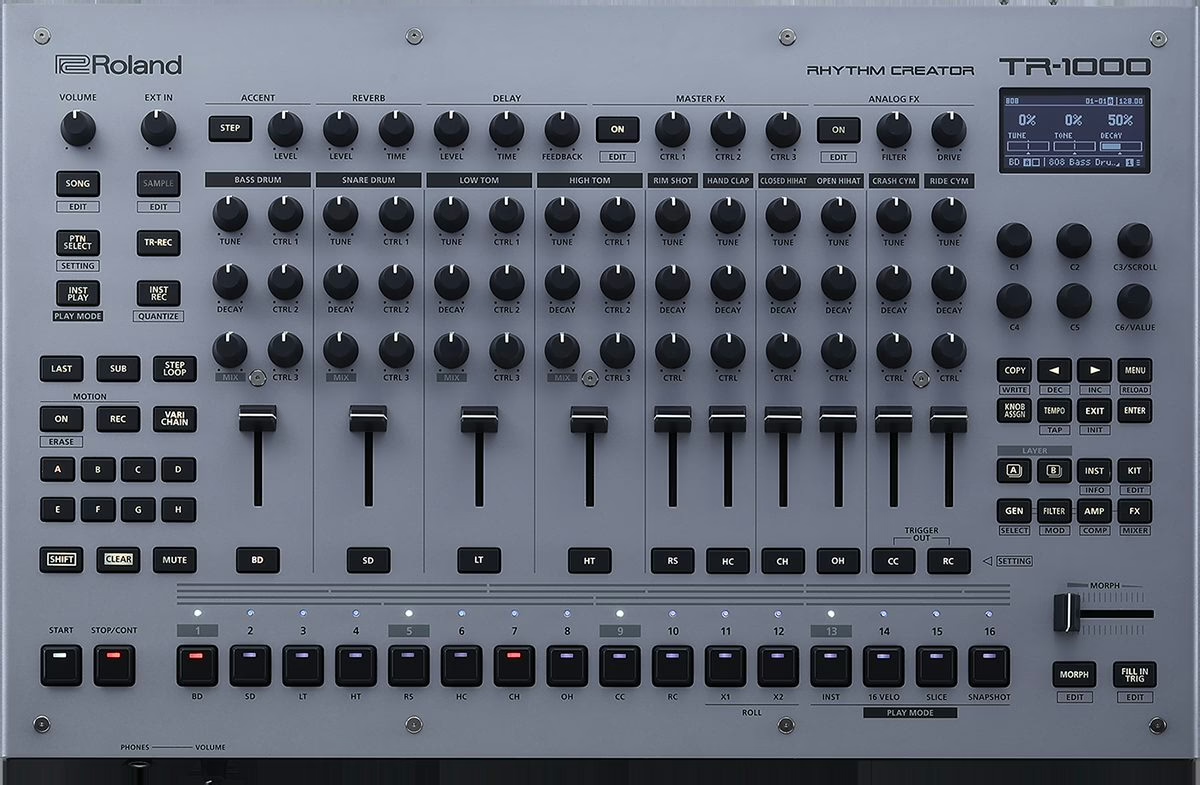
It took more than forty years for Roland to put true analog voices back into a flagship drum machine. The TR-1000 Rhythm Creator owns that flagship status: an analog engine, three digital engines and a full stereo sampler stacked inside a fan-free, 5.5 kg aluminium-and-steel chassis built to last.
A TR that plugs analog back in
The pitch is simple: sixteen analog circuits recreated from the original TR-808 and TR-909, but built with modern components. This is no straight copy — the dynamic range is wider and each voice gains new parameters. Anyone who knows a 909 kick or an 808 clap will recognise the signature, with a shaping range the originals never offered.
Three engines under the hood
Analog is only one of four sound sources. Alongside it, the TR-1000 carries:
- the ACB (Analog Circuit Behavior) engine with 21 circuit-bent “8X/9X” digital drum models;
- FM synthesis (7 tones) and virtual analog synthesis;
- 340 PCM tones and, above all, a full stereo sampler.
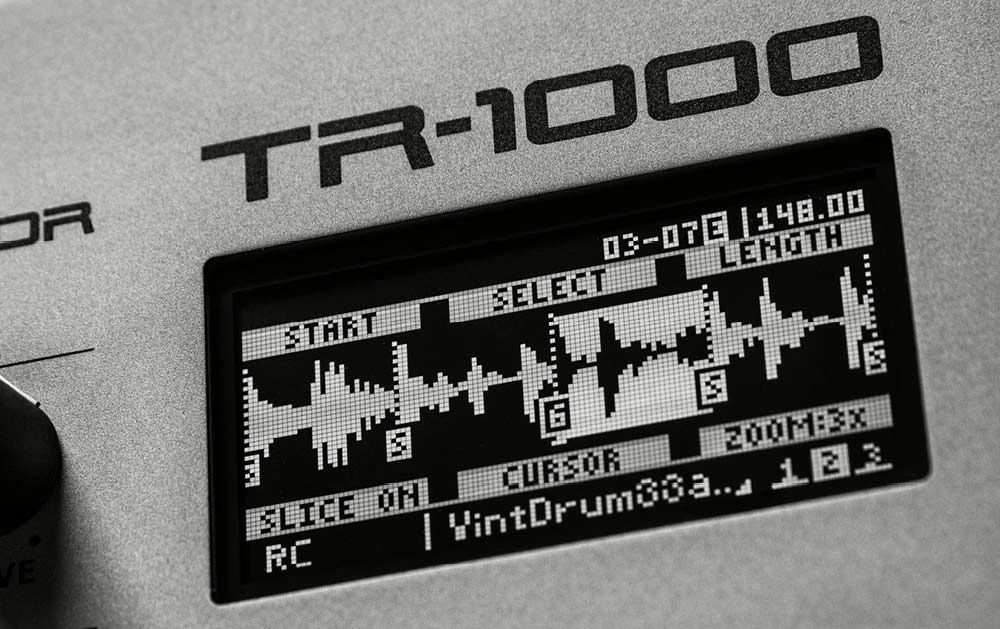
The sampling spec is no afterthought: 46 GB of user storage, 2,121 preloaded tones, WAV/AIFF/MP3 import, up to 16 minutes per sample, tempo sync, time-stretching and non-destructive slicing. This is a genuine rhythm workstation, not a sample player bolted onto an analog box.
Filter, drive and a stack of effects
Roland took the processing seriously. In the analog domain, a state-variable filter (SVF) inspired by the brand’s vintage OTA designs and a dedicated drive stage dirty the signal on demand. Every track then gets a multimode filter and four-band EQ, two compressor types, envelope control and 17 instrument effects. On the master bus sit 6 reverbs, 4 delays and 14 master effects, including SP-303/SP-404 vinyl sims and the SDD-320 Dimension D. Enough to finish a track without ever reaching for a computer.
A sequencer built to be played
The sequencing architecture is generous: four dual-generator “Layer” tracks, six standard tracks and one dedicated trigger-output track. Each pattern holds 16 steps across 8 variations (A–H), with four fills. Beyond classic TR-REC, you get real-time recording, motion recording for parameter automation, per-step conditions and probability, per-track playback directions (forward, reverse, pendulum) and a Song mode. The new Morph slider, recalling up to 16 snapshots per track, turns the machine into a performance instrument in its own right.
| Block | What the TR-1000 offers |
|---|---|
| Analog | 16 circuits after 808/909, SVF filter, dedicated drive |
| Digital | ACB (21 models), FM (7), virtual analog, 340 PCM |
| Sampling | Stereo, 46 GB, 2,121 tones, time-stretch, slice |
| Outputs | Main + analog FX + 10 individual/trigger outputs |
Connectivity and integration
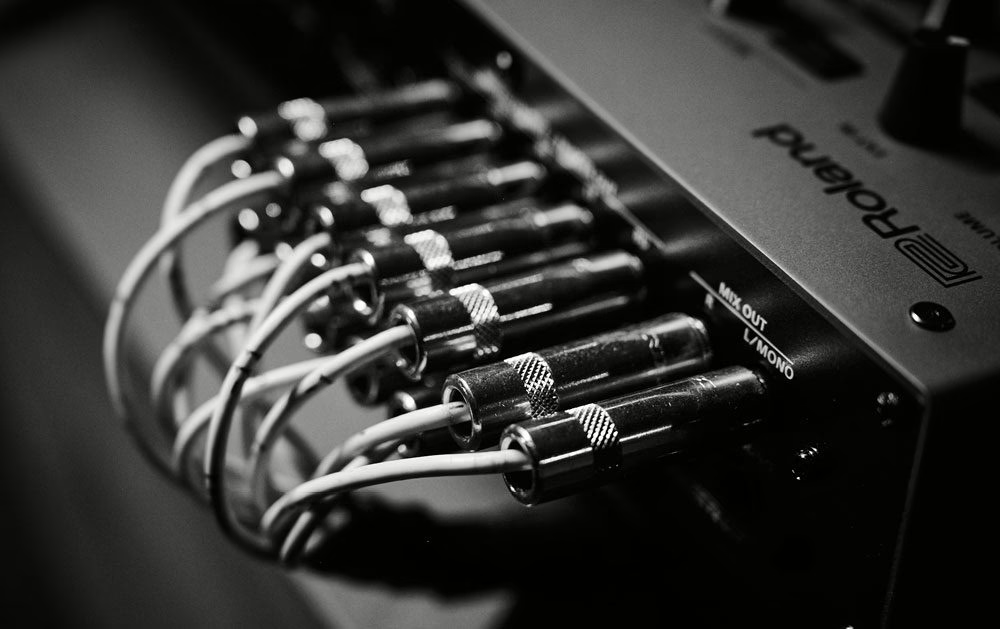
The rear panel does not cut corners. Ten individual outputs, switchable to trigger outputs, break instruments out to a console or a modular rig, on top of the main outs and the analog FX output. There are two sampling inputs, a filter/CV input, a pedal jack, full MIDI DIN with DIN sync to clock vintage gear, and a pair of USB ports (multi-channel Type-C to a computer, Type-A for drives and controllers). A graphic OLED display and the TR-1000 app for editing and sound management round out an open, upgradeable platform, with Roland promising new engines via firmware.
Price and positioning
The TR-1000 lists at $2,699 in the US and £2,286 in the UK (around €2,700). This is the top of Roland’s rhythm catalogue, three to four times the price of a TR-8S. At that money it does not replace the compact boxes — it sets a new ceiling where authentic analog, digital and sampling finally meet in one stage-ready unit. For context on a fast-moving market, see our pieces on the Elektron Outbox 8 and separate outputs and our roundup of analog and hybrid drum machines worth knowing in 2026.
Frequently asked questions
Does the TR-1000 work without a computer?
Yes, completely. The four sound engines, the sampler, the effects and the sequencer are all standalone. USB-C acts as a multi-channel audio and MIDI interface when you want to record into a DAW, but nothing requires it.
Can it sync with vintage gear?
Full MIDI DIN includes DIN sync, designed precisely to clock period Roland machines and compatible boxes. The ten trigger outputs also let you drive a modular system step by step.
How many sounds and how much sampling memory?
The machine holds 2,121 preloaded tones and 46 GB of user storage (64 GB internal in total), with samples up to 16 minutes, time-stretching and non-destructive slicing.
What does the Morph slider do?
It interpolates between snapshots of your settings — up to 16 per track — in a single gesture. It is the machine’s performance tool: move from a clean take to a saturated one without touching every knob.
My take
True analog back at Roland, paired with serious sampling and ten outputs: on paper, the TR-1000 does what the stage has been asking for. The price will sting, and it lines the machine up against modulars and big grooveboxes rather than the compact TRs. Still, the logic holds — one box that carries a live set start to finish, no computer, with real hands-on control through the Morph. The last word belongs to a room: if those analog voices deliver, this is the most serious TR since the 909.