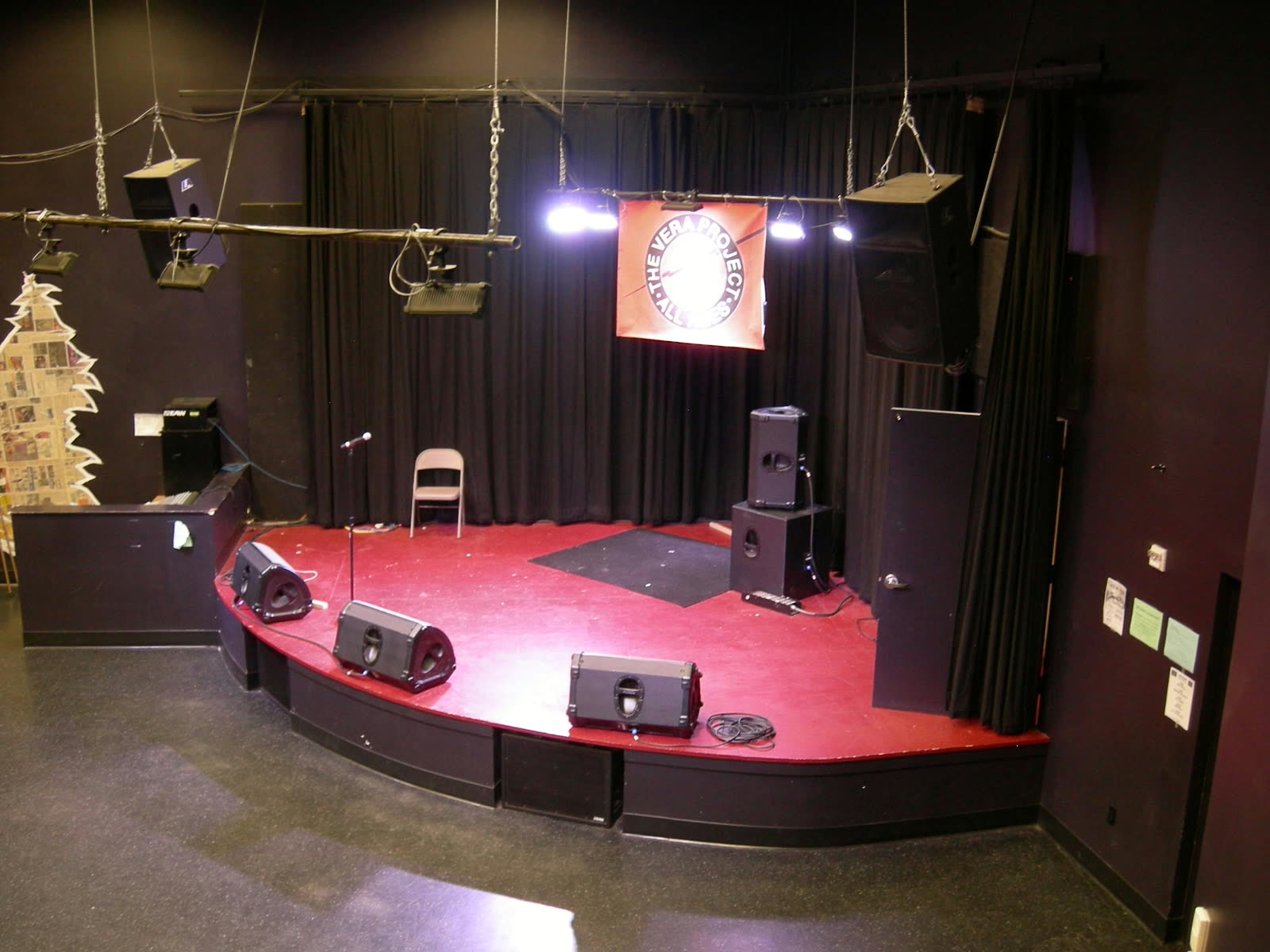
A stage monitor — wedge, floor monitor, foldback, the words all name the same object — comes in two families: those that carry their own amplifier and those that do not. The choice looks trivial, and it decides your budget, the weight of your flight cases, the cables you run, the power you need on stage and the way the system fails. Here is what you need to settle it.
- An active monitor holds its amplifier and processing: one line cable does the job, but it needs mains power on stage.
- A passive monitor needs an external amplifier and a speaker cable, but stays lighter and simpler to swap.
- At equal quality, active costs less per unit in small numbers; passive becomes cheaper from six or eight wedges up.
- When something breaks, an active cabinet goes out of service whole; a passive rig is repaired piece by piece.
Two topologies, two ways of cabling a stage
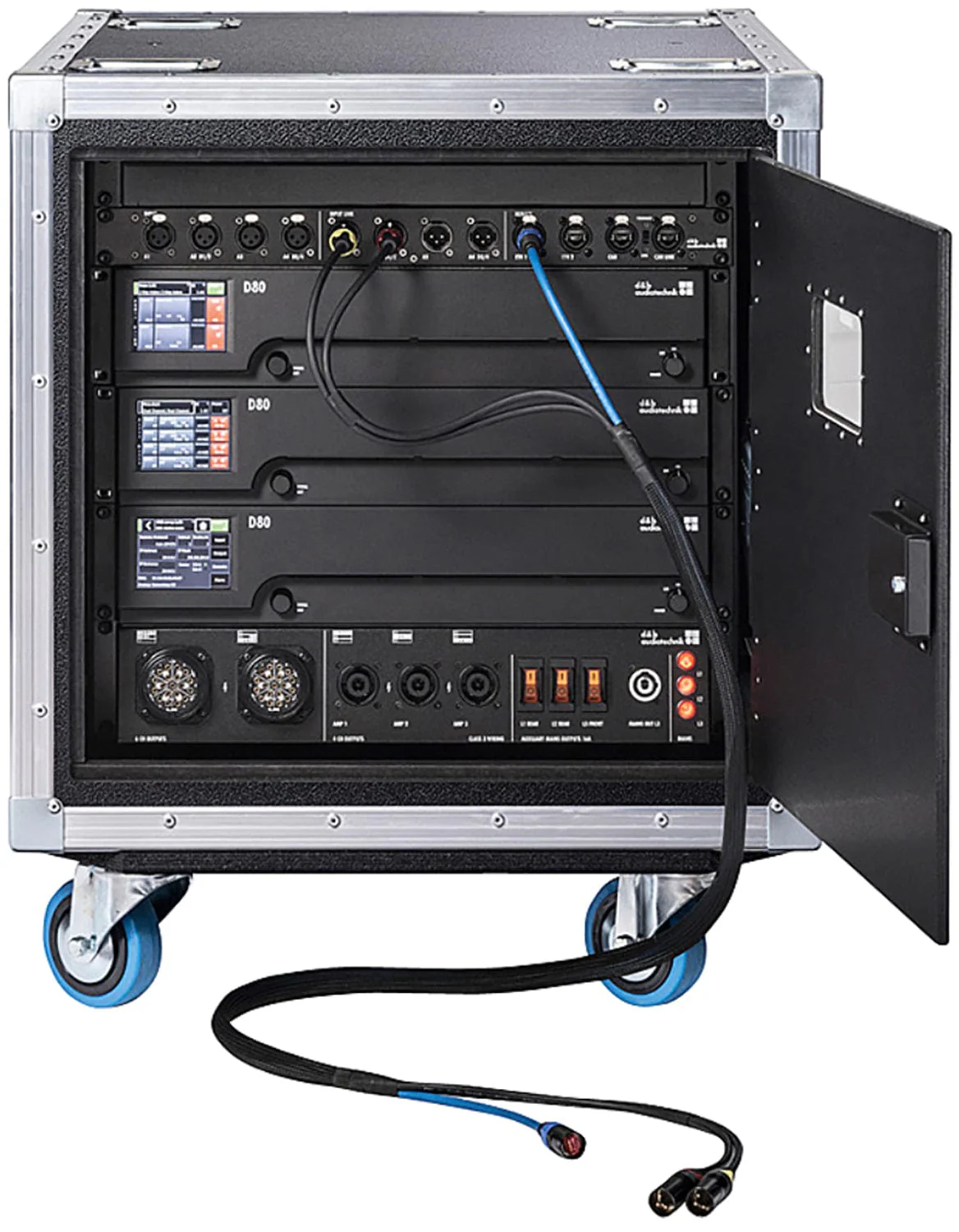
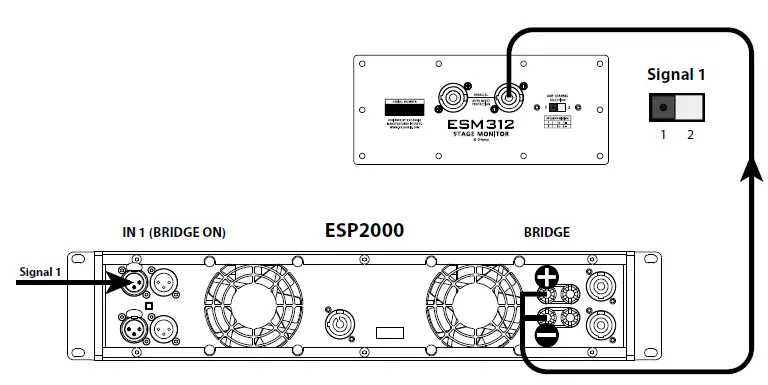
In an active monitor, the amplifier and processor sit inside the box, right behind the driver. The manufacturer has therefore set the crossover, the protection and the voicing themselves — you feed it a line signal and it works. In a passive monitor, the box holds only the drivers and their crossover: power arrives from an amplifier racked at the mix position or in the wings.
The comparison, item by item
| Criterion | Active monitor | Passive monitor |
|---|---|---|
| Cable run to the stage | A line cable, light and long | A speaker cable, heavy and length-limited |
| Mains power on stage | One socket per wedge | None |
| Weight to carry | Heavier per unit | Lighter, but add the amp rack |
| Crossover settings | Set by the maker, locked | Yours to set, therefore yours to get right |
| Cost, two to four wedges | More economical | The amp rack dominates the total |
| Cost, eight wedges and up | You pay for eight amplifiers | Becomes the cheaper option |
| Failure | The whole cabinet goes out of service | Repaired subsystem by subsystem |
| Commissioning | Immediate | Requires knowing how to set the amp |
One point deserves emphasis because it distorts a lot of price comparisons: in a passive rig, the amplifier rack is paid for once. Across two wedges it wrecks the budget; across twelve it disappears into the total. The tipping point usually sits between six and eight units, but it depends above all on the power per channel you are aiming for.
The sound question, less clear-cut than people claim
You often hear that passive sounds better because it lets you pick the amplifier. That was arguable twenty years ago. Today a decent active monitor carries active crossover and voicing designed for that exact cabinet, which no generic setting on an outboard amp matches without measurement. Active therefore starts with a genuine coherence advantage.
The opposite holds at the other end of the market: a properly aligned passive system, with a quality amplifier and settings made in the right place, keeps the advantage of control — you can adapt the protection, tune the limiting, choose the power available. Which assumes you know how to do it, and that is exactly the subject of our guide to live sound system alignment.
The criterion that actually decides, in the field, is almost never the one comparisons lead with: it is power on stage. Eight active wedges means eight sockets to find, eight extension leads to route without tripping anyone, and as many chances to bring in a ground loop. With passive, all that heads to the stage is speaker cable and the current stays at the mix position. On a cramped stage or outdoors, that argument weighs more than all the others put together.
Choosing for your situation
For a band carrying its own gear, two to four active wedges are the obvious call: nothing to set, nothing to understand, one cable per monitor. The constraint becomes the weight going into the van and the sockets you can find on stage.
For a permanently equipped venue — hall, music school, house of worship — passive regains the advantage: the amp rack lives at the mix position, sheltered, and the cabinets on stage fear neither damp nor power cuts. The settings stay stable from one event to the next because nobody touches them.
For a production company, the honest answer is: both. A stock of passive wedges with amp racks for the bigger configurations, and a few active boxes for light jobs where deploying a rack makes no sense. That is what nearly everyone does, whatever the forums say.
Power, driver size and angle
Three characteristics matter more than the active-versus-passive debate. Driver diameter sets the colour: a twelve-inch gives a fuller low mid, a ten-inch stays more intelligible on a voice and weighs less. Quoted power should be read carefully — what counts is the pressure genuinely available at one metre, with comfortable reserve, not a marketing figure.
The cabinet angle, finally, is the most neglected parameter although it governs everything: too flat and the wedge fires into the knees, too upright and it sprays the room and triggers feedback. Models offering two angles settle the question. Once the gear is chosen, our guide to connecting a stage monitor to a mixing console covers the wiring.
Frequently asked questions
How do I connect powered speakers to a mixing console?
With a balanced line cable, XLR for preference, running from an auxiliary send on the console to the cabinet’s line input. No amplifier in between is needed, but you do need a mains socket near each cabinet.
Is an active monitor more fragile than a passive one?
It carries more electronics, so more components exposed to vibration, heat and stage damp. In exchange, its protection circuits are calibrated for its own drivers, where a badly set outboard amplifier destroys a passive cabinet in seconds.
Can active and passive monitors be mixed on the same stage?
Yes, with no technical difficulty — each wedge gets its own send. The only catch is that their sensitivities differ: at the same bus level they will not play at the same volume, and you will compensate at the send.
How much power does a stage monitor need?
For a vocal on a club stage, a twelve-inch of around 300 real watts leaves comfortable reserve. The limiting factor is almost never available power but gain before feedback, which depends on the microphone, the wedge position and the correction applied.
Wedges or in-ears?
It depends on the stage and the musician. Our article on when in-ear monitors make sense weighs it position by position, including the cases where a wedge stays ahead.