On a TV set, a news report or a drama, clean speech often comes from a mic you never see in the shot: a shotgun mic on the end of a boom pole, held just out of frame by a boom operator. It is a craft in its own right, and a soundtrack depends on it as much as on the choice of mic. Here is what to understand so this pair gives its best.
The shotgun mic and its interference tube
A shotgun is not an ordinary mic with magical directivity. In front of the capsule, a long slotted tube creates path differences for sound arriving from the sides. That off-axis sound recombines out of phase and is attenuated, while sound coming from the front reaches the capsule in phase. The result is a tightened forward pickup, a narrow lobe known as lobar directivity.
The Sennheiser MKH 416 has been the reference here for decades, the de facto standard of film, TV drama and news. But every shotgun shares the same principle, and the same limit, which the diagram below illustrates.
Why directivity depends on frequency
The interference tube only works well above a certain frequency, tied to its length. In the treble and upper mids, directivity is marked and the lobe tightens. But the lower you go, the larger the wavelength becomes relative to the tube, and directivity collapses toward the pattern of the bare capsule, often a supercardioid. A shotgun is therefore far more directional on a consonant than on the low end of a voice.
Hence a design trade-off: a longer tube gains low-frequency directivity, but becomes bulky and awkward to handle. Another practical consequence, off-axis sound is not only attenuated, it is also coloured. A badly aimed shotgun does not give you a discreet off-frame, it gives you a dull, metallic voice. The rule fits in two words: aim well.
The boom, gesture and placement
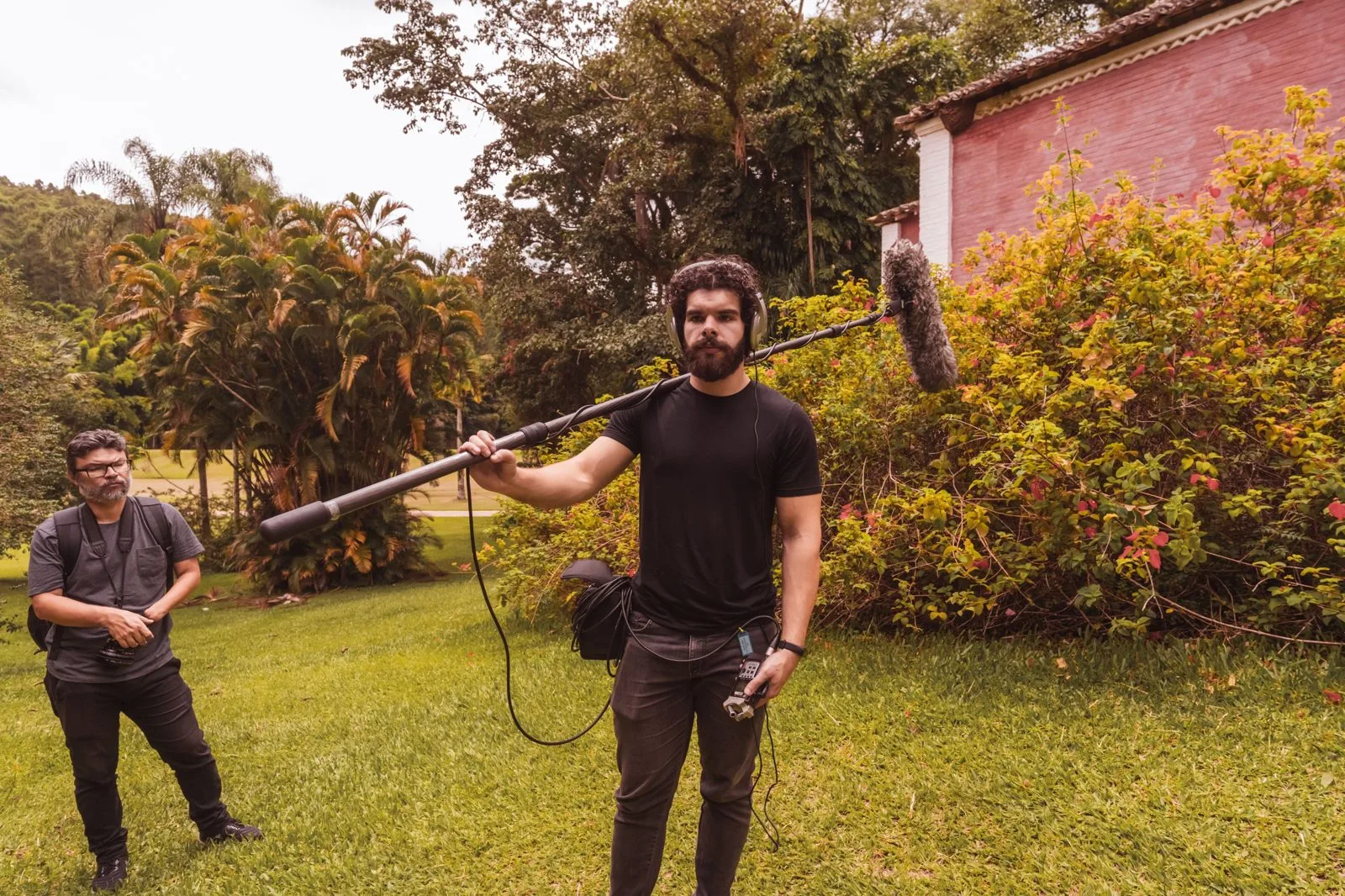
The boom places the mic as close to the mouth as possible without entering the shot, most often from above, angled down toward the face. You aim at the chin rather than the top of the head, to capture the voice and not the resonance of the forehead. The operator keeps the distance as constant as possible and anticipates movement, because every change in distance shows up in level and in how much room you pick up.
That is the whole challenge: the closer the mic, the less room reverberation you capture, thanks to the inverse-square law. Too close, though, and the proximity effect of directional mics bloats the bass, and the sonic perspective no longer matches the image. We detailed this trade-off between closeness and naturalness for vocals in a piece on distance, angle and proximity effect; the same laws apply on a boom. And the operator always works on headphones, the only reliable judge of what actually gets in.
Protecting from wind and shocks
A shotgun is sensitive to wind and handling. Indoors, a simple foam windscreen is often enough. Outdoors, you move to a basket windshield, the familiar blimp or zeppelin, a hollow cage that creates a zone of still air around the capsule, topped by a furry windjammer when the wind picks up. The capsule is also held in an elastic suspension, which isolates it from handling noise and vibration travelling up the pole.
These three protections, windshield, suspension and furry cover, are not comfort accessories: without them, a gust or a simple hand brush ruins a take you cannot rescue in the edit. The operator adjusts them to the location and the weather, not once and for all.
Boom and lavs, the duo
In real production, the boom rarely works alone. It is doubled with wireless lavalier mics on the talent, for safety and to cover situations the boom cannot follow. The set mixer arbitrates between the two: the boom usually offers the most natural sound and the right perspective, the lav guarantees a constant, discreet presence. We described this two-source setup, and the mixer’s role, in our article on TV studio audio. Live, these signals then travel up to the gallery, an OB truck for instance, where they are mixed for air.
My take
The shotgun fascinates with its laser reputation, and that is exactly the trap. Its directivity only really works in the top of the spectrum, and bad aiming costs you in tone, not just in level. The real value sits at the end of the pole, in the steadiness of the gesture and the discipline of placement, far more than in the brand of mic. A well-held MKH 416 beats a pricier model poorly aimed. For anyone starting in location sound, the best spend is not the next mic, it is an hour of clean booming on headphones.