Reverb is probably the most-used effect in the mix, and easily the most abused. We reach for it on reflex, spread it everywhere, and end up drowning the track in a haze that feels “pro” but eats the clarity. Understand what a reverb actually is, learn its main families, and know which controls really matter, and everything changes: reverb stops being a coat of varnish and becomes a genuine tool for space and depth. Here’s the guide.
What is reverb, exactly?
In a real room, a sound never reaches you on its own. You hear the direct sound first, then, a few milliseconds later, its early reflections off the walls, ceiling and floor, and finally a dense tail of overlapping reflections that decay into silence. That acoustic signature — a blend of delays, filtering and diffusion — is what your ears read as “a space.” Artificial reverb does nothing more than rebuild that phenomenon, either by calculation (algorithms) or by measuring a real place (convolution).
Two parameters shape the perception. First, pre-delay: the short gap between the direct sound and the onset of the reverb, which tells the ear how big the room is and, crucially, keeps an instrument’s attack intact. Then the decay time, often written RT60 (how long the reverb takes to drop by 60 dB), which decides whether you’re in a dry booth or a cathedral. Everything else — density, colour, damping — sculpts the character.
The main reverb families
Historically, we recreated reverb with physical objects long before we simulated it. Each method left behind a colour that today’s plug-ins keep imitating, because it still sits right in a mix. Here are the main ones, with what sets them apart to the ear and their typical uses.
| Type | Origin | Sonic signature | Typical use |
|---|---|---|---|
| Room | Algorithmic / convolution | Short, dense, strong early reflections | Adds body without length; drums, spoken word |
| Hall | Algorithmic / convolution | Long, wide, gradual build-up | Strings, pads, ballads, the “big” effect |
| Plate | Vibrating metal plate | Bright, dense from the start, no real room feel | Vocals, snare, the classic studio effect |
| Spring | Mechanical spring (amps, combos) | Metallic, bouncy, that trademark “boing” | Guitar, dub, vintage textures |
| Chamber | A real reverberant room, miked | Natural, diffuse, less bright than a plate | Vocals and ensembles, high-end realism |
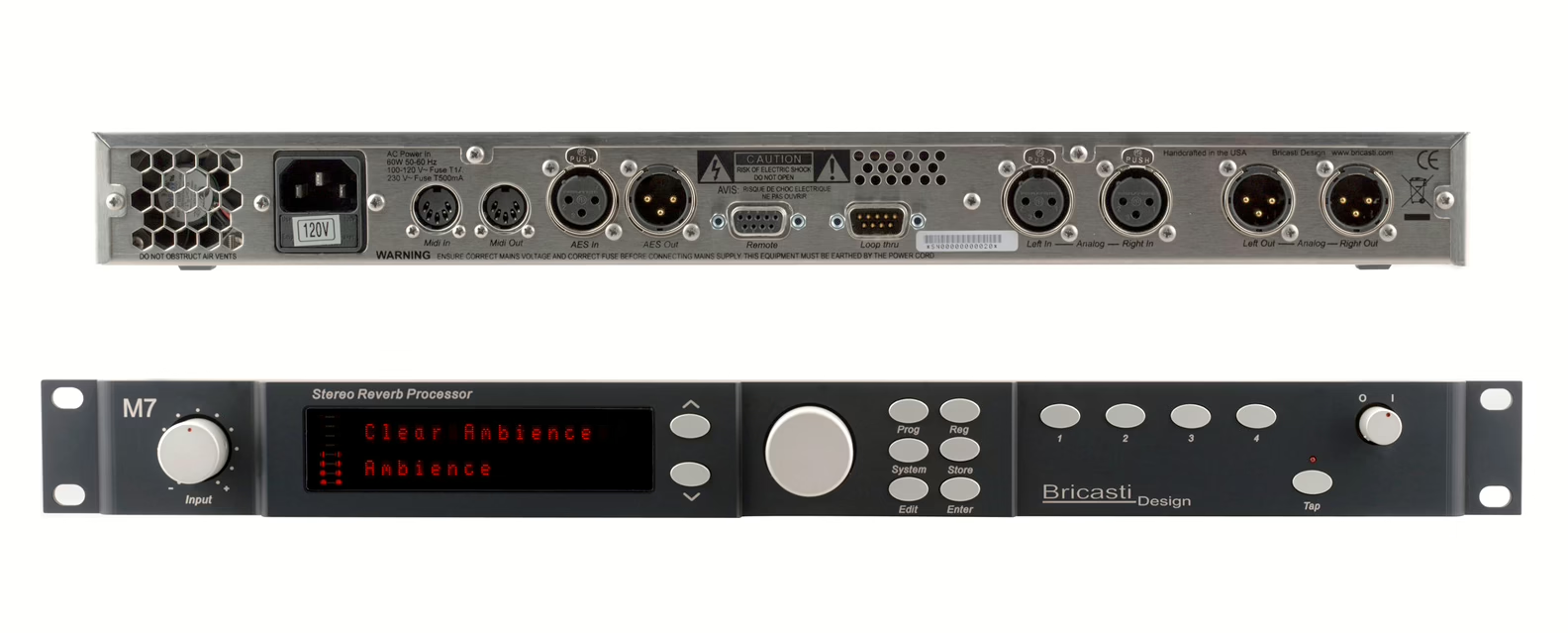
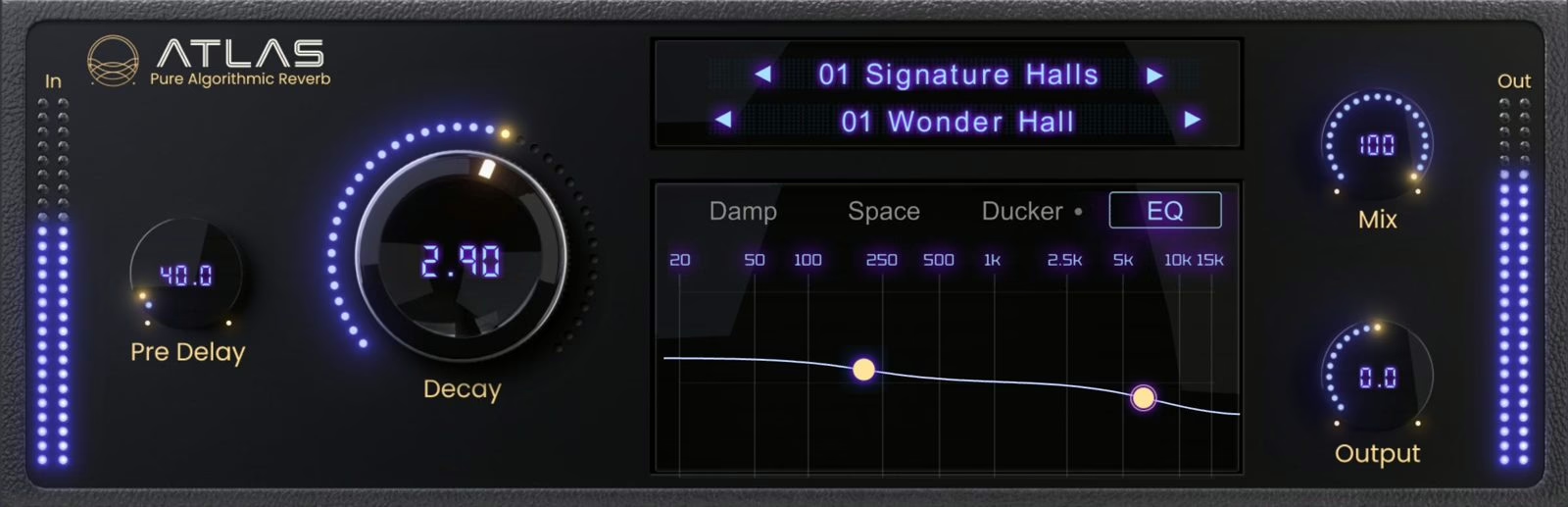
Beyond these colours, one technical split matters: algorithmic versus convolution. An algorithmic reverb computes the space in real time from networks of delays and filters; it’s flexible, tweakable, often more musical on a long tail, and it fits the mix well precisely because you can bend it. A convolution reverb instead applies the measured fingerprint of a real place (an impulse response) to the signal: the realism is striking, but the object is more fixed and heavier on the CPU. The recent algorithmic reverbs built for the mix make it clear that “which one is better” is the wrong question: they’re two tools for two intentions.
The controls that actually matter
A modern reverb can throw twenty parameters at you. Five of them account for 90% of the result; the rest is fine-tuning.
- Pre-delay: from 0 to around 40 ms. Raise it to peel the reverb off the source, keep the attack sharp and the articulation legible. On a vocal, 20 to 30 ms is often enough to preserve intelligibility while still opening up space.
- Decay / size: the length of the tail. The longer it is, the bigger the space feels — and the greater the risk of masking. Set it while listening in the context of the mix, never soloed.
- Damping and HF filtering: in a real room, highs die away faster than lows. Roll off the top of the tail for a reverb that stays behind the source and doesn’t hiss.
- Reverb EQ: the highest-value move of all. A high-pass around 200-300 Hz on the return stops the reverb from clogging the low end; a gentle mid dip makes room behind the vocal.
- Mix / amount: on an insert, keep the wet signal measured; on an aux send, it’s the bus level that sets the dose. When in doubt, push the reverb until you clearly hear it… then pull it back until it “disappears”: that’s usually the right spot.
One more control deserves better than its reputation as a mere trick: ducking, which pulls the reverb down while the source plays and lets it bloom back in the gaps. You get the depth of a long tail without ever sacrificing clarity. It’s the same sidechain principle used elsewhere in the mix, and it works wonders on a lead vocal.
Using it well in the mix
The first decision isn’t the reverb type but its routing. As an insert on a track, the reverb affects only that track: handy for a characterful effect. On an aux send, several tracks share one reverb: that’s how you build a coherent shared space, as if the instruments were playing in the same room. Good mixing almost always rests on two or three shared reverb buses — a short room for cohesion, a plate for vocals, a hall for the moments that need to breathe — rather than a different reverb on every track.
Reverb is also your main tool for depth. Volume places a sound left or right and louder or softer; it’s the amount of reverb, its pre-delay and its filtering that place it in front or behind. A dry vocal with very little reverb stays up front; a pad with a long, filtered tail retreats to the back of the stage. Thought of that way, alongside Mid/Side processing for width, reverb becomes a real tool for staging in three dimensions.
Finally, don’t confuse reverb with delay. Both create space, but a rhythmic delay often keeps a vocal more legible than a long reverb, because its repeats are discrete and locked to tempo. The best mixes play both against each other, and some recent tools literally bloom an echo into reverb to blur the line.
My field safeguard
After years of live engineering and running a studio, I’ve come to treat reverb like a slow sugar: lovely in the moment, costly over time. The habit that has served me best fits in one sentence: always set reverb with proper gain staging and in context, never soloed. Soloed, a beautiful tail always sounds too short and you push it; in the mix, it’s already too much. Cut the lows, filter the highs, and if a track sounds “muddy” without you knowing why, mute every reverb one by one: nine times out of ten, that’s the culprit — the same way you’d audition against a clean reference like a solid compression chain.
In short
Reverb isn’t an effect to sprinkle on but a language: the type (room, hall, plate, spring, chamber) sets the colour, the choice between algorithmic and convolution sets the intention, and a handful of controls — pre-delay, decay, damping, EQ and amount — decide whether your mix breathes or suffocates. Work in shared buses, think depth before decoration, and keep your ear on clarity at all times. A well-set reverb goes unnoticed: you only notice it the day you switch it off.