In the crowded market of wireless lavalier mics for creators and podcasters, Hollyland pushes a step further with the LARK M3. The headline is one word: modularity. Where most kits stop at two transmitters and one receiver, the M3 scales to four transmitters and four receivers.
A system that adapts to the set
The concept flexes both ways: one transmitter can feed up to four receivers (the same speaker captured on several cameras at once), and four transmitters can pair to a single receiver for independent multi-person capture. Through a USB-C receiver connected to a computer or phone, you pull up to four isolated tracks. For a round table, an interview or a light multi-camera shoot, this is exactly the flexibility that was missing at this price.
Technology in service of the voice
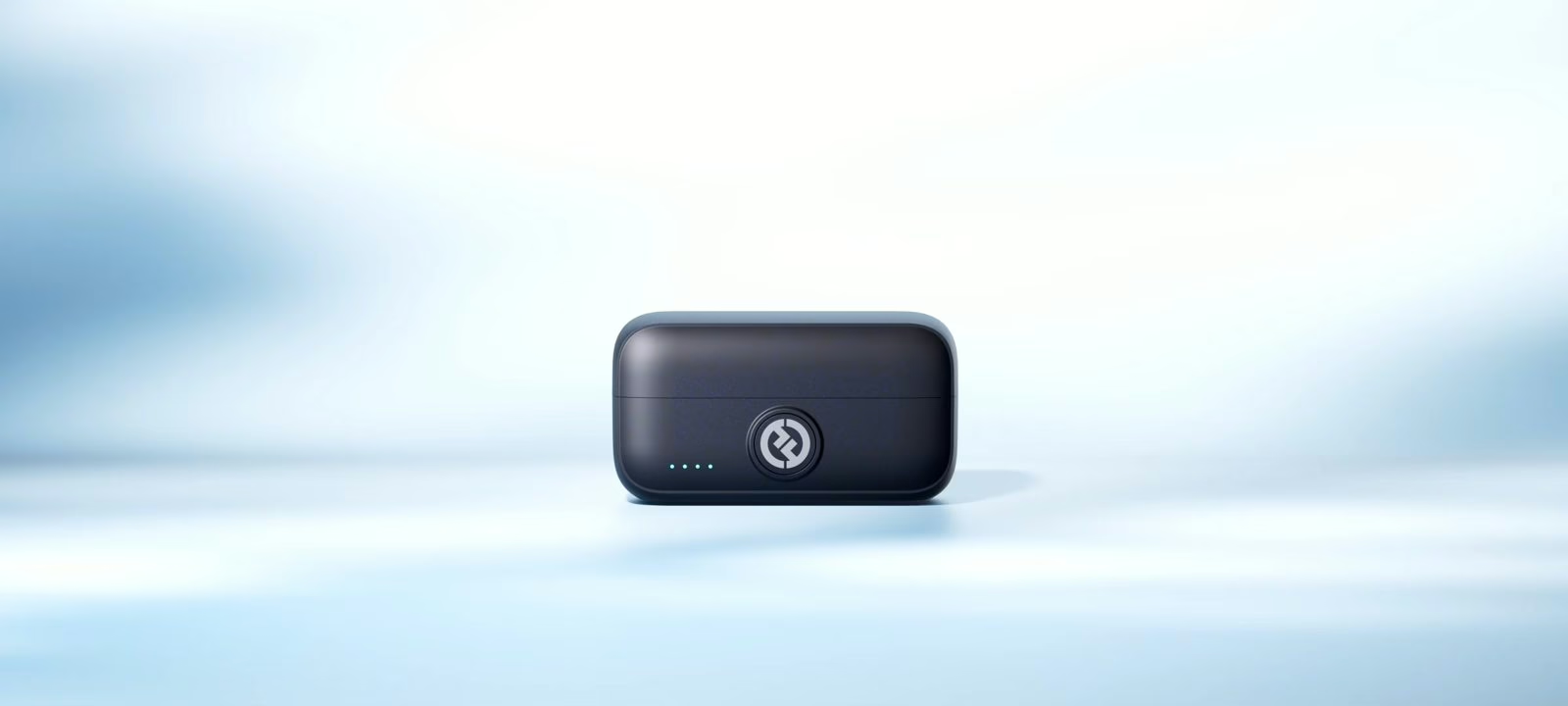
On the audio side, the LARK M3 records at 48 kHz up to 32-bit float, with a stated signal-to-noise ratio of ≥ 70 dB and a maximum SPL of 125 dB. The link runs on Hollyland’s own HDT technology at 2.4 GHz with adaptive frequency hopping, for a range up to 300 m in open field. AI noise cancellation offers three levels (roughly 10, 15 or 20 dB of attenuation), backed by eight vocal presets you can fine-tune in the app. Each transmitter weighs about 9 g and mounts magnetically.

Battery life and connectivity
The transmitter lasts about 8 hours per charge with noise cancellation off (4 to 4.5 hours with it on), and the system reaches around 40 hours by alternating two transmitters through the case. Hollyland offers the M3 with USB-C or camera receivers, with MFi certification for Apple devices and iOS/Android compatibility (Android capped at 24-bit). Onboard recording to isolated tracks secures the take, a safety net against a dropout.
| Feature | LARK M3 |
|---|---|
| Capacity | Up to 4 transmitters and 4 receivers, 4 isolated tracks |
| Audio | 48 kHz / 32-bit float, SNR ≥ 70 dB, 125 dB SPL |
| Link | HDT 2.4 GHz frequency hopping, up to 300 m |
| Processing | AI noise cancellation (3 levels), 8 vocal presets |
| Price | From $99 (2 transmitters, 1 receiver) |
Price and positioning
The M3 starts at $99 for the 2-transmitter / 1-receiver kit, moves to $119 in 2 transmitters / 2 receivers, and $179 for the 2/4 or 4/2 configurations. At these prices, Hollyland is clearly aiming at creators, field journalists and video podcast production. To go further, revisit our piece on the Hollyland MELO P1 wireless audio studio and our look at the SYNCO Xtalk XPro wireless intercom.
Frequently asked questions
How many people can you capture at once?
Up to four, by pairing four transmitters to one receiver. Through a USB-C receiver you then recover four isolated tracks, useful for a clean edit in post-production.
Is 32-bit float available everywhere?
Recording reaches 48 kHz / 32-bit float, but the Android connection is capped at 24-bit. On iOS (MFi certified) and on a computer over USB-C, you get the full resolution.
What real battery life should you expect?
About 8 hours per transmitter without noise cancellation, 4 to 4.5 hours with it. By alternating two transmitters through the charging case, the system reaches around 40 hours of use.
Does noise cancellation degrade the voice?
It is adjustable across three levels (roughly 10, 15 or 20 dB), so you can dose it to the environment. Eight vocal presets, tunable in the app, help keep a natural sound.
My take
The M3’s real find is not the spec sheet— already solid — but the four-transmitter / four-receiver logic that fits real shoots: several voices, several cameras, a clean edit behind. 32-bit float and onboard recording reassure, and the entry price puts all of it within reach of a solo creator. AI noise cancellation still has to be judged by ear, as always: pushed too hard, it sculpts the voice. Used well, the M3 ticks a lot of boxes for very little money.