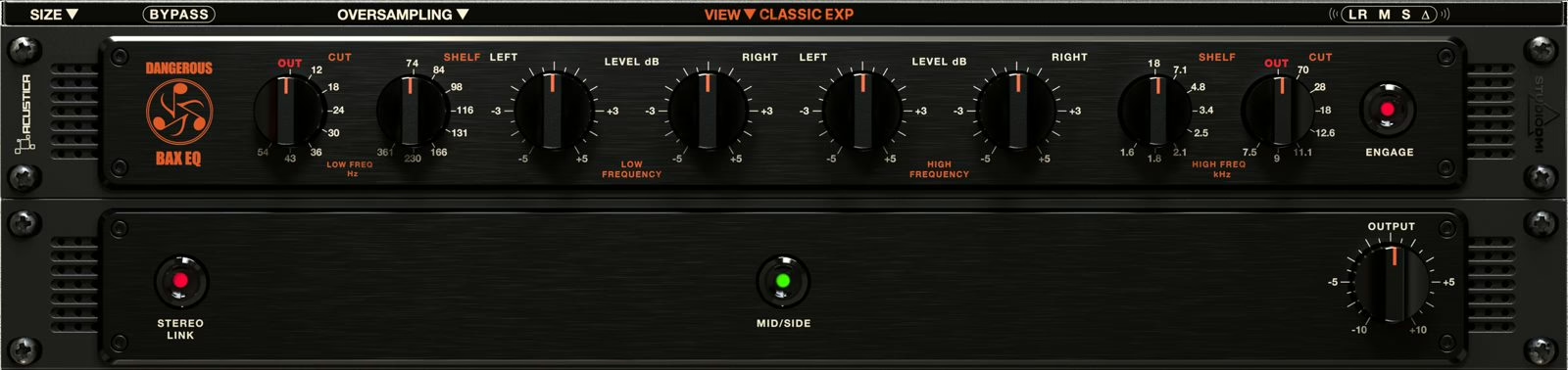
Some units evoke a colour just by name. Dangerous Music’s BAX EQ is one of them: for nearly two decades, this hardware mastering equalizer has lived in the racks of the most demanding mastering rooms. Software takes on it already existed, but none had ever carried the company’s own stamp. That changes now: Dangerous Music is releasing its plugin version, built with Acustica Audio and — crucially — certified by the people who still design and build the hardware.
The BAX EQ, an EQ philosophy
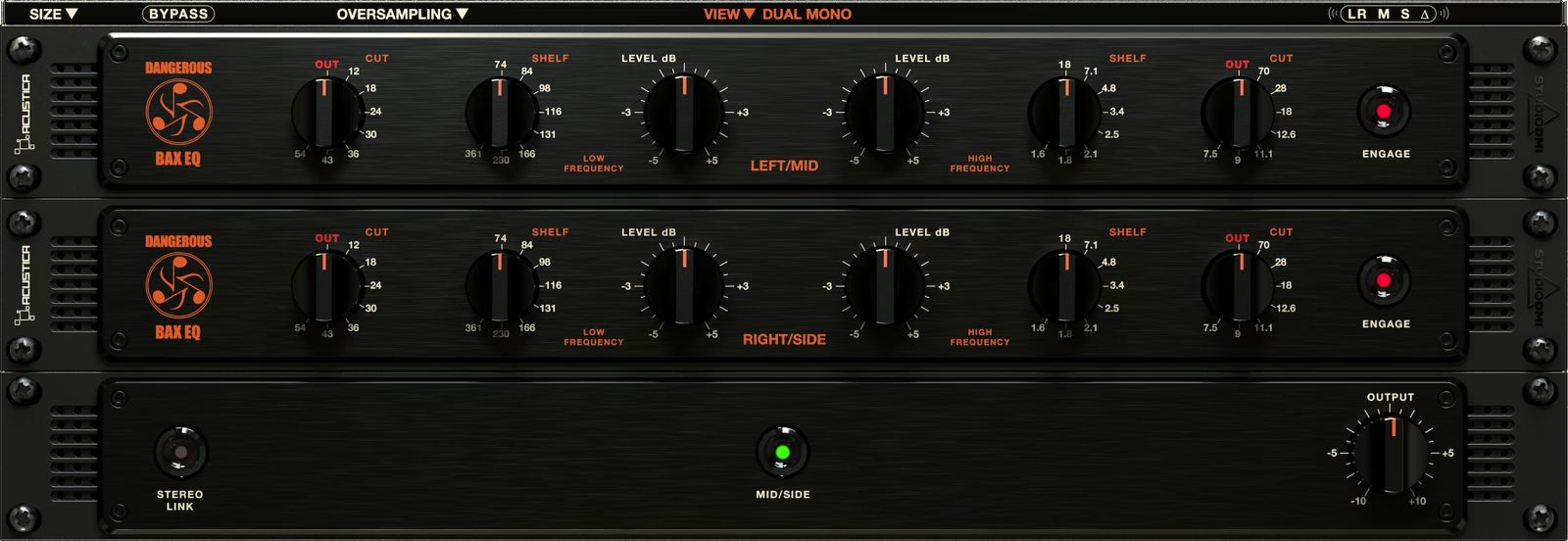
To grasp why this plugin matters, you have to understand what makes the BAX EQ special. Where a parametric equalizer carves narrow bands, the BAX works in broad gestures: very gentle shelf filters in the lows and highs, paired with cut filters designed to keep phase coherent. It’s the direct heritage of the Baxandall curve — a “tone control” approach that favours a global, musical tilt over surgical correction.
In practice, that’s exactly the tool you reach for in mastering, or on a mix bus: adding a touch of weight under kick and bass, opening air on vocals and strings, tightening the cohesion of a whole — all without ever sounding “processed.” A good BAX move isn’t heard, it’s felt.

What a “certified” version changes
The word isn’t marketing fluff here. Certification means the people who designed the hardware, and still build it today, did the listening, the measuring, the comparing and the final approval. Original designer Chris Muth personally signed off on the plugin’s sound, compared against production hardware across four successive revisions. Dangerous Music supplied production units, measurement curves and mastering-grade converters for impulse-response capture.
Development went to Acustica Audio, a developer known for its dynamic sampling engine — the same house behind the recently covered Mystic 2 tube channel strip that went neural. Mastering engineer Luca Pretolesi, of Studio DMI, was also involved in the critical-listening phase. In other words: this isn’t yet another emulation “inspired by” a famous box, it’s the version the brand owns as its own.
Features and integration
At its core, the plugin stays faithful to the hardware’s simplicity: four sections — low-cut, low shelf, high shelf and high-cut — worked by ear more than by analyser. Two additions take advantage of the software format: an independent left/right processing mode and a mid/side mode, with the option to link or unlink the two channels’ parameters. Handy, say, for opening the highs only on the sides of a mix without touching the centre.
Dangerous Music offers the plugin in two flavours, a MIX version and a MASTER version, to fit the two main use cases. It comes in VST3, AU and AAX for macOS and Windows, priced at $179, with a fully functional 30-day trial — enough to put it against your own sessions before deciding.
My take
I say it every time the debate flares up: fully in-the-box is perfectly viable, and I’ve mastered inside the DAW without hang-ups for years. Broad-shelf EQ is precisely where ITB has nothing to envy the hardware: there’s no exotic saturation to reproduce, only a curve, phase coherence and a behaviour. If the model is done seriously — and certification by the original designer is about the strongest guarantee you can ask for — the plugin does the job. That said, $179 for such a specialised tool mostly makes sense if you master regularly; for occasional use, a good shelf on your usual EQ already covers 80% of the ground.
Who it’s for
Mastering engineers and mix-bus enthusiasts who already know the BAX move and want it back — identical and validated — in their DAW. To dig deeper into bus processing, our feature on audio compression explained pairs nicely with the “less, but right” logic; and if you’re after other ways to colour your tracks, our roundup of channel strips worth trying opens more doors.