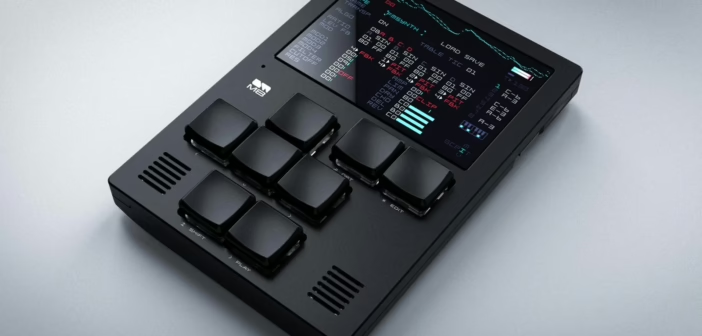
Teenage Engineering is rolling out OS 2.5 for its EP-133 K.O. II sampler as a free update. On the menu: a class-compliant USB audio interface, an arpeggiator, reverse playback and a new auto-chop. Enough to upgrade the little beat box from serious toy to genuine production hub.
An update that changes the nature of the machine
Released just a few days ago, OS 2.5 for the EP-133 K.O. II is not just a bugfix. Teenage Engineering is using the opportunity to bring its whole portable range into line: the EP-40 Riddim is also getting version 2.5, and the EP-1320 Medieval is moving to 1.5. On paper, this is one of those updates that extend a product’s lifespan well beyond its original spec sheet — exactly the kind of software maintenance that separates the brands that matter from the rest.
For the record, the EP-133 K.O. II is the direct heir to the PO-33 K.O!, expanded to 128 MB of memory, with a redesigned sequencer and punch-in 2.0 effects. Priced around €300, it occupies a special place: serious enough to be the heart of a live set, compact enough to fit in a small bag. Version 2.5 fills several gaps users have been flagging since launch.

USB audio, the real headliner
The one new feature that would justify the update on its own is class-compliant USB audio. In practice, the USB-C port is no longer just for charging the device or transferring files: it becomes a full bidirectional audio interface. You can send a stereo stream from a computer or phone straight into the K.O. II for sampling, and conversely route the machine’s output back into your DAW for recording — with no extra interface in the chain.
The detail matters: “class-compliant” means no driver installation, instant recognition on macOS, Windows, iOS and Android. For anyone producing on the move, that removes the weakest link in the mobile workflow: the interface box and its cables. Cleanly sampling a YouTube loop, without going through a headphone jack and the associated loss of quality, finally becomes trivial.
The “I”: why USB audio is not a gimmick
I lived through the shift from analogue to computer-based music-making from the inside, and I saw how the sticking point was never the sound itself, but the plumbing: converters, drivers, latency, cabling. A machine that natively presents itself as a class-compliant audio interface instantly solves a good chunk of those headaches. You stay fully within a viable all-digital setup, without giving up the tactile feel of having real controls under your fingers. That is exactly what I expect from hardware: that it brings something audible or tangible to the workflow, not that it complicates life in the name of vibe.

The rest of the bundle: concrete tools for beatmaking
Beyond USB, version 2.5 casts a wide net and answers some very down-to-earth requests:
- Reverse playback: any sample can now be played backwards from the Sound Edit mode — the classic reversed cymbal or vocal trick, finally built in.
- Arpeggiator: applicable to samples in oneshot and legato modes, to generate patterns and rolls without having to program everything step by step.
- “Equal length” auto-chop: slicing into strictly equal segments, complementing the transient-based mode, ideal for cleanly chopping a drum loop or a verse.
- Mono samples up to 40 seconds: by switching a sample to mono, you double the available length — perfect for pads, textures and field recordings.
- Adjustable sample rate: 46.875 kHz, 32 kHz or 26.25 kHz, an intentional trade-off between fidelity and lo-fi grit, and a finer way to manage memory.
- Refined sequencing: pattern copy-paste by pad, fader automation clear per track, time shift per pad and optimised timestretch.
This decision to enrich the sequencer rather than just stacking more voices says a lot about the brand’s philosophy: it remains an instrument of gesture, where performance matters more than the spec race. The same kind of iterative software approach underpins other compact machines: we saw it with the Yamaha SEQTRAK moving to 2.0, or with the first major firmware update for the Novation Launch Control XL 3, which also transformed the workflow more than the hardware itself.

Three machines, one shared refresh
To put into perspective what this firmware wave actually covers, here is the current version status across the brand’s portable range:
| Machine | Type | New OS | Key addition |
|---|---|---|---|
| EP-133 K.O. II | Sampler / composer | 2.5 | USB audio, arpeggiator, reverse |
| EP-40 Riddim | Dub performance | 2.5 | Sequencer feature alignment |
| EP-1320 Medieval | Themed sampler | 1.5 | Adoption of the new engine features |
The point here is not the comparison chart itself but the message it sends: Teenage Engineering treats its products as living platforms, not as frozen objects sold once and forgotten. At a time when hardware obsolescence is still the norm, that is an argument that weighs as much as the sound.

What to take away from it
With version 2.5, the EP-133 K.O. II gains what it needed to finally leave the drawer: clean integration with computers and phones, plus slicing and performance tools that make it genuinely productive. All of it free, on a machine that was already well designed. For those who like the tactile approach of a Korg Kaoss Pad, this is a chance to rediscover an instrument that now has very little in common with a toy. The update can be downloaded from the brand’s official website.