


Harmonic saturation looks like an accessory until you mix without it: a touch of drive, and a clean but flat track starts to sit forward. These are the saturation plugins I recommend in 2026, free and paid, grouped by family: one-knob colour, multiband saturation and tape grain.
- Best overall: Soundtoys Decapitator, five analogue circuits and a Punish button, 199 $ list price.
- Best value: Klanghelm SDRR2, four saturation modes for 23 €.
- Best free: Softube Saturation Knob, one knob and a band selector.
- For surgical saturation: FabFilter Saturn 2 and its six bands.
- For tape grain: u-he Satin, a tape machine you build yourself.
The comparison at a glance
Publishers’ list prices, checked on 12/11/2026. Sales are frequent in this category, especially at Soundtoys.
| Plugin | Publisher | Family | Price | Formats | Systems |
|---|---|---|---|---|---|
| Decapitator | Soundtoys | one-knob colour | 199 $ | VST, VST3, AU, AAX | macOS, Windows |
| SDRR2 | Klanghelm | one-knob colour | 23 € | VST, VST3, AU, AAX | macOS, Windows |
| Saturation Knob | Softube | one-knob colour | free | VST, VST3, AU, AAX | macOS, Windows |
| IVGI | Klanghelm | one-knob colour | free | VST, VST3, AU, AAX | macOS, Windows |
| Density | Airwindows | one-knob colour | free (donations) | VST, AU | macOS, Windows, Linux |
| Saturn 2 | FabFilter | multiband | 149 $ | VST, VST3, AU, CLAP, AAX | macOS, Windows |
| Satin | u-he | tape | 129 $ | VST, VST3, AU, AAX, CLAP | macOS, Windows, Linux (beta) |
| Tape | Softube | tape | 99 € | VST, VST3, AU, AAX | macOS, Windows |
The plugins in detail
Soundtoys Decapitator: best overall
199 $ list price, often far less on sale · iLok required
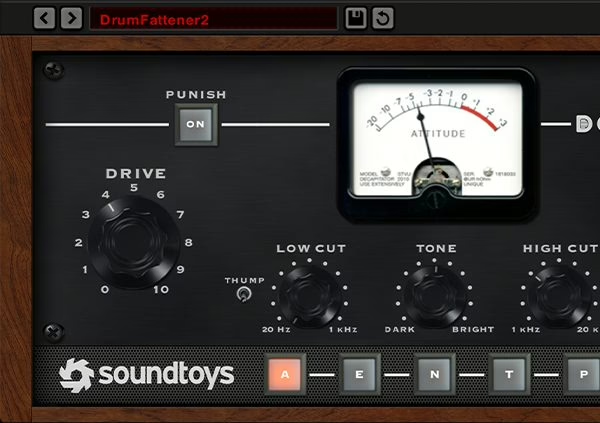
Decapitator models five analogue circuits, inspired by Ampex, EMI, Neve, API and Chandler stages, selectable with one click. Each has its own grain, from discreet warmth to outright breakup, and the Punish button pushes everything further when drums or a synth need character. Who it is for: anyone who wants one colour plugin for the next ten years. Limits: the list price; iLok; a tendency to harden the top end if you forget the output filter.
Klanghelm SDRR2: best value
23 €
Four modes, TUBE, DIGI, FUZZ and DESK, and a dynamic response to the input that behaves like a real analogue stage. DESK mode turns it into a full console channel, with a two-band EQ and transient handling; TUBE remains the most musical on buses and vocals. Who it is for: everyone, tight budgets first. Limits: a dense interface at first sight; a sound that changes a lot with input level, so set the trim carefully.
Softube Saturation Knob: best free
free
One saturation knob and a three-way switch, Keep High, Neutral and Keep Low, which decides where the distortion bites: Keep Low crushes a drum loop while preserving the low end, Keep High does the opposite. Who it is for: the first saturation plugin to install, and a habit many pros keep. Limits: a single flavour; a Softube account is required to activate it.
Klanghelm IVGI: the free all-rounder
free
The free little brother of SDRR reuses its algorithms with simplified controls: trim, drive, output, plus two settings, asym and response, that make all the difference. Modelled crosstalk and slight instability bring stereo tracks to life. Who it is for: buses and the master, as a discreet colour. Limits: a single grain family; no built-in EQ.
Airwindows Density: the free one for the curious
free, donation-funded · open source
Density applies a sine transfer function, the gentlest saturation there is, which you can stack up to extreme thickening. You can filter the saturated part, blend it with the dry signal, or even “desaturate” to thin a sound out. Who it is for: anyone who wants to understand saturation, and Linux users. Limits: an interface limited to the host’s sliders; no VST3 or AAX.
FabFilter Saturn 2: multiband saturation
149 $
Saturn 2 splits the spectrum into up to six bands and saturates each one independently, with 28 distortion styles and a complete modulation section. Grain on the top of a vocal without muddying the lows, a single band dialled in to the decibel: it is the most precise tool on this list. Who it is for: demanding mixes, sound design, bass buses. Limits: more controls, so more attention needed; a modern sound, less “vintage” than Decapitator.
u-he Satin: tape grain made to measure
129 $
Tape speed, bias, azimuth, playback heads, wow and flutter: Satin lets you build your own tape machine, and also does tape delay and flanging. Saturation is one ingredient serving the cohesion of a bus or a whole mix. Who it is for: anyone who wants to “analogise” a bus or a full mix. Limits: almost too much tool for a bit of grain on one track; noticeable CPU load in high quality mode.
Softube Tape: tape, ready to use
99 €
Three machines in one, Type A, B and C, for instant results: Tape gently smooths transients and brings the “glued” cohesion you want on a bus or master, without harshness and with minimal latency. Who it is for: anyone who wants tape grain without opening ten menus. Limits: less editing than Satin; a subtle effect that disappoints if you expect overt saturation.
How to choose: the criteria that really matter
- The colour family. Tube and transformer (Decapitator, SDRR2) add harmonics and density; tape (Satin, Tape) rounds off transients and compresses; multiband (Saturn 2) localises the effect.
- Gain compensation. Saturation that raises the level always sounds better: without automatic compensation, compare at matched loudness.
- Dry and wet blend. A built-in parallel mix saves you an aux bus for every track.
- Oversampling. Essential as soon as the drive goes up, to avoid aliasing in the highs; it costs CPU and latency.
To go further on tape grain, read our article on tape emulation, and for dynamics, compressor types and how to use them. Tape echoes have their own guide: the best tape echo plugins.
My take
Start with SDRR2 and Saturation Knob: for 23 €, you cover almost every colour need in a mix. Decapitator remains the most inspiring as soon as a source calls for character, and it is well worth its sale price. Saturn 2 earns its place the day saturation has to sit in one area of the spectrum only, something no one-knob plugin can do.
Frequently asked questions
What is the best free saturation plugin?
Softube Saturation Knob for simplicity, Klanghelm IVGI for discreet colour on buses, Airwindows Density for gentleness and Linux. All three are free and used in real productions.
Saturation, distortion, overdrive: what is the difference?
It is a question of amount. Saturation adds low-level harmonics to thicken a sound; distortion and overdrive push the same phenomenon until the timbre itself changes.
Should saturation go before or after the compressor?
Before, it shaves peaks and makes the compressor’s job easier; after, it colours a signal that is already controlled. Both are common: listen at matched level.
Is Decapitator worth the price?
At list price, it is debatable against SDRR2; on sale, it is hard to beat. Its five circuits cover a range of colours no free plugin offers.
Can you saturate the master bus?
Yes, in small doses: IVGI, Softube Tape or Satin add cohesion without squashing the mix. Always check the result at matched loudness.
Update log
- 12/11/2026: first version of the guide, replacing our earlier selection on the same topic. Eight plugins, list prices checked the same day.