Twenty-five years after the first version, Waldorf is resurrecting its iconic drum engine with Waldorf Attack 3. With a completely redesigned interface, a modernised sound engine and deep sampling integration, this plug-in aims to reclaim a place in studios alongside today’s heavyweights like Battery, XO, Punch, Drumazon or the drum machines integrated into DAWs.
Who is Waldorf Attack 3 really for?
Attack 3 remains above all a drum synthesizer. It is therefore aimed at three main families of users:
- Sound designers and electronic music producers who want to shape completely original kicks, snares and percussion, going beyond the overused 808/909 libraries heard everywhere.
- Long-time Attack 1/2 users who want to rediscover the original philosophy, but with a modern interface, up-to-date compatibility and sampling functions worthy of an instrument released in 2026.
- Hybrid producers (electro, techno, pop, trap, film, video games) who like to combine percussive samples with synthesis to build coherent, lively and highly modulable kits.
Where Battery or XO are first and foremost sample managers, Waldorf Attack 3 clearly positions itself as a drum synth that also knows how to sample. It is an alternative for those who find virtual drum machines “too static” and want to recapture the liveliness of a true per-voice synthesis engine.
Interface and workflow: designed for creating full kits
The first major break with earlier versions of Attack is the interface. Waldorf has abandoned the famous vertical column of slots in favour of a horizontal layout closer to current standards, far more pleasant for programming full drum kits.
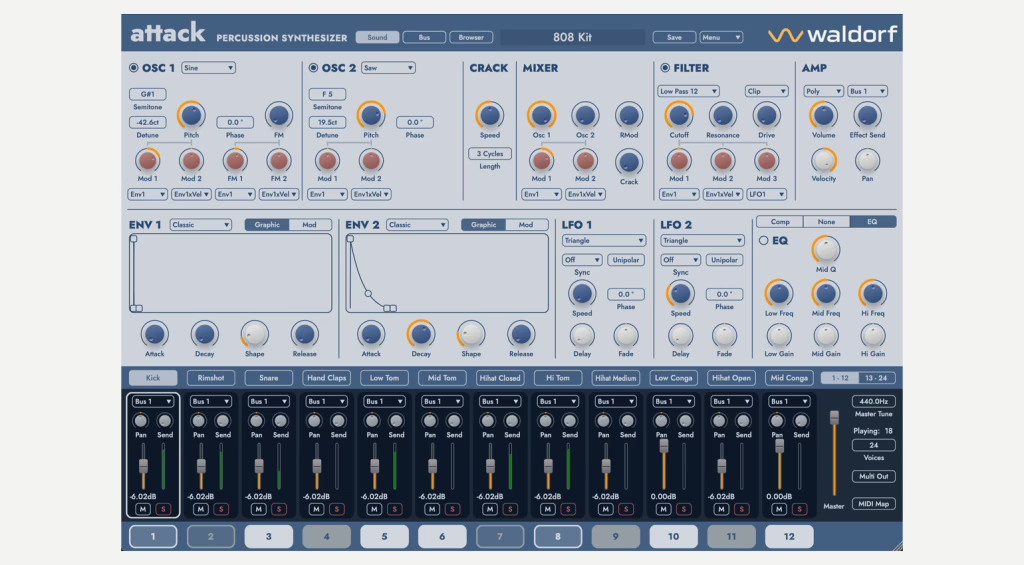
In practical terms for the user:
- Completely redesigned, scalable interface: the dated look and tiny plug-ins on 4K screens are gone. Attack 3 is fully resizable, which is essential for intensive studio use.
- Clearly segmented engine: oscillators, filters, envelopes, LFOs and FX are organised logically, with immediate visual feedback. For a sound designer, this clearly shortens the time between idea and result.
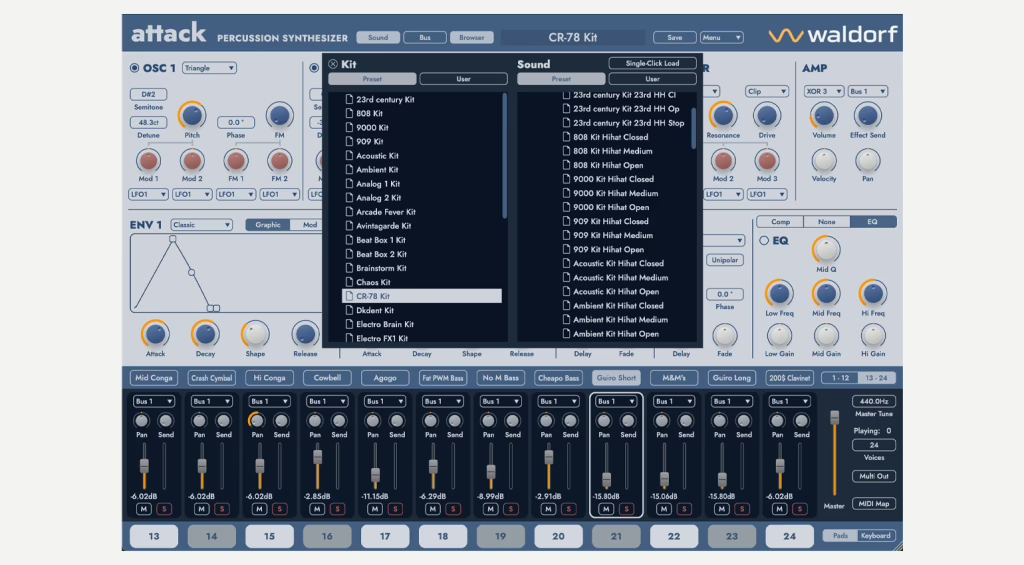
- Dedicated browsers: kits, sounds, samples and MIDI mapping each have their own browser. This brings it closer to tools like Battery or Maschine in terms of content management, while maintaining a synthesis-focused environment.
Compared with Attack 2, the challenge was not just cosmetic: the old design clearly held back modern workflows. Attack 3 fixes this and finally becomes a credible tool for fast production, including in professional situations.
A hybrid engine: drum synthesis and modern sampling
Historically, Attack was known for its ability to generate sharp, synthetic drums. Attack 3 builds on this foundation, but Waldorf has modernised the core sound to remain competitive against recent solutions.
Refined oscillators and controlled phase
The oscillator section has been completely refined for greater precision. Phase control of the synthetic waveforms allows for:
- more consistent kicks from hit to hit,
- more predictable transients, very useful for modern mixing,
- better compatibility with parallel compression and aggressive dynamic processing.
In a context where producers often compare results with heavyweight engines like Serum, Phase Plant or Pigments for creating percussion, this oscillator refinement is essential to remain in the race.
Integrated sampling: far more than a simple one-shot player
Attack 3 does more than just load a wav for show. User sample import is fully exploitable for realistic or experimental programming:
- Full sample import, supporting the user’s own sounds.
- Velocity mapping: stack multiple variations of the same sound over different velocity ranges, just like on a dedicated sampler.
- Round-robin playback: ideal for avoiding the “machine-gun” effect on hi-hats, acoustic snares or organic percussion.
- Adjustable start point: useful for sculpting transients, shortening attacks or exploring unexpected textures within a sample.
This does not rival a dedicated multi-layer sampler like Kontakt for large instruments, but for percussive and sound-design use, Attack 3 ticks the right boxes. The big advantage: everything stays within a single instrument, with the same per-voice modulation and effects logic.
Filters, drive and modulation: enough to compete with modern drum machines
Upgraded filters for a modern sound
The filter section in Attack 3 has clearly been brought up to date:
- 24 dB filters added: more slope to sculpt kicks, percussive bass and sub toms, with clean cuts comparable to those offered by modern synths.
- Positive and negative comb filters: perfect for metallic percussion, futuristic snares or rhythmic FX, an area where many drum machines remain fairly limited.
- Sample-rate reduction: to add grit, crunch and deliberate aliasing, in a lo-fi/IDM/Glitch spirit, without needing an external plug-in.
Drive section: a saturation palette tailored to drums
Waldorf has added several new types of drive, tailored to percussive treatment:
- Transistor
- Crunch
- Overdrive
- Diode
- Clip
These modes cover a spectrum ranging from subtle thickening to full-on distortion. On the market, most users now stack dedicated saturation plug-ins (Decapitator, FabFilter Saturn, etc.) on their drums. The advantage of Attack 3 is that you can already pre-sculpt the character of each element inside the instrument itself, before even hitting your external effects chain.
Envelopes and LFOs: modulation built for rhythm
Attack 3 introduces:
- Two new advanced envelopes: allowing you to go far beyond a simple ADSR, for instance to finely sculpt the dynamics of a kick or the evolution of a complex clap.
- Two full-featured LFOs: powerful enough to modulate pitch, filter, volume or even more exotic parameters, for evolving grooves, subtle wobbles and timbral variations.
- Extended modulation routing: this brings it closer to the semi-modular philosophy of some modern software synths, placing Attack 3 on a higher level than many “closed” virtual drum machines.
For styles like hypnotic techno, bass music or IDM, this modulation depth is a real differentiator: you get kits that live and breathe rather than frozen loops.
Kit management, polyphony and effects: an instrument capable of covering a full set
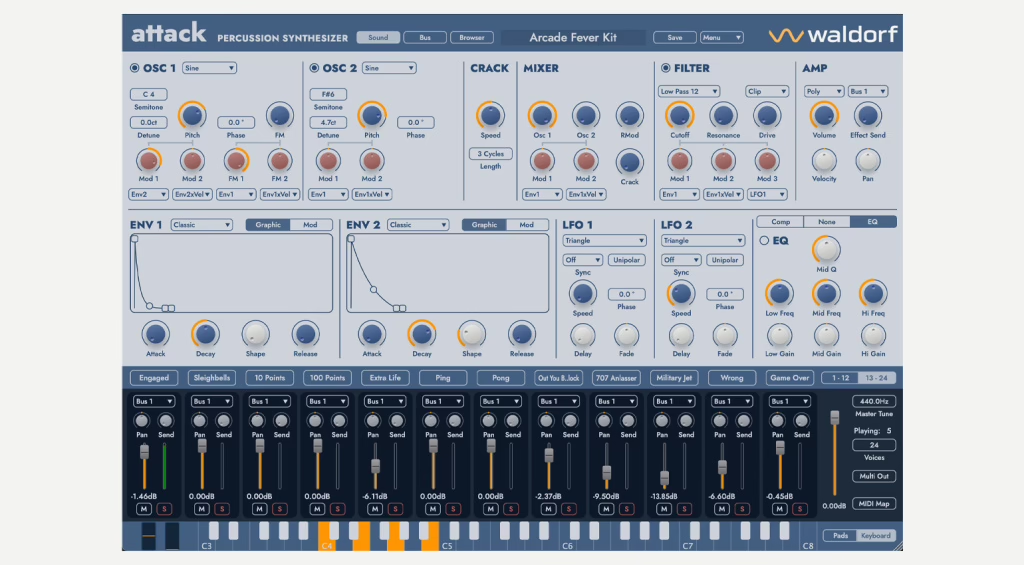
Attack 3 offers 24 individual sounds per kit, which easily covers a full kit with variations, additional percussion and a few FX elements.
- 12 of these sounds can be played polyphonically as pitched instruments: handy for percussive bass, stabs, melodic hits derived from samples or oscillators, or hybrid bells and textures.
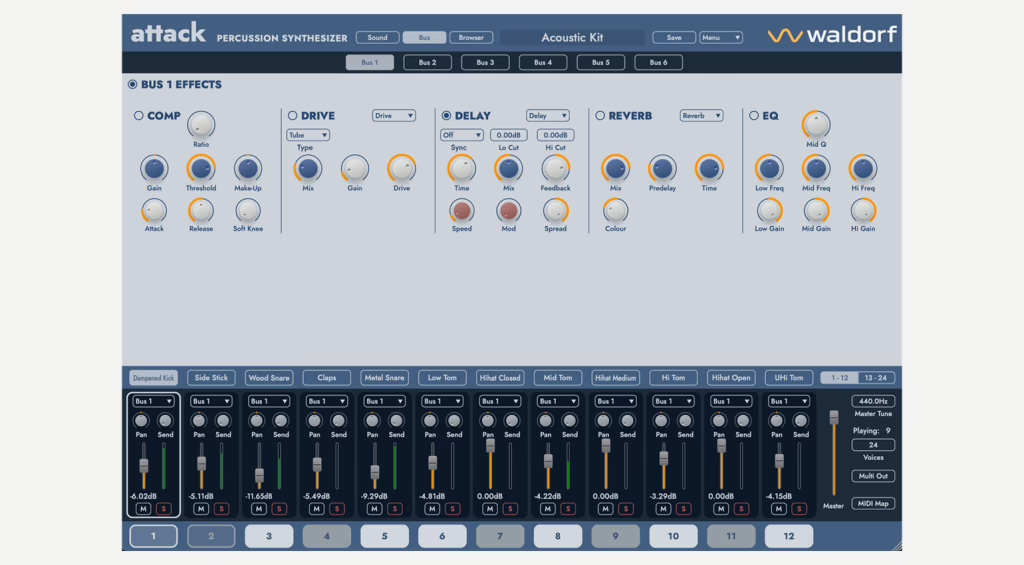
- Each sound has its own insert effects: so you can treat a snare, kick or hat very specifically.
- Global effects round out the setup to glue the whole kit into a single sonic space.
In practice, this architecture allows you to build an entire track from a single instance of Attack 3 for the whole rhythmic section and part of the melodic percussive elements. It is not just a “kick generator”, but a fully-fledged rhythmic foundation for a project.
Positioning in the market: simple update or true revival?
Functionally, Waldorf Attack 3 is not just a small visual refresh of an old plug-in. Between the GUI overhaul, modernised oscillators, new filters, drive section, advanced envelopes, LFOs, deep sampling integration and effects management, it is clearly a revival.
Compared with current benchmarks:
- Against classic drum samplers (Battery & co), Attack 3 provides a genuine per-voice synthesis section that avoids relying solely on samples.
- Against software grooveboxes (virtual Drumazon, DrumBrute Impact, etc.), Attack 3 offers greater sonic flexibility: you are not locked into emulating an existing machine.
- Against big all-round synths (Serum, Pigments, Phase Plant), Attack 3 loses in overall versatility but gains in efficiency for building complete kits, with a workflow designed from the ground up for drums.
In short, Attack 3 targets producers who want a single environment for all their synthetic and hybrid percussion, rather than stacking ten different plug-ins.
Price, upgrade and value for money
The announced retail price is €99 inc. VAT. For a specialised yet very complete instrument, this places it competitively against the major drum plug-ins on the market.
Two points to note:
- Introductory offer: a 50% discount is available until 22 February, which makes the purchase particularly attractive for those seeking a modern drum engine at a lower cost.
- Upgrade pricing: owners of Waldorf Edition and Waldorf Edition LE (which include Attack 2) benefit from a favourable upgrade price, accessible via their Waldorf user account.
For long-standing users, this upgrade price is clearly an incentive to move on from an obsolete plug-in to a tool that meets today’s standards, while retaining Waldorf’s sonic signature.
Verdict: for whom is Attack 3 a good choice?
Best suited if:
- you like to build your drums from synthesis rather than stacking samples from commercial packs;
- you need an instrument capable of generating both percussive elements and playable pitched sounds (bass, stabs, FX) in a single environment;
- you are looking for a more creative alternative to a simple drum sampler, without getting lost in the complexity of a big general-purpose synth;
- you are an Attack 2 user who wants to recapture that workflow with an interface and features at a 2026 level.
To be considered with caution if:
- you only work with ultra-ready-made sample libraries and have no desire to “design” your own sounds;
- you expect a highly sophisticated internal sequencer, like a standalone groovebox (Attack 3 is designed first and foremost as a sound engine within a DAW);
- you already own several modular software synths and do not need a dedicated drum environment.
For demanding producers who want a software drum machine focused on synthesis and creative sampling, Attack 3 marks a relevant return for Waldorf in a segment where few players still embrace a true drum synthesis approach.
FAQ: choosing and using Waldorf Attack 3 wisely
Does Attack 3 replace a drum sampler like Battery or XO?
Not entirely. Attack 3 can load samples, handle velocity, round-robin and start point, but its DNA is still that of a drum synthesizer. If what you mainly want is to organise, classify and browse thousands of samples, a dedicated sampler will remain more ergonomic. On the other hand, for creating and transforming your percussion sounds, Attack 3 will be more powerful than a simple one-shot player.
Is Attack 3 worth upgrading from Attack 2?
Yes, if you are still using Attack 2, the upgrade is strongly recommended: you gain an interface that is finally readable and modern, a more precise oscillator engine, new filters and drives, advanced envelopes and LFOs, as well as much more up-to-date sample handling. For daily production use, Attack 2 really shows its age, whereas Attack 3 is adapted to 2026 workflows.
Can you produce “mainstream” drums (trap, pop, EDM) with Attack 3, or is it mainly for experimental work?
Attack 3 comfortably covers both territories. Its phase precision and 24 dB filters allow you to craft very modern kicks and snares suitable for trap or EDM. The modulations, comb filters and sample-rate reduction then open the door to more experimental textures if you wish. Nothing forces you into noisy IDM: when programmed well, Attack 3 can produce radio-friendly drums.
Do I need other effect plug-ins to use Attack 3 in professional production?
Attack 3 already includes per-sound insert effects and global effects, which are more than enough for sound design and demos. In a professional mixing context, you will probably still use your external EQs, compressors, reverbs and saturations to finalise the sound on the drum bus or mix bus. Think of Attack 3 as an instrument that produces already well-shaped sounds, which you then refine with your usual processing chain.