A young Hong Kong outfit shows up with a pocket synth unlike anything else on the shelf: the Mach Devices MD-7 swaps ordinary encoders for force-feedback motor discs and hands you its entire DSP engine to hack. Small box, big idea — and a confident jab at the pocket-synth establishment.
A pocket instrument that bets on feel
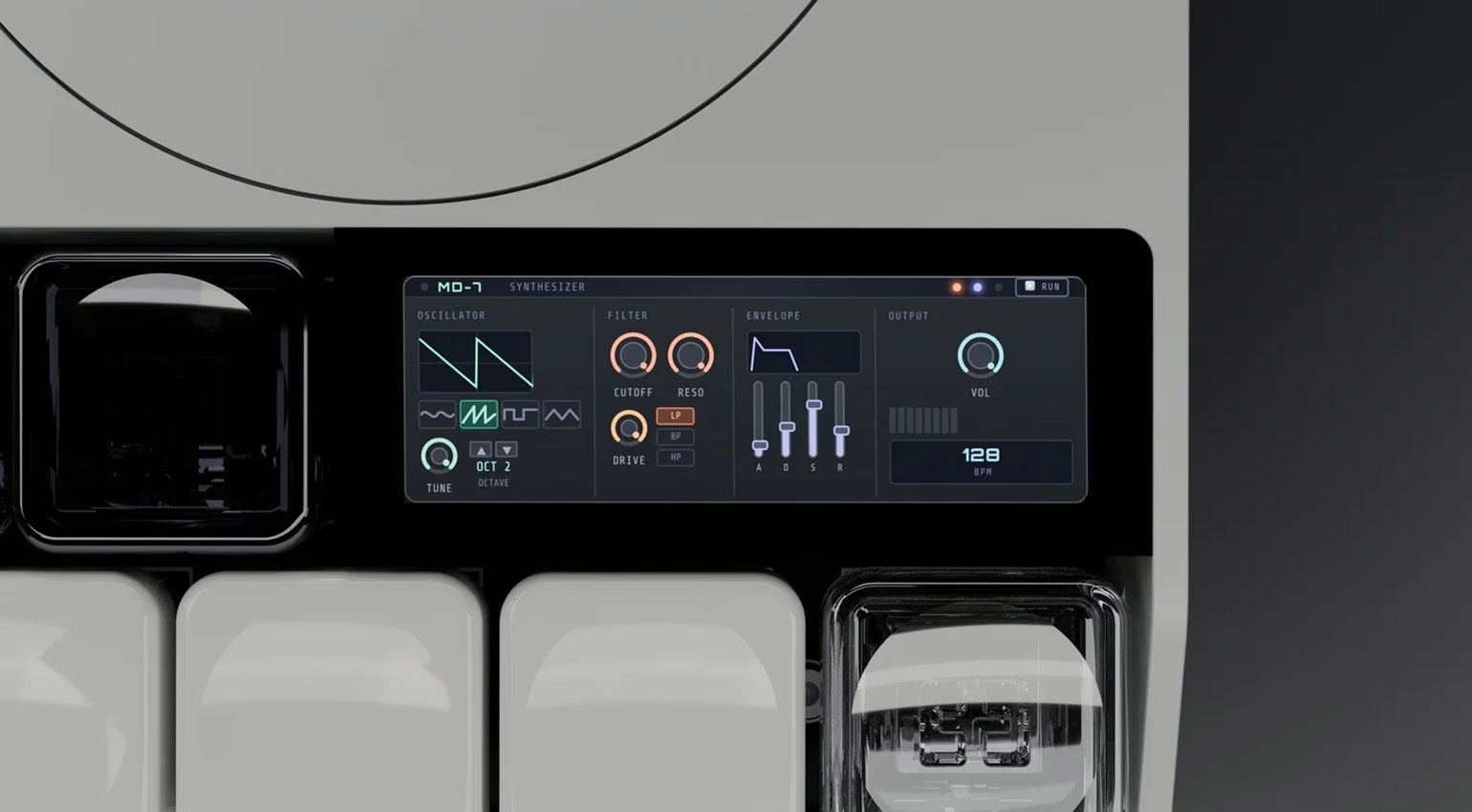
The MD-7 fits in one hand. Minimalist aluminium chassis, a 13-key button-style keyboard, a tiny IPS screen: on paper it looks like yet another cousin of the ultra-compact groovebox family Teenage Engineering kicked off. Except Mach Devices — a still-under-the-radar Hong Kong maker — poured its effort somewhere no one expected, into the physical feel of the controls rather than a bigger feature checklist.

Knobs that push back
The real novelty is those rotary discs, driven by Field-Oriented Control motors — the same precise motor-control technique used to fly drones and steer robots. In practice, each disc changes its resistance in real time depending on the parameter you are editing: crisp virtual detents to step through waveforms, a smooth glide to sweep a cutoff, gentle end-stops at the edges of a range. Force feedback stops being cosmetic and becomes tactile information.
The idea didn’t come from nowhere. High-end control surfaces have long used motors to convey intent: a console’s motorized faders recall an automation move the instant you touch them. Seeing that logic trickle down into a sub-$300 device — and applied to knobs rather than faders — is what makes the MD-7 interesting beyond the gimmick.

Open source down to the firmware
Second gamble: everything is open. The DSP engine, the modulation matrix and the sequencer all ship open-source, and nothing stops you from writing your own firmware to turn the machine into whatever you want — subtractive synth, effects bench, generative drum box. In a market where makers guard their code jealously, that stance speaks to a specific crowd: the people who would rather get their hands dirty than wait for the next official update.
Connectivity all runs over USB-C, in a deliberately stripped-back layout:
- one USB-C port dedicated to power;
- a second USB-C port handling D/A conversion, MIDI I/O and a microphone input;
- a stereo headphone output on minijack;
- a microSD card slot for storage.
My take
I spent years behind consoles with motorized faders — a desk that recalls an automation move in a single gesture leaves a lasting mark on how you relate to a machine. So the idea of getting that mechanical dialogue back on a pocket synth genuinely appeals to me: a knob that tells your fingertip where you are in a range is more musical than a mute endless encoder. My reservation is wear: a motor moves, heats up and ages; on a device meant to take knocks in a bag, long-term reliability will be the real judge. The first batch selling out says nothing about durability — only about the appetite of a curious community. One to watch, then, but with the benefit of the doubt: this is the kind of design nerve I’d like to see rewarded.
Price and availability
The MD-7 is listed at HK$2,345, roughly $299 (about £235), worldwide shipping included. The first run is already flagged as sold out, with shipments expected later in the year. Here’s the short version.
| Spec | Mach Devices MD-7 |
|---|---|
| Format | Pocket synth/groovebox, aluminium chassis |
| Controls | Haptic motor discs (FOC), 13-key keyboard, IPS screen |
| Sound engine | Open-source DSP, customizable mod matrix and sequencer |
| I/O | 2 × USB-C (power / audio-MIDI-mic), minijack headphone out, microSD |
| Price | ~$299 (HK$2,345) |

A niche that keeps filling up
The pocket synth is no longer virgin territory: between the Pocket Operators, Teenage Engineering’s grooveboxes and a wave of more affordable challengers such as the M-VAVE FM-1 and its sub-$80 FM engine, the field has grown crowded. The MD-7 isn’t trying to win on price or feature count; it steps sideways, onto tactile ergonomics and software openness. That echoes the bet made by open-architecture instruments like the Isla Electronics Caladan with its swappable voice cards: lean on modularity and community rather than raw spec-sheet muscle. Whether so small a player can go the distance on production and support remains the open question. The curiosity, though, is already there. For the official details, Mach Devices’ product page is the reference.