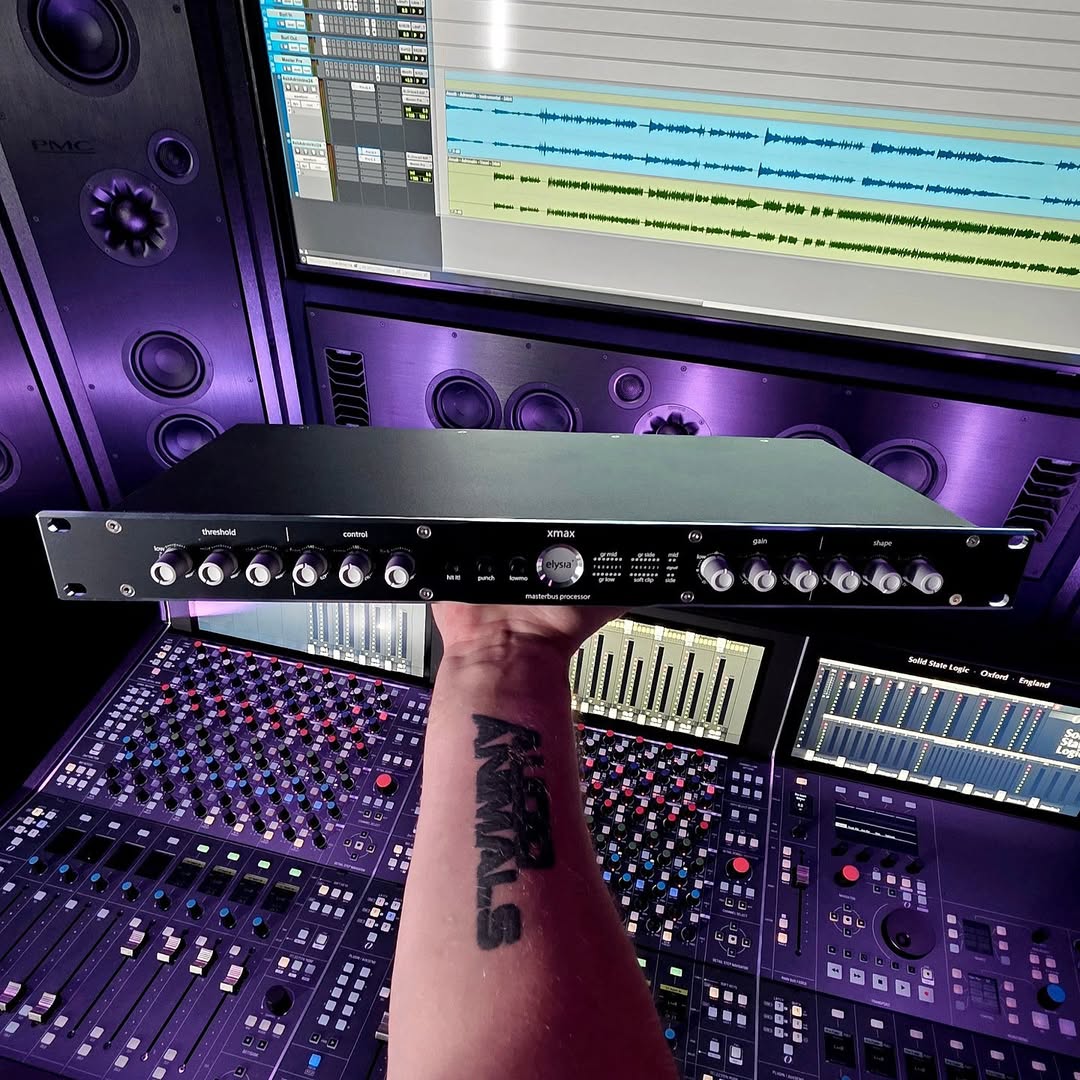
Presented at the NAMM Show 2025, the Elysia XMAX targets studios that want to take back control of their master bus without leaving the analogue world. A Class‑A stereo bus processor, it combines multiband compression, internal Mid/Side processing, shelving EQ and soft clipping derived from the alpha compressor, in order to offer a true bus processor analog for mixing, mastering and live sound.
Context: where the Elysia XMAX sits in the range
With the XMAX, Elysia extends its range of Class‑A analogue processors by targeting a clearly identified need: to offer a complete masterbus processor that centralises dynamics and stereo management on the final bus. The manufacturer highlights a discrete Class‑A design and internal Mid/Side processing, to preserve signal integrity while giving plenty of room to manoeuvre when it comes to overall mix balance.
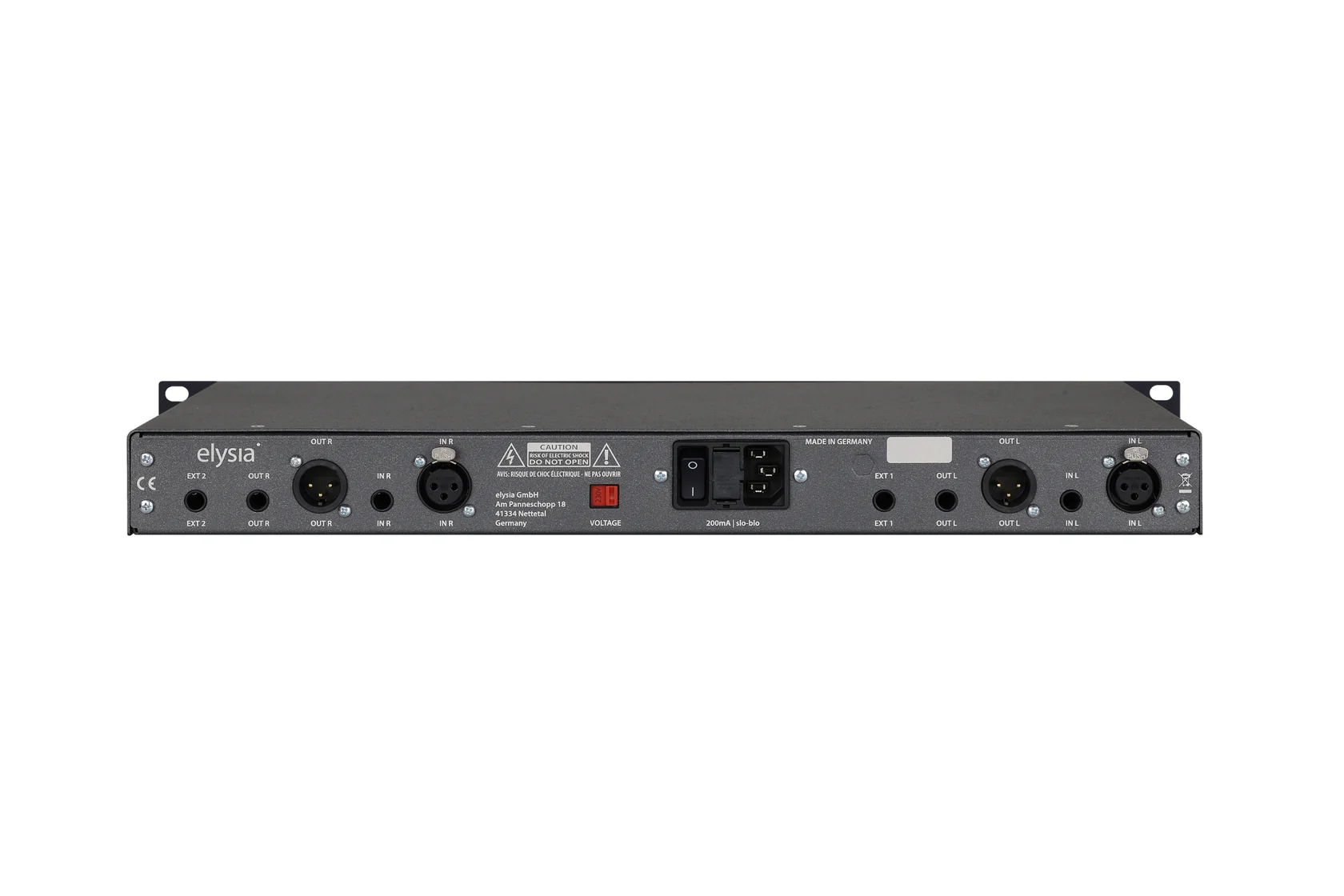
The XMAX is announced in three formats sharing the same audio electronics: a 1U 19″ rack unit, a 500 Series module and a portable qube version. In every case, the aim remains the same: to provide mastering studio hardware ready to become the centre of gravity of the stereo bus in a studio, control room or mobile setup.
Architecture: multiband, Mid/Side and soft clipping
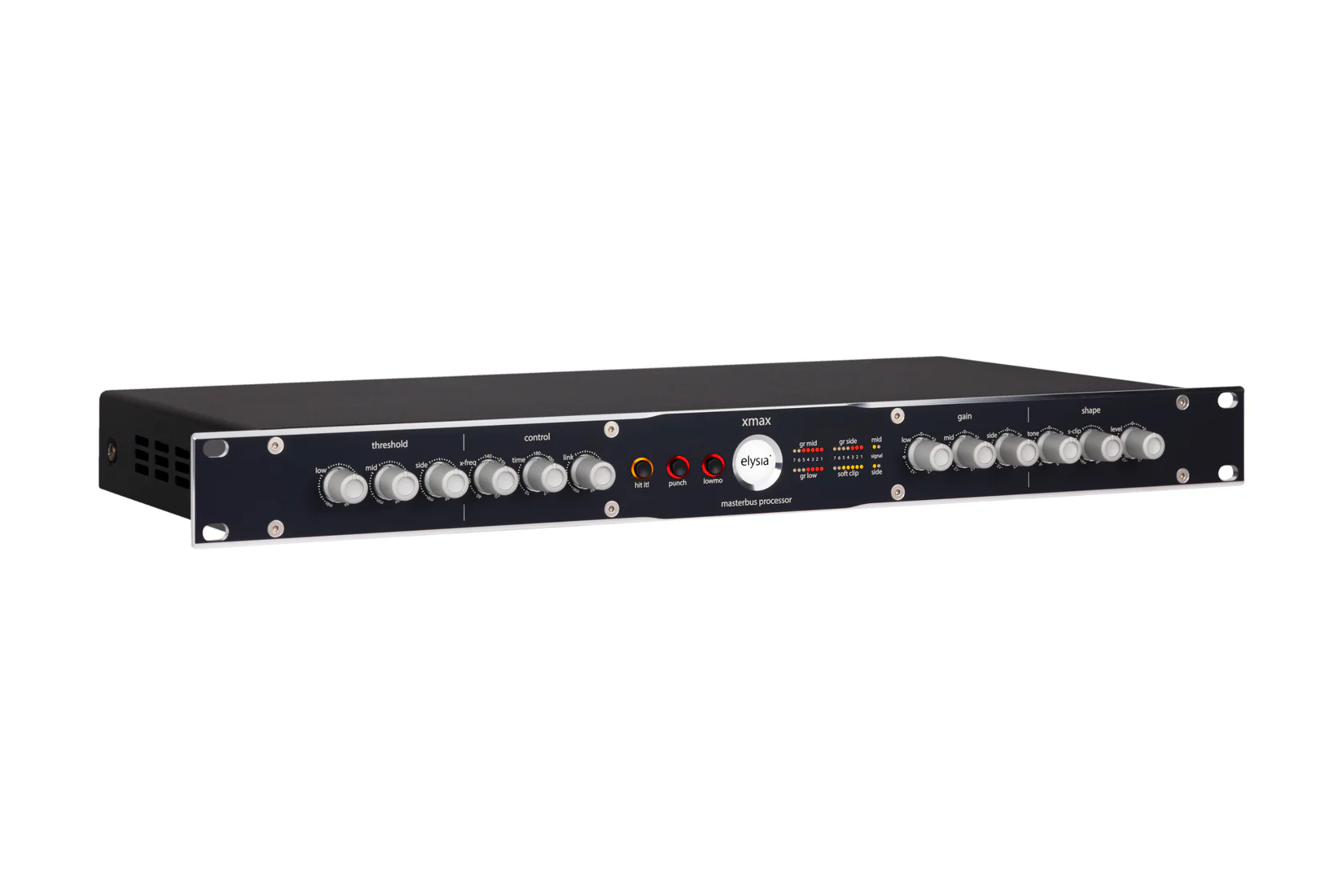
The Elysia XMAX brings together several processing blocks in a single unit, with a signal flow designed specifically for the master bus. The incoming stereo signal is first encoded into Mid/Side, then split into three processing zones: the Low band (low‑frequency content of the Mid channel), the Mid band (midrange of the Mid channel) and the Side band. Each band has its own threshold and output level, allowing you to shape the low end, the body of the mix and the stereo width independently.
- Multiband compression: the three compressors (Low, Mid, Side) share a fixed 10 ms attack, chosen to preserve transients while maintaining effective control. When gain reduction exceeds 8 dB, the Auto Fast function automatically shortens the attack on fast transients, which limits distortion and keeps the signal intelligible.
- Variable crossover frequency: the x-freq control sets the boundary between the low and mid bands over a range from 40 Hz to 470 Hz. It lets you steer the processing towards sub‑bass, bass or low‑mid frequencies depending on the material.
- Global Release: a global release setting controls the recovery time of the three compressors. Short values create a more rhythmic, energetic feel, while longer times deliver smoother compression, useful for mastering.
- VariLink: this function adjusts how tightly the bands are linked. You can go from completely independent operation to fully linked behaviour, similar to a stereo VCA compressor. The most energetic band can then drive the overall response, and you can choose which band takes that role by adjusting the thresholds.
- Lowmo: this filter targets the low‑frequency component of the Side channel to pull the bass back towards the centre. The bottom end therefore remains stable and compatible with the majority of playback systems.
- Tone: a high‑shelf EQ from –8 dB to +8 dB lets you dial in overall brightness and add “air” to a mix or master without resorting to an external EQ.
- Soft Clip Limiter: placed after Mid/Side decoding back to L/R stereo, the soft clipper derived from the alpha compressor is designed to catch very short peaks before the A‑D converters. It behaves like transistor‑based analogue saturation, rounding off peaks rather than chopping them, which helps increase perceived loudness while avoiding digital clipping.
- Analogue metering: the front panel displays, in real time, the gain reduction of each band (Low, Mid, Side) as well as the action of the soft clipper. The user can immediately see what is happening on the bus, whether they are after a subtle bit of “glue” or a more assertive control.
By combining these elements, the Elysia XMAX positions itself as fully featured mid-side mastering gear: multiband, Mid/Side, light tonal shaping and gentle limiting are all integrated into a single bus processor.
Mastering hardware in 2025: what are the benefits?
In the landscape of mastering hardware 2025, where plug‑ins dominate day‑to‑day work in both home studios and professional rooms, the XMAX puts forward several advantages linked to analogue processing. The first concerns level management before conversion: the soft clip limiter lets you handle peaks in the analogue domain, whereas a software limiter can only act after A‑D conversion.
The internal Mid/Side processing and multiband compression also address a frequent request from mastering studios: separate control of the centre, the sides and different frequency zones without multiplying outboard units. Low‑end centring, managing the body of the mix and fine‑tuning the stereo width are all handled in a single signal path, which simplifies the stereo bus chain.
The XMAX is also aimed at situations where latency must remain very low, such as live sound or hybrid chains that send the final bus out to hardware before returning to the DAW. In these contexts, a dedicated bus processor analog for the master remains a robust and transparent solution.
Formats, pricing and role in the studio
Elysia offers the XMAX in three versions to cover different types of studios and control rooms:
- 1U 19″ rack: a full stereo master bus processor, listed at Thomann since April 2025. It weighs around 1.76 kg with a depth of 232 mm. The street price observed in November 2025 is around €1,735 inc. VAT, with a 3‑year warranty and a 30‑day money‑back policy.
- Qube version: the same audio circuit housed in a compact aluminium enclosure suitable for writing rooms, mobile setups or live rigs. The XMAX qube is offered at around €1,333 inc. VAT.
- 500 Series module: the XMAX is also available in 500‑series format, announced at NAMM 2025 at around €1,125 inc. VAT, for users who already own a 500‑series rack.
On major retailers, the XMAX sits alongside units such as the SSL Fusion, SSL BUS+, Tegeler Creme RC, API 2500+ and other high‑end bus processors. It clearly falls into the mastering studio hardware category aimed at independent mastering studios, mix engineers and advanced home studios looking to build a coherent analogue chain.
Integration into a modern studio and production workflows
In a contemporary studio, the XMAX is designed to sit on the main stereo bus or on group buses. Inserted between the output of the console or interface and the A‑D converters, it allows you to:
- tighten the low end via the Low band and the Lowmo function, in order to keep bass centred and under control,
- bring out the body of the mix (vocals, snare, guitars, synths) via the Mid band and the choice of standard or Punch ratio,
- adjust stereo width and the energy of the side elements via the Side band, for example by widening guitars or ambience tracks,
- dial in overall brightness with the Tone control, adapting the sound to streaming platforms, podcasts, online video or radio broadcast,
- secure the maximum level sent to the A‑D converters thanks to the soft clip limiter, gaining perceived loudness without exceeding 0 dBFS.
For a studio delivering mixes for music, podcast or video, the XMAX can therefore become the default pass‑through point for the stereo bus: the DAW feeds the processor from the interface outputs, the XMAX handles dynamics and stereo, then the signal goes back to the converters to be captured in a mastering project or directly within the production workflow.
The qube version also makes mobile or hybrid configurations easier. It offers the same processing character as the rack version in a more compact environment, useful for sessions on the move or for live rigs where a bus processor analog has to remain portable.
Technical performance
The technical specifications of the Elysia XMAX confirm its high‑end positioning:
- Frequency response: below 10 Hz up to 180 kHz (–3 dB), comfortably covering the useful audio spectrum.
- THD+N: around 0.01% at 0 dBu (20 Hz – 22 kHz).
- Noise floor: around –91.3 dBu (20 Hz – 20 kHz, A‑weighted).
- Dynamic range: 112 dB (20 Hz – 22 kHz).
- Maximum levels: input level up to +21 dBu and output level up to +22 dBu.
- Impedances: 20 kΩ input, 68 Ω output, for straightforward integration into professional analogue chains.
- Power consumption: around 12 W for the rack version, 9 W for the qube, and 205 mA for the 500‑series module.
- Potentiometers: 41‑position detented pots, making it easier to recall settings and work consistently on long‑term mastering projects.
Elysia also provides recall sheets for the rack, 500 and qube versions, available to download from the official website. They allow you to accurately document the settings used for an album, podcast series or broadcast chain.
Strengths and limitations for studios in France
For a studio in France focused on mixing or mastering, the Elysia XMAX offers several concrete advantages:
- Versatility on the stereo bus: multiband compression, Mid/Side processing, shelving EQ and soft clipping all in a single processor, with ergonomics designed for the master bus.
- Build quality: discrete Class‑A circuits, wide dynamic range, low noise and multiple formats (rack, 500, qube) depending on the infrastructure available.
- Peak management before conversion: the soft clip limiter helps you get the most out of your converters’ dynamic range, which is particularly useful for productions destined for streaming platforms or broadcasters.
- Readable controls: dedicated controls and analogue meters make it easier to get to grips with the unit and visually monitor compression and soft clipping.
However, a few points are worth considering before investing:
- Cost: with a price around €1,735 inc. VAT for the rack version, the XMAX is primarily aimed at professional studios, very well‑equipped home studios and live sound providers.
- Bus‑oriented design: the processor is designed for the master bus or group buses. It can be used on individual sources, but its main potential lies in stereo bus management.
- Learning curve: the multiband + Mid/Side + soft clipping combination requires some time to fully master, even though the signal flow is clearly documented by the manufacturer.
Within the universe of mastering hardware 2025, the Elysia XMAX thus positions itself as mid-side mastering gear aimed at studios that want to build a solid analogue chain around a dedicated bus processor.
FAQ about the Elysia XMAX
What is the Elysia XMAX?
The Elysia XMAX is a Class‑A stereo master bus processor designed for mixing, mastering and live applications. It combines multiband compression (Low, Mid, Side), internal Mid/Side processing, high‑frequency shelving EQ and a soft clip limiter derived from the alpha compressor. It is a bus processor analog intended for the main stereo bus of a studio.
How does the XMAX differ from a standard stereo compressor?
A standard stereo compressor generally processes the entire left/right signal with a single set of controls. The XMAX works internally in Mid/Side and multiband: the Mid component is split into a low band and a mid band, the Side component has dedicated processing, and each band has its own threshold and output level. The VariLink function also lets you adjust how tightly the bands are linked, providing far more flexibility than a simple stereo compressor.
What formats and prices are available?
The Elysia XMAX is available in three formats: a 1U 19″ rack unit, a 500 Series module and a portable qube version. Typical street prices are around €1,735 inc. VAT for the rack, €1,333 inc. VAT for the qube and €1,125 inc. VAT for the 500‑series module, depending on the retailer. All three variants share the same audio electronics and processing quality.
Is the XMAX suitable for a home studio?
From a technical point of view, the XMAX is perfectly suitable for a home studio wanting dedicated mid-side mastering gear on the stereo bus. In practice, its price point and level of sophistication make it more appropriate for advanced home studios and users who want to build a high‑end analogue chain around a serious bus processor.
How do you integrate the Elysia XMAX into a hybrid workflow?
In a hybrid setup, the DAW sends the stereo bus to the XMAX via the audio interface. The processor then applies multiband compression, Mid/Side processing, tonal shaping and soft clipping. The processed signal is then returned to the A‑D converters to be recorded into a mastering project, a final mix session or a broadcast chain. This approach combines the advantages of analogue processing with the flexibility of a software environment.