A “synth voice” in a pedal: who is the BM-17 really for?
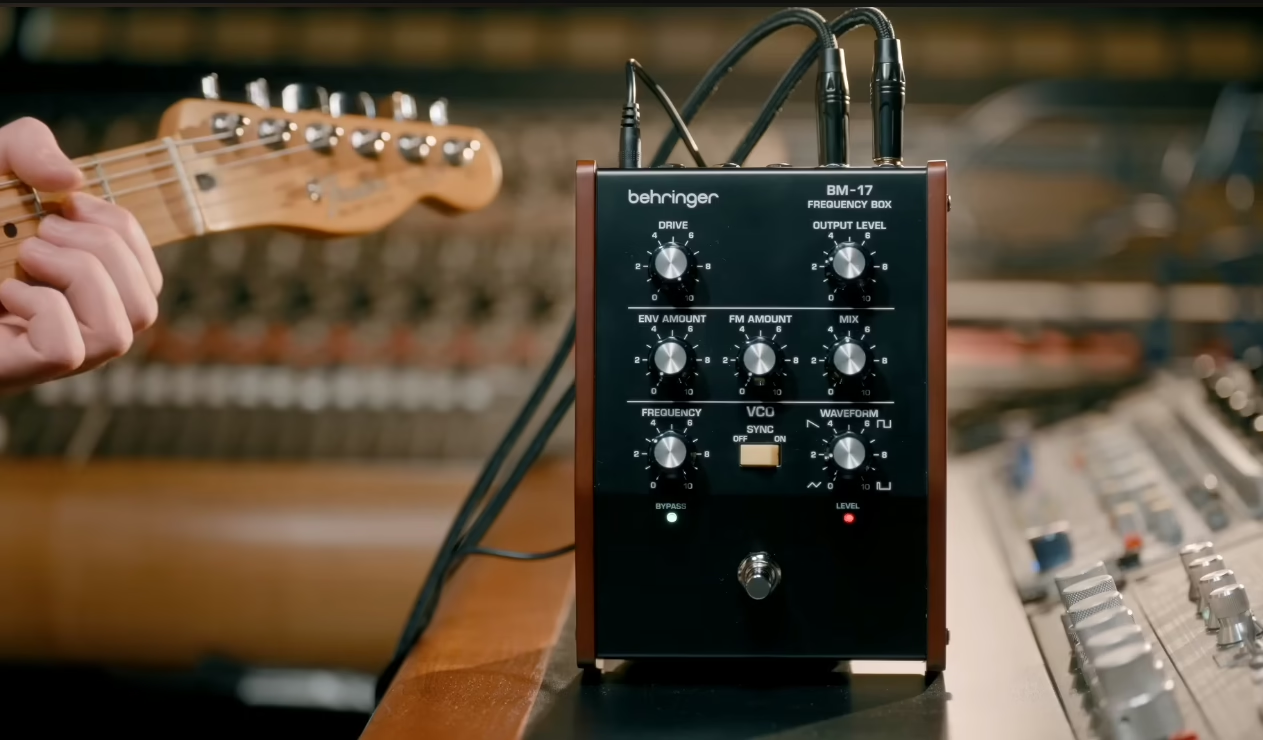
With the BM-17 Frequency Box, Behringer brings the spirit of the legendary Moogerfooger MF-107 FreqBox from Moog into a compact format: a full-blown analog oscillator controlled by the input signal, not just another distortion. Where most guitar pedals stick to drive or filtering, the BM-17 behaves much more like a self-contained synthesizer voice that you control with a guitar, bass, synth or any audio source.
Offered at $109 on pre-order, it lands in a virtually empty niche: affordable analog “synth pedals” inspired by the Moogerfooger line, at a time when the original MF-107 is either impossible to find or goes for serious money on the used market. For demanding musicians who want to inject genuine modular-style logic into a pedalboard, the BM-17 is one of the very few options at this price point.
Understanding the BM-17: a frequency pedal, not yet another overdrive
At the heart of the BM-17 is an analog VCO (voltage-controlled oscillator). It’s exactly the same kind of circuit you’ll find in a modular synth or a Minimoog, simply blended here with your instrument signal.
This VCO can be controlled in three main ways:
- Manual adjustment via the Frequency knob, which sets the oscillator pitch as if you were tuning a synth.
- Envelope follower: the pedal analyses the level of your playing and derives a control signal from it. The harder you play, the more certain parameters (including frequency) can be modulated. This allows for textures that respond to your dynamics, far from a static fuzz.
- Sync mode: by engaging the Sync switch, the VCO pitch is locked to your input signal. Your guitar or synth then dictates the perceived pitch, recalling synced-oscillator tones from modular synths, with aggressive, very “biting” harmonics.
The big appeal, and where the BM-17 goes beyond a simple educational clone, is the ability to combine these control modes: by playing with the base frequency, the envelope follower and sync at the same time, you get unstable, spitting, crackling textures that are extremely sensitive to the smallest change in your playing. You’re much closer to a Eurorack module than a standard stompbox.
For guitar: from massive fuzz to “alien” textures
For a guitarist, the most relatable comparison is an extreme fuzz that gradually morphs into a true monophonic synth. Depending on the settings:
- The BM-17 can deliver huge fuzz / distortion tones, thick and rich in harmonics, ideal for massive riffs and leads that cut through the mix.
- By tweaking Sync and frequency, you move into snarling harmonic layers, those deconstructed tones where the guitar’s fundamental seems to be swallowed up by the oscillator.
- Pushing the stand-alone VCO approach, you get fully modular-style timbres: drones, vintage-synth-style leads, “alien” tones that Behringer describes as likely to make your neighbours think there’s an extraterrestrial abduction going on next door.
In practice, for a guitarist used to more conventional pedals, the BM-17 is a sound design tool rather than a simple always-on effect. It really shines for:
- Striking intros and interludes.
- Noise, shoegaze, post-rock or experimental metal sections.
- Studio textures, by doubling a traditional clean or distorted signal with the VCO output.
For synths and modular: an analog module disguised as a pedal
The BM-17 is not just for guitarists. Behringer explicitly presents it as a tool aimed at synth setups and modular rigs. Its key asset: very generous rear-panel connectivity with CV I/O (control voltage) and dedicated outputs:
- Envelope follower output: you can tap the envelope follower generated by the BM-17 to modulate a filter, VCA or another module in a modular system.
- Oscillator output: the BM-17 oscillator can be used as a stand-alone external VCO, exactly as if you were adding a small analog module to your rack. This effectively turns the pedal into a compact analog sound module.
- CV / expression input(s): you can control certain parameters from an expression controller or an external CV source, opening the door to sequences, external LFOs and complex modulations.
For a modular user, the logic is clear: the BM-17 acts simultaneously as a full-fat VCO, an envelope follower and a distortion / mixing block in a stage-ready enclosure. At £99, that makes it one of the most cost-effective ways of adding a complete analog oscillator plus some control utilities to an existing system.
BM-17 vs. Moogerfooger MF-107: clever tribute or low-cost copy?
The original Moogerfooger MF-107 FreqBox has an almost mythical status: a rare pedal, used prices climbing steeply, deep CV integration and that unmistakable Moog sound. The BM-17 is clearly inspired by this concept: an analog VCO driven by the input signal, with envelope follower and CV interfaces.
The major differences play out on several fronts:
- Price point: at €109, the BM-17 sits in a completely different universe from used MF-107 units. It’s much more of an aggressively priced entry-level product than a collector’s piece.
- Sound identity: even if the circuit philosophy is similar, the Moog signature of the MF-107 (VCO, filtering, headroom) simply can’t be replicated identically at this price. You should therefore see the BM-17 as an inspired tool, not a 1:1 clone.
- Build and format: the BM-17 is announced in a compact, rugged enclosure, typical of recent Behringer pedals, designed to withstand gigging. It’s a far cry from the luxurious feel of the old Moogerfoogers, but in terms of features vs. footprint, the BM-17 clearly comes out ahead.
For any musician who has been dreaming of a FreqBox but doesn’t want to hunt down vintage gear or drop a small fortune, the BM-17 is, in practical terms, the easiest way right now to access this kind of analog frequency processing.
In the studio and on stage: how to integrate the BM-17 into an advanced setup
The best way to approach the BM-17 is to think of it as a self-contained modular block to be placed strategically in your signal chain.
On a guitar or bass pedalboard
- After your drives / fuzz: to exaggerate the harmonics already generated and move into almost synth-like territory.
- Before delays and reverbs: so you can open up those “alien” sounds in space and create very wide soundscapes.
- In parallel (via a looper or switcher): to blend a “normal” tone with the BM-17 in an insert loop, which is very effective in the studio.
In a synth / modular setup
- As an extra VCO: using only the oscillator output into an external filter or VCA.
- As a CV generator: using the envelope follower output to bring other modules to life.
- As controlled distortion: sending an already modulated synth into the BM-17 to push analog saturation to the limit.
The mix of an aggressive price, a claimed roadworthy build and rich connectivity makes the BM-17 particularly appealing to musicians who regularly move between studio and stage and want to keep a versatile analog core in their gig bag.
A price-to-features ratio that’s hard to ignore
At £99 on pre-order, the Behringer BM-17 Frequency Box sits right at the crossroads between:
- The world of classic guitar pedals, where this kind of budget usually buys you a mid-range overdrive or fuzz.
- The modular world, where a quality analog VCO, an envelope follower and a handful of CV I/O will easily cost more once you add them up.
You can debate endlessly about the ethics and strategy behind Behringer drawing on all-time classics, but from a strictly user perspective, the takeaway is clear: for a very modest outlay, the BM-17 offers a genuine analog frequency laboratory that used to be the preserve of far more expensive niche pedals.
The pedal is now available to pre-order. Early adopters looking to expand an experimental pedalboard, a modular rig or a hardware synth setup are likely to see it quickly as a serious option.
FAQ: getting the most from the Behringer BM-17 Frequency Box
Is the BM-17 suitable for a “classic” guitar pedalboard?
Yes, as long as you know what you’re after. The BM-17 is not a transparent overdrive or a simple boost: it produces synth tones, ultra-dense fuzz and chaotic textures. If you mostly play more traditional rock, pop or funk, it will be more of a one-off special effect than a permanent part of your core sound. For experimental rock, shoegaze, extreme metal or cinematic atmospheres, it can easily become central.
Can I use the BM-17 without an instrument, purely as a little synth?
Yes. The internal VCO can run as a stand-alone source. You can let the oscillator “run” and tune it with the Frequency control, then treat that signal like a synth module: filter it, modulate it with other effects, and so on. With its dedicated outputs (oscillator and envelope follower), it can even serve as a building block for a compact analog setup without any other hardware.
Does the BM-17 really replace a Moogerfooger MF-107 FreqBox?
No, it’s not a like-for-like replacement. The MF-107 remains its own thing, with the Moog signature sound, build and collectable status. However, if you’re after the same overall philosophy – an analog oscillator driven by your instrument, with envelope follower and CV integration – the BM-17 offers a modern, more compact and, crucially, far more affordable take on it. For day-to-day creative use, it’s a very credible alternative.
What’s the point if I already own a well-stocked modular system?
At first glance the BM-17 might seem redundant, but it offers several advantages: a VCO + envelope follower + distortion all in one self-contained box, immediately usable outside the rack, and at a price far below the cost of equivalent separate modules. It’s particularly interesting if you want to take part of your modular logic on stage without carting your whole case around, or if you need a backup VCO and some extra CV generation for complex patches.