Avec le SDS-3, Behringer remet en circulation un morceau d’histoire de la batterie électronique : le célèbre drum synth Simmons SDS-3 de 1978, recréé sous la forme d’un drum synth analogique moderne, au format Eurorack et proposé autour de 249 $, pour un prix public d’environ 250 € à un peu moins de 300 € chez les revendeurs européens. Le module vise clairement les beatmakers, les batteurs hybrides et les utilisateurs de systèmes modulaires qui recherchent des sons de drums 80’s sans passer par des banques de samples.
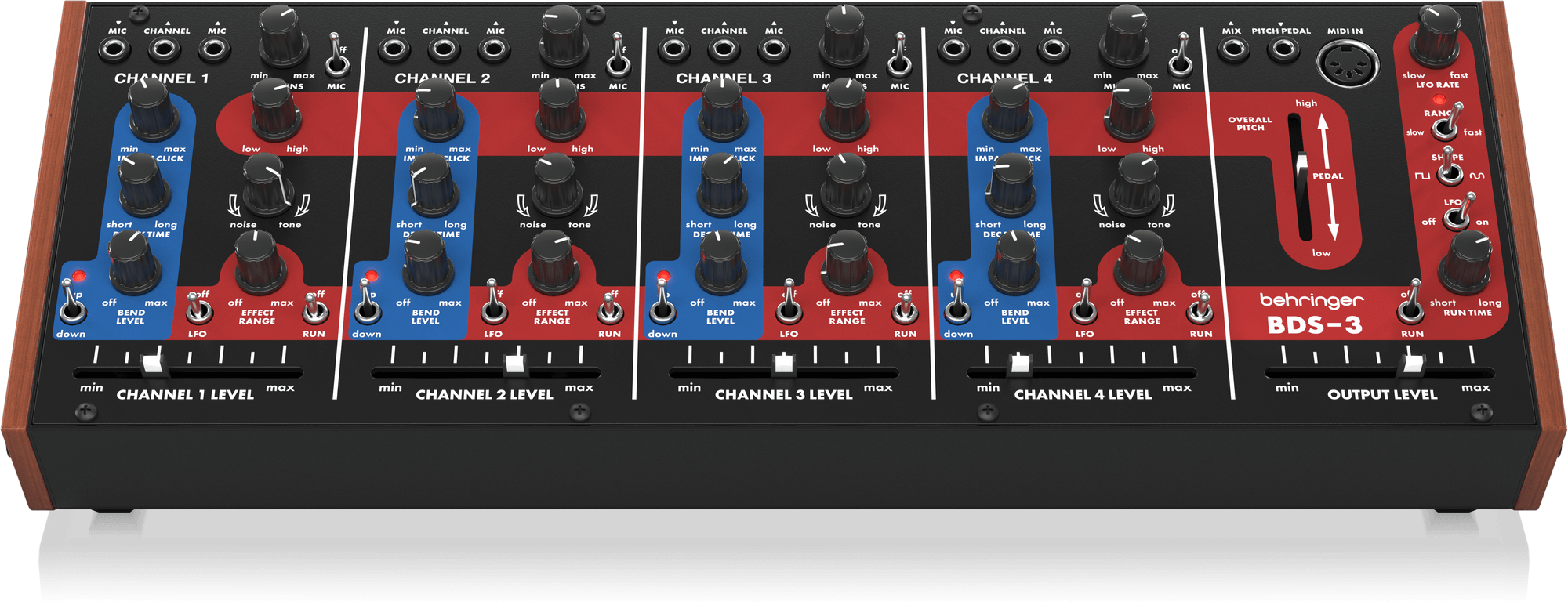
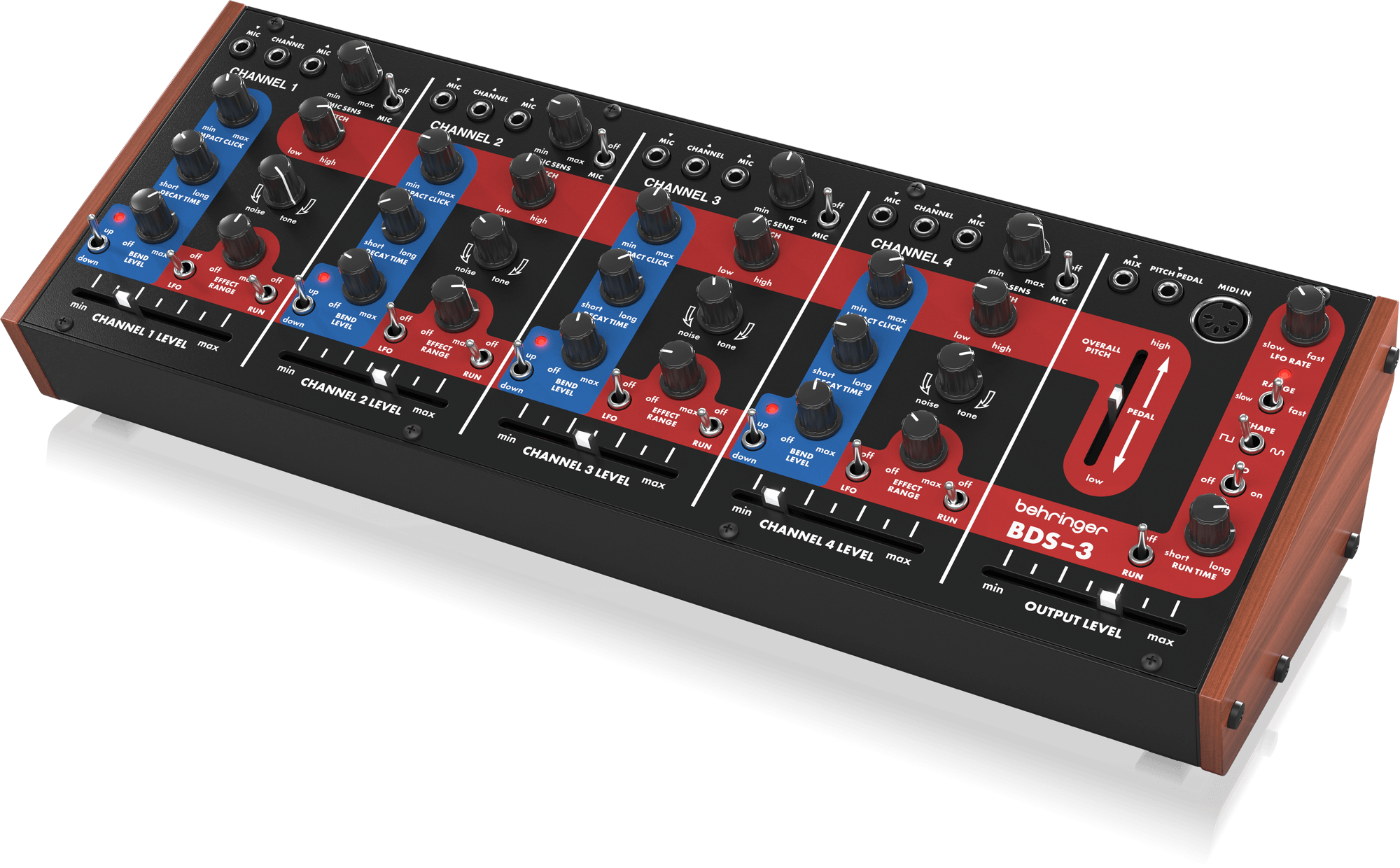
Ce clone du Simmons SDS-3 adopte une approche très directe : quatre voix de synthèse de batterie analogique, un canal d’effets, une façade remplie de potentiomètres et de faders, sans écran ni menus, et une connectique qui facilite l’intégration autant en home studio qu’en live ou dans un module Eurorack batterie.
From Simmons to Behringer: a brief history of the SDS-3
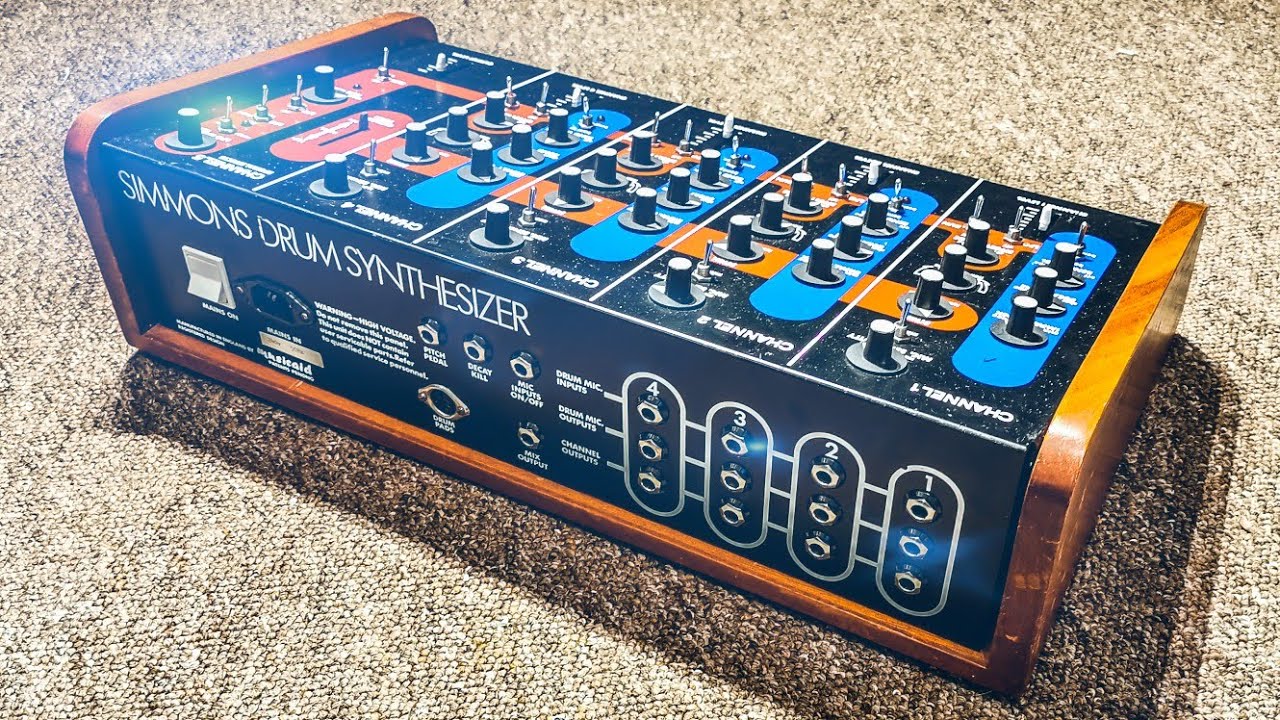
The original SDS-3, forerunner of the SDS-V and the 80s Simmons kits
The original SDS-3 appeared in 1978 as one of the first analog drum synthesizers from Simmons. It was a four-channel desktop module, used with Premier pads, which became the foundation for the brand’s later developments, notably the SDS-V, the first complete Simmons electronic drum kit with the famous hexagonal shells. The SDS-3 therefore sits right at the very beginning of the Simmons drum line that would go on to define much of the 80s sound.
The architecture of this first SDS-3 already laid the foundations for what would make the brand’s reputation: very distinctive tom and percussion sounds, built from analog oscillators, noise generators and pitch envelopes, capable of producing the characteristic glissandos of electronic drums of the era.
Why the SDS-3 had remained a hard-to-find “holy grail”
The SDS-3 was never produced on a large scale, and its original, strictly desktop format doesn’t fit particularly well with today’s setups built around racks, modular systems and compact rigs. Add to that the age of the circuitry, the rarity of units in good condition and the maintenance required for heavy use, and it had become more of a collector’s item than an everyday workhorse.
By translating this concept into a modern module, Behringer is aiming to make the Simmons SDS-3 sound accessible again, this time in a format that’s easy to integrate, with up-to-date connectivity (MIDI, USB, individual outputs, Eurorack compatibility) and far wider availability via the brand’s usual distribution network across Europe and the UK.
What the Behringer SDS-3 brings in 2025
Four analog drum synth voices and one modulation channel
The Behringer SDS-3 takes the core idea of the original model: four identical analog drum synthesis channels, plus a fifth channel dedicated to effects and modulation. Each channel can produce kicks, toms, percussion, gongs, bells, cymbals and other percussive sounds, depending on how you set the parameters. Retailers clearly pitch it as a 4‑channel analog drum synth that can quite easily form the core of an electronic drum kit on its own.
Diode ladder filter, noise generator, level sliders, pitch, bend, decay, impact click
On each channel, the SDS-3 offers a set of controls inspired by the original SDS-3, with several modern additions. The documentation and product pages from retailers mention in particular:
- a Pitch control for the main pitch of the voice;
- an Impact Click parameter to add the attack click that’s so typical of Simmons drums;
- a Decay Time control to set the length of the sound;
- a Bend Level control (positive or negative) that sets the depth of the pitch glissando;
- a Noise/Tone Balance control to blend the noise component with the tonal component;
- an Effect Range parameter that sets the amount of modulation (LFO / sample & hold) per channel;
- a channel volume slider for direct mixing.
The product sheets also list a diode ladder filter and an analog noise generator, which makes it possible to create synthetic cymbal and hi-hat sounds as well as more experimental percussive textures. The whole thing stays very faithful to the original philosophy: a very readable front panel with sliders and knobs designed for hands-on, real-time tweaking.
LFO, sample & hold and Run Time effect for continuous pitch sweeps
The SDS-3’s effects channel handles global modulation. It includes in particular:
- an LFO with at least two waveforms (square and sine) and two speed ranges, capable of reaching audio rates;
- a sample & hold circuit to generate random variations in pitch or timbre;
- a global pitch control affecting all channels;
- the Run Time function, which allows for very pronounced continuous pitch sweeps, highlighted in MusicRadar’s write-ups.
Each channel has an Effect Range parameter that determines how much modulation it receives, allowing you to keep some sounds stable while others are highly animated. For techno, electro or synthwave producers, this kind of modulation is particularly useful for evolving drum patterns over time.
Studio and live integration: more than just a “vintage module”
Trigger / mic inputs for playing with real drums
The SDS-3 offers, for each channel, a mic/trigger-type input as well as an individual audio output. Product pages and the Audiofanzine news item mention these inputs, which let you trigger the sounds from drum triggers, electronic drum pads or trigger signals coming from other machines.
For an acoustic drummer looking to hybridise their kit, a typical configuration would be to place triggers on the toms and snare, route the triggers to the SDS-3’s inputs, then send the individual outputs to a mixing desk or audio interface. The module then becomes an analog extension of the kit, focused on Simmons-style sounds, without the need to cart around a fragile vintage unit.
MIDI, USB, individual outputs and master out
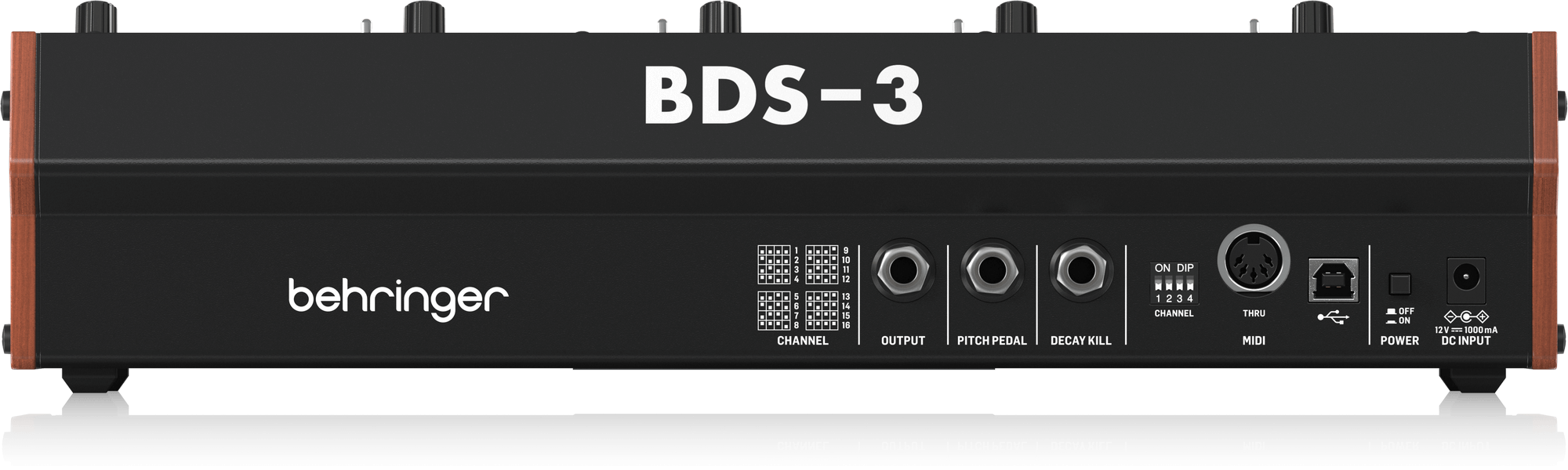
On the digital connectivity side, the SDS-3 features a DIN-format MIDI input, a MIDI Thru output and a USB‑B port for direct integration with a computer or DAW. It can therefore be sequenced from a DAW, a hardware controller or a MIDI‑capable drum machine, without having to rely on analog triggers.
For audio, the Thomann product pages and other retailers mention:
- four individual analogue outputs for the drum channels;
- a mix output on both 3.5 mm and 6.35 mm jacks, handy for sending the whole kit to an interface or console;
- a pitch pedal input (Pitch In) to control the global pitch of the sounds;
- a Decay Kill input for a footswitch, which instantly cuts the decay of the voices.
This combination of individual outs and a master out makes the module usable both in a simple configuration (a single cable to your audio interface) and in a more advanced setup, with separate processing for each voice in the mix.
Using it with a sequencer or drum machine
The SDS-3 doesn’t have an internal sequencer: it’s designed as an analog drum synthesis engine to be integrated into an existing system. It can be triggered:
- via MIDI or USB‑MIDI from a DAW, a hardware sequencer or a digital drum machine;
- via the mic/trigger inputs, from drum pads or gate signals coming from a modular system.
In a home studio, a common scenario is to use a digital drum machine for sequencing while sending certain tracks (toms, special percussion, kick layers) via MIDI to the SDS-3. The module’s individual outputs are then recorded and processed separately, letting you keep the stability of an in‑the‑box workflow while adding the colour of an analog drum synth.
What kind of sounds can you expect from the SDS-3?
Kicks, snares, toms, cymbals, hi-hats and experimental textures
Descriptions from Thomann and Gear4music make it clear that each SDS-3 channel can generate a wide range of sounds: kicks, toms, percussion, gongs, bells, cymbals and more. In practice, the combination of oscillator + noise + pitch envelope covers most elements of an electronic kit:
- kicks and toms with more or less pronounced pitch glides;
- snare drums that lean towards noise, with an adjustable noise/tonal blend;
- synthetic cymbals and hi-hats based on filtered noise;
- metallic sounds and abstract percussion by playing with pitch and modulation.
The “Simmons drum synth” character is very much there: the clicky attack, snappy envelopes and pronounced pitch transitions instantly deliver an 80s-flavoured sound, but the scope goes well beyond that as soon as you push the modulation and decay times.
How it responds to saturation and external effects
Thanks to the individual outs, each SDS-3 voice can be treated separately with an external effects chain: compressor, distortion, delay, reverb, filters and so on. Retailers emphasise the module’s fully analogue approach, which means its response to saturation will depend directly on whatever you place after the output, just like on a classic analogue drum machine.
Typically, you might:
- send a kick to a compressor or saturator to beef up the impact;
- route a heavily modulated channel into a delay or reverb to create atmospheric textures;
- keep processing minimal to retain very sharp transients in a techno or electro mix.

Alternatives and complementary gear
Other analog drum synths (HexDrums, Erica, etc.)
The SDS-3 is part of a broader trend: the return of analog drum synths. Among the alternatives mentioned in the specialist press, you’ll often see Erica Synths’ solutions (such as the HexDrums systems and various Eurorack percussion modules), as well as other analogue, drum-focused modules. These products are often positioned at a higher price point or in different formats, but they address the same need: regaining direct, hands-on control over drum sound synthesis without relying on samples.
For a Eurorack user with an existing setup, the SDS-3 can also complement your current percussion modules by adding a dedicated voice for Simmons-style sounds and those recognisable tom glides, while leaving other modules to handle more conventional kicks or more experimental sounds.
SDS-3 as a counterpart to a digital drum machine
In a home studio, the most obvious scenario is to use the SDS-3 as an analogue counterpart to a drum machine or digital sampler:
- the drum machine handles sequencing, sample-based sounds and general-purpose kits;
- the Behringer SDS-3, triggered via MIDI or triggers, delivers the Simmons sounds, gliding toms, metallic percussion and analog layers that you then process individually.
This kind of setup lets you easily enhance an existing rig without having to overhaul it: the drum machine still provides the backbone of the groove, while the SDS-3 adds a very recognisable sonic signature, particularly well-suited to techno, electro, synthwave productions and hybrid drummer setups.
https://www.youtube.com/watch?v=nOd-TCJS2Bg
Behringer SDS-3 FAQ
Is the Behringer SDS-3 enough to replace a full drum machine?
The SDS-3 offers four analog drum synth voices and one effects channel, but it doesn’t have a built-in sequencer. It can absolutely be the main sound engine of an electronic drum kit, provided you pair it with a sequencer (DAW, drum machine, hardware or modular sequencer). To replace a fully self-contained drum machine, you’ll therefore need at least one external sequencer.
Can you use the SDS-3 without a full Eurorack setup?
Yes. The SDS-3 ships in a metal desktop chassis with wooden side panels and an external power supply. You can simply place it on a desk and use it as a standalone device. The internal synth module can be transferred into a standard Eurorack case later on, so you can integrate it into a modular system without having to buy the whole thing again.
Is the SDS-3 suitable for an acoustic drummer wanting to hybridise their kit?
Yes. The per-channel mic/trigger inputs allow you to trigger the SDS-3’s sounds from pads or from drums fitted with triggers. The drummer can route each individual output to a mixing desk or audio interface and balance the acoustic and synthetic sound in the mix. It’s a practical way to add Simmons-style sounds to an acoustic kit without investing in a vintage module.
Can you use the SDS-3 purely over MIDI or USB, without audio triggers?
The module accepts MIDI notes via the DIN input and via the USB‑B port. It is therefore perfectly possible to use it exclusively over MIDI/USB, sequenced from a DAW or controller, without using the mic/trigger inputs at all. This configuration will particularly suit home‑studio producers who mainly work in the box.
What’s the difference between the mix output and the individual outputs?
The mix output combines the four drum synth channels into a single stereo or mono signal, which is handy for simpler setups or for monitoring. The individual outputs, on the other hand, let you send each channel to its own input on your mixer or audio interface, so you can apply processing (EQ, compression, saturation, effects) tailored to each element of the kit. To really get the most out of the SDS-3 at the mixing stage, the individual outputs are strongly recommended.