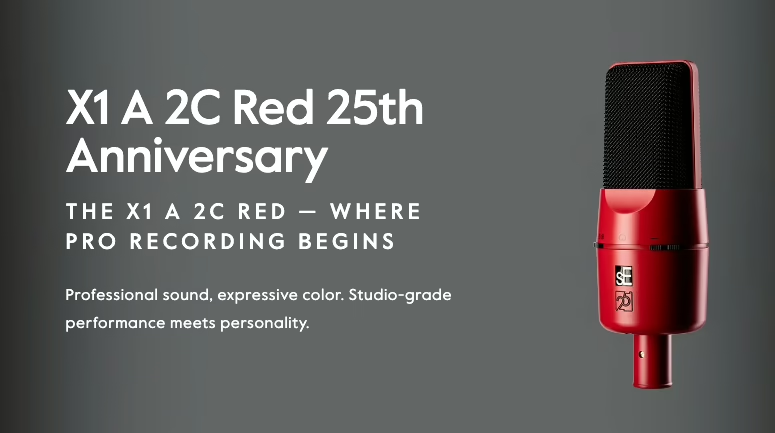
For the brand’s 25th anniversary, sE Electronics is releasing its X1 A in a limited two-tone series: red or white, same circuit, same capsule, but with a look tailored for video and streaming. Behind the anniversary effect, it remains a very serious condenser mic in its price range, able to compete with the budget benchmarks on the market.
Who is the sE X1 A 2C 25th Anniversary really for?
Before talking colours, it’s worth placing this X1 A 2C in today’s landscape:
- Content creators / streamers: you’re on camera all the time. A red or white metal mic with a clean design becomes part of your set and branding, without sacrificing audio quality.
- Project studios and demanding home studio users: you’re looking for a proper XLR cardioid condenser, robust, and able to stand comparison with entry-level classics like the Audio-Technica AT2020, Rode NT1-A (previous generation) or AKG P120.
- Sound engineers / backline: you need a simple, reliable, inexpensive mic collection, but one that can handle high sound pressure levels without flinching, on sometimes aggressive sources (brass, percussion, guitar amps).
In all three cases, the X1 A 2C does not change the sound compared with the standard X1 A: it uses the same cardioid condenser mic with internally shock-mounted capsule, but showcases it with a red or white metal body and the same rugged build.
What this red and white edition does (and does not) change
The X1 A 2C 25th Anniversary models are first and foremost X1 A microphones. In practical terms:
- Same acoustic design: large-diaphragm capsule, a “focused” cardioid pickup pattern to limit unwanted room noise – a real asset in an untreated home studio.
- Same full-metal construction: metal body and grille, designed to withstand transport and frequent setups/tear-downs.
- Same capsule on internal suspension: reduces handling and structure-borne noise (stand vibrations, desk, etc.) without necessarily needing an external shockmount from day one.
The true novelty is cosmetic and strategic: bright red or pure white, allowing it to blend naturally into a video-oriented setup. Where a black mic tends to “disappear”, the X1 A 2C can instead become a visual signature for your channel.
Do note, however: this is a limited edition. Once stocks are gone, the range will in principle revert to the standard X1 A with its more classic black design.
And what about the price?
The X1 A 2C 25th Anniversary is listed at around €129.00 (also quoted at $127.00 / £108.00 / €129.00). This firmly puts it in the affordable condenser territory, but with technical specs that already look towards the upper end of the budget segment.
The X1 A: a modern standard for affordable condensers
To understand the appeal of this 25th Anniversary edition, you need to go back to the basics: the original X1, then its evolution, the X1 A. As early as 2016, the X1 A marked a real qualitative leap in the entry-level market, with figures previously seen mainly on noticeably more expensive models.
Its key features include:
- A specifically developed capsule, capable of handling up to 150 dB SPL – an extremely high level for a studio mic at this price.
- An integrated windscreen, useful for close-up vocals or certain instruments, without having to add external accessories.
- A gold-plated XLR connector, to ensure good conductivity and better long-term resistance to oxidation.
In practice, this trio – high SPL handling, cardioid pattern and solid rear rejection – makes it very forgiving for beginners: less risk of clipping during recording, less room noise, and a sound that is quickly usable, even in an environment that is far from acoustically ideal.
Compared with the key market references
If you compare the X1 A (and therefore this X1 A 2C 25th Anniversary) with the big names in this segment:
- Versus an Audio-Technica AT2020: the X1 A generally offers higher SPL tolerance and a slightly more “robust” approach to loud sources, which makes it relevant on drums or cranked guitar amps.
- Versus a Rode NT1-A (previous generation): the NT1-A focuses on extremely low self-noise for delicate vocal recordings in a quiet studio. The X1 A positions itself as a versatile tool, more forgiving in less controlled environments.
- Versus the AKG P120/P220: you are still in a similar family, but the X1 A is often noted for its particularly strong price-to-performance ratio and its “ready for anything” character in a home studio.
For a content creator or musician without a treated space, this profile is often more relevant than a hyper-neutral mic that is very demanding regarding room acoustics.
Video, streaming and visual identity: why colour matters
In today’s world of video podcasts, Twitch streams, YouTube channels, the mic is no longer just an audio tool. It appears clearly on camera, sometimes at the centre of the frame.
The X1 A 2C 25th Anniversary leans into this:
- Red version: perfect for gaming universes, high-energy music, or highly stylised channels.
- White version: ideal for minimalist setups, bright environments, or content focused on education, tech, or “clean” podcasts.
All with a coherent look: metal body, understated design, no overload of LEDs or gimmicks. It remains a studio microphone, but one that is happy to be seen.
The V Series dynamics: the live counterpart to the X1 range
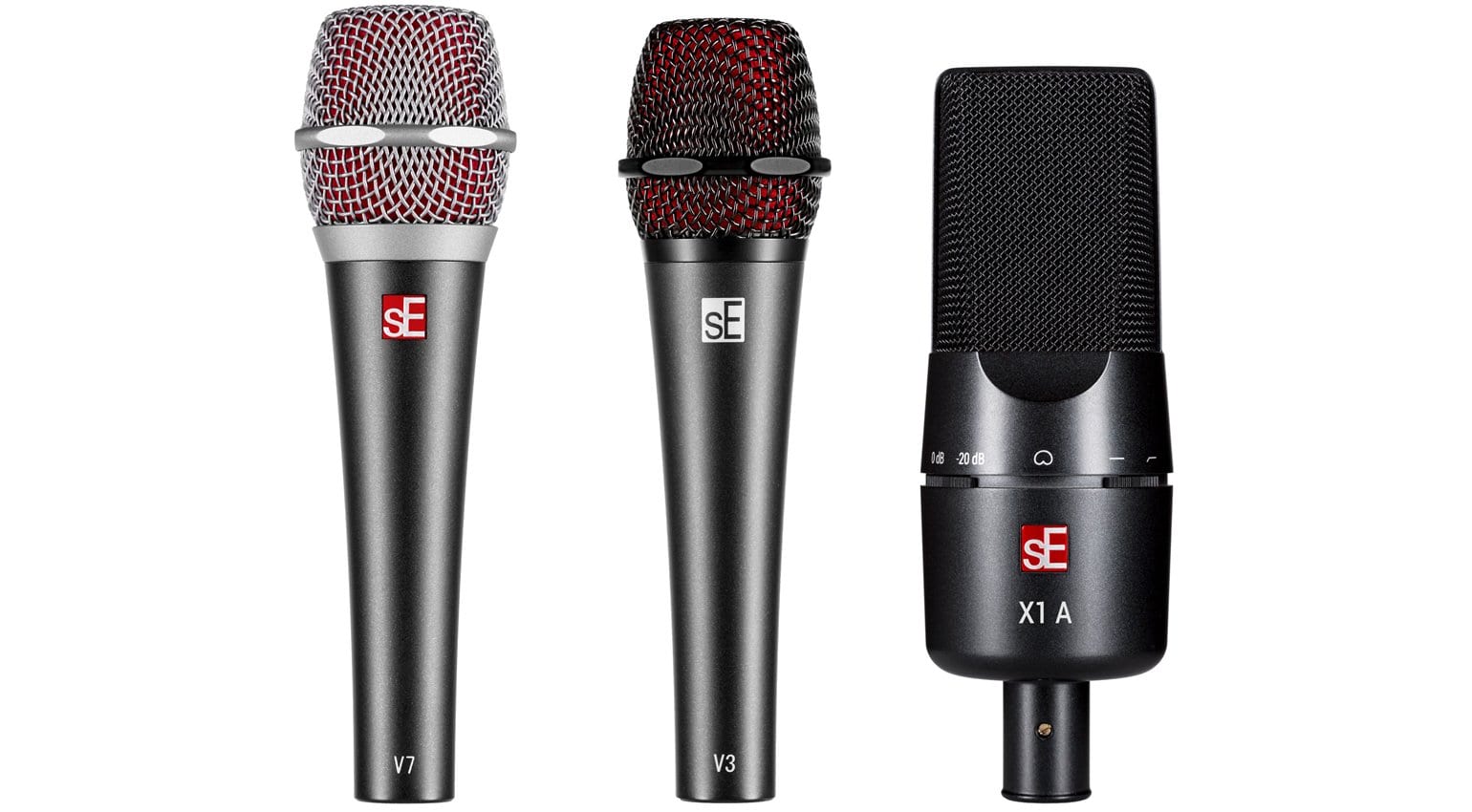
Alongside this X1 A edition, sE Electronics is also developing its range of dynamic microphones with the V Series, originally designed for live performance but perfectly usable in the studio or home studio.
V7: supercardioid for chiselled vocals
The V7 is a supercardioid dynamic mic, advertised for “crisp” vocals, meaning pronounced articulation and presence. Priced close to the timeless Shure SM58, it clearly aims to offer a more modern alternative:
- Tighter pickup pattern than a standard cardioid, so more side rejection and better source isolation in noisy environments.
- A sound signature often perceived as more defined in the upper midrange, helping vocals cut through the mix without heavy EQ.
In a home studio, a V7 can also be an excellent backup (or main) option for spoken voice if the room is truly unsuitable for a condenser.
V3: cardioid all-rounder for vocals/instruments
The V3 uses a more traditional cardioid pickup pattern, with more forgiving positioning behaviour. It is designed as a true all-rounder:
- Sung or spoken vocals, rehearsals, gigs, simple live recordings.
- Amplified instruments (guitar, bass), percussion, brass, etc.
Price-wise, the V3 and V7 sit on either side of the SM58, with the ambition of offering a more refined sonic character for users who already know the Shure standard sound and want an alternative with more personality.
Back to the “classic” X1 A: strengths and limitations
In real-world use, the X1 A has earned its reputation because it ticks several boxes that are rarely combined at this price point:
- Very respectable audio quality: neutral enough to suit most voices and instruments, without extreme coloration that would limit its uses.
- 150 dB SPL handling: you can place it in front of a snare, tom, cranked guitar amp or brass section without living in constant fear of clipping.
- Healthy behaviour in the mix: recordings are easy to process, without weird artefacts or phase issues that are common on some ultra-cheap mics.
Its limitations are mainly linked to its price segment:
- The very finest details, especially in silky top-end frequencies, remain the domain of higher-end microphones.
- The integrated windscreen can sometimes give the impression of a slight loss of micro-detail on very soft voices, compared with a bare high-end condenser paired with a good external pop filter.
But in its price context, the X1 A remains one of the best price/performance ratios for entering the world of serious XLR condenser mics without ending up with disposable gear.
FAQ: choosing and using the sE X1 A 2C 25th Anniversary
Is the X1 A 2C 25th Anniversary suitable for podcasting and streaming?
Yes, absolutely. Its cardioid pattern reduces room pickup, which is valuable in an untreated office or living room. The audio quality is more than good enough for professional podcasts and streams. On top of that, the red and white versions reinforce your on-screen visual identity. You will just need an audio interface with 48 V phantom power and, ideally, a pop filter or good mic positioning.
Can you use the X1 A 2C on loud instruments (drums, electric guitar)?
Yes. With a 150 dB SPL handling, it is comfortable in front of a snare, tom, guitar amp or powerful brass. This is actually one of its key advantages over some more fragile competitors. As always with a condenser, pay attention to placement and input gain, but you are well within its comfort zone.
What is the sound difference between the X1 A 2C and a dynamic mic like the SM58 or V7/V3?
The X1 A 2C, as a condenser, will generally offer more detail, better high-frequency response and a more precise image, ideal for studio use and clean spoken voice. A dynamic like the SM58 or V7/V3 will be more forgiving with feedback and very noisy environments, with a sound that is often “tighter” and less detailed. For recording in a relatively quiet home studio, the X1 A 2C will often be more flattering; for live use or a truly terrible-sounding room, a dynamic mic may still be more appropriate.
If I already own a black X1 A, does this 25th Anniversary edition bring any audio improvement?
No. According to the available information, the X1 A 2C 25th Anniversary follows the same design: same type of capsule, same cardioid pattern and same general construction. The change is essentially aesthetic (red or white) and related to the limited nature of the series. If you already have an X1 A and are happy with it, the main interest of this edition would be to complement your setup with a second mic that sounds identical but looks visually distinct.