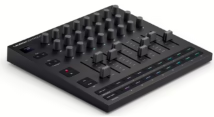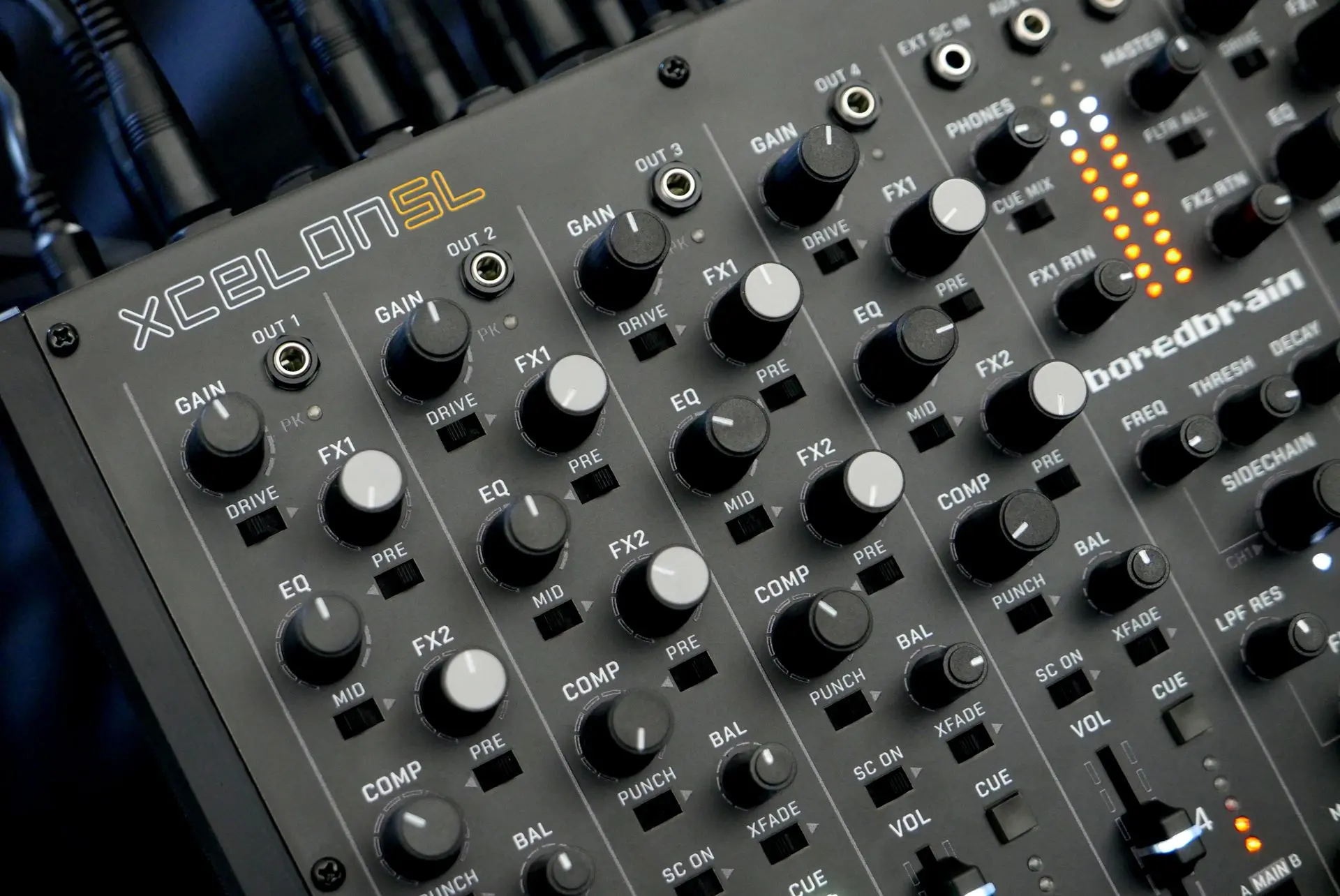
With the Xcelon SL, Boredbrain has created exactly the kind of product the electronic live scene has been asking for: an analogue performance mixer designed simultaneously for hardware musicians, Eurorack setups and DJ-style workflows. Where a studio console often stays static, this Xcelon SL instead encourages hands-on playing, dramatic transitions and real-time texture changes.
For what kind of live set is the Boredbrain Xcelon SL really interesting?
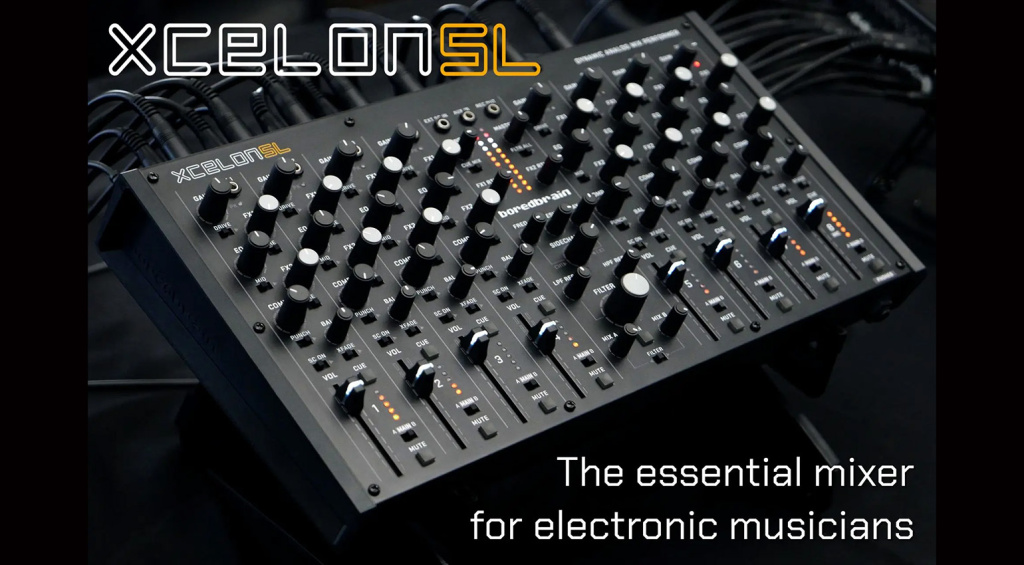
The positioning of the Xcelon SL is clear: it targets complex electronic live sets where drum machines, synths, grooveboxes, Eurorack systems and sometimes a vocal or additional instrument all coexist. Where a simple little analogue mixer often lacks character and performance features, Boredbrain stacks up:
- 8 channels, mono or stereo, to host several machines without compromise
- a drive section per channel to dirty up or boost sources
- an EQ with switchable mid band to precisely sculpt key elements (kick, bass, lead, vocals)
- a compressor with punch boost on every channel, plus sidechain
- a crossfade per track, similar to a club mixer or a stems system for DJs
So the philosophy is closer to an Allen & Heath Xone or a PLAYdifferently Model 1 in terms of performance approach, while still firmly belonging to the world of the analogue mixer for hardware musicians. The big difference: direct integration with the Eurorack world, Boredbrain’s home turf.
Channels, drive, EQ, compression: how does the Xcelon SL stack up against conventional mixers?
The Xcelon SL’s 8 channels are not just “full of knobs”: they bring together functions that are usually scattered between the console, pedals and outboard rack. For a live musician, that reduces the number of elements to manage and centralises all key performance gestures.
Drive and gain: a real sound design tool, not just for “pushing the level”
Each channel features a gain control and a drive switch. On a studio console, gain mainly serves to set the input level. Here, it becomes a creative tool:
- in clean mode, it lets you exploit analogue headroom for a punchy mix
- with drive engaged, you can add grit to drum machines, thicken a bass or make a lead scream without multiplying external distortion units
In today’s ecosystem, very few performance-focused mixers offer this type of per-channel drive. You’d normally look at boutique consoles or creative use of coloured preamps. Here, it’s built in and designed to be played.
EQ with mid switch: a more musical, less “corrective” approach
Each channel’s equaliser is equipped with a mid switch, allowing you to target the midrange differently. For an electronic live set, that’s crucial:
- adapting the midrange to the role of the track (kick vs vocals vs lead vs pads)
- letting a dense mix “breathe” without resorting to complex external processors
Compared with a small consumer analogue mixer, this is closer to a compact studio console EQ section, but clearly optimised for stage use: few parameters, but carefully chosen.
Compressor with punch boost: a devastating weapon for electronic music
Every channel includes a compressor with a punch boost mode. In the context of electronic music, this is particularly relevant:
- tightening up a drum machine or bass live without wheeling out a rack of compressors
- adding “smack” to a kick or bite to an MC vocal
Few musician-oriented live mixers offer a channel compressor, and fewer still with a punch function. You might find that on some digital desks or pricier stage consoles. Here it’s fully analogue, which will appeal to anyone seeking immediate response and natural saturation.
Central filter, sidechain, crossfader: the deliberate bridge to the DJ world
The core of the Xcelon SL’s proposition is its ability to play the mix like a DJ would, but with an architecture designed for live musicians.
DJ filter in the centre: a gesture that’s become standard on stage
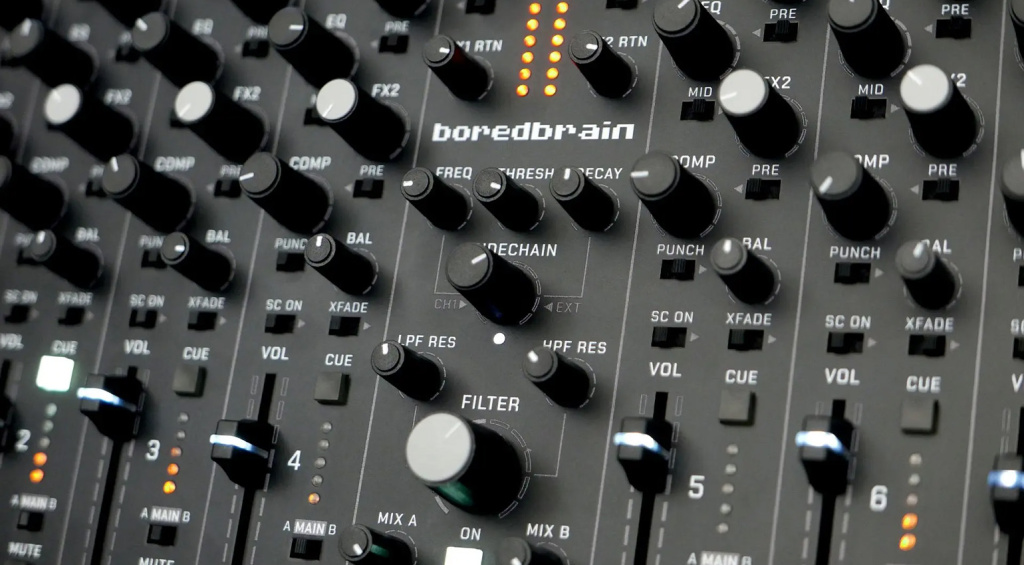
At the centre of the Xcelon SL you get a DJ-style filter with continuous sweep from low-pass to high-pass and separate resonance controls for each mode. It’s the kind of filter found on high-end DJ mixers, valued for:
- cutting the low end or top end of an entire mix in a single move
- shaping build-ups and drops typical of techno, house, drum & bass, etc.
- avoiding complex gestures across all tracks just to create a breakdown
In practice, this filter allows the performer to tell a story with the mix itself: you get close to the language of club DJs, but applied to a live hardware setup.
Built-in sidechain: the “pump” without a patching nightmare
Another key function for electronic music is the sidechain tied into the channel compressors. The Xcelon SL provides controls for:
- frequency
- threshold
- decay
and a choice between channel 1 or an external source as the trigger signal.
This makes it easy to recreate the classic pumping effect of kicks over pads, basses or drones without plug-ins, a DAW or convoluted routing. It’s exactly the sort of feature sorely lacking on general-purpose live mixers, which often forces people to bodge together Eurorack patches or internal sidechains in drum machines.
Per-channel crossfade: a powerful tool for hybrid live/DJ sets
The Xcelon SL offers a per-channel crossfade mode. For a musician who alternates between:
- a full-hardware live set
- and pre-produced sequences sent from a sampler or computer
it’s particularly clever: you can manage transitions like a DJ, switching from one sonic “deck” to another while still keeping fine-grained control over individual tracks.
Effects and routing: two analogue sends, but no built-in DSP
The Xcelon SL includes no onboard effects (no internal reverb or delay), but instead offers:
- two analogue sends
- send pots per channel
- a pre-mix option to decide where the send sits in the signal chain
This choice is consistent with its target audience: demanding hardware musicians usually already own their favourite multi-effects (pedals, racks, 19-inch processors) and prefer a simple, reliable analogue path that’s easy to integrate. Unlike all-in-one digital mixers, Boredbrain is betting here on setup modularity rather than a closed solution.
Connectivity: one foot in the studio world, the other in Eurorack
The Xcelon SL also stands out with dual-level connectivity designed to juggle racks, desktop synths, pedals and Eurorack.
Rear panel: all the essential I/O on 1/4-inch jacks
On the rear you’ll find a full set of 1/4″ (6.3 mm) jack connections:
- stereo inputs for your synths, drum machines and other hardware
- a microphone input for vocals, MCs, announcements or creative processing
- two effects loops (stereo sends/returns)
- a master out to feed the PA or recorder
This is the standard format for studios and stages, making the Xcelon SL immediately compatible with most audio interfaces, monitor speakers and sound systems.
Front panel: minijacks for talking to Eurorack
On the front, Boredbrain leverages its modular expertise with:
- a minijack output per channel
- a stereo external input
- an auxiliary input
- a record out to capture your set
This layout is ideal for integrating an Eurorack system into a larger setup without multiplying converter boxes and odd cables. For example, you can:
- send mixer channels out to processing modules (filter, wavefolder, distortion)
- bring back submixes or modular voices on the stereo inputs
It’s a major advantage over traditional DJ mixers, which are poorly suited to modular levels and formats, and even over many generic analogue consoles that simply don’t provide this kind of front-panel integration.
Price, positioning and potential limitations
Boredbrain has so far only stated that the Xcelon SL is “coming soon”. No release date or price has been announced yet. Given:
- its fully analogue architecture
- the level of per-channel features (drive, EQ, compressor, sidechain, crossfade)
- and the likely robust build needed to withstand regular gigging
we can reasonably expect a fairly high-end product, above compact consumer mixers.
It will therefore mainly appeal to:
- electronic live performers who want a highly playable analogue nerve centre
- Eurorack users looking for an out-of-rack performance mixer that stays tightly integrated with their system
- DJs/producers increasingly leaning towards hybrid sets with hardware + decks/computers
Conversely, those looking for:
- an all-in-one mixer with built-in effects and scene memory
- or an affordable solution for occasional rehearsals
are likely to find the Xcelon SL overkill and probably too expensive for their needs.
Interested musicians can already keep an eye on Boredbrain’s announcements to be notified as soon as the price and availability details are revealed.
FAQ: choosing (or not) the Boredbrain Xcelon SL for your setup
Does the Xcelon SL replace a conventional studio mixer?
No, it is first and foremost designed as a performance mixer. It can of course be used in the studio, but its strength lies in real-time playing (central filter, sidechain, crossfade, drive, per-channel compressors). For pure mixing/post-production, a console or dedicated control surface will often be more suitable, and sometimes cheaper.
If I already have a large Eurorack system, do I need the Xcelon SL?
If your Eurorack already includes an advanced modular mixer with sidechain, filters and effect routing, the Xcelon SL will somewhat duplicate what you have. However, if your rack is heavily geared towards sound generation and you lack a command centre for live performance, the Xcelon SL can become the key piece that links Eurorack, external synths and the sound system.
Is the lack of built-in effects a real drawback?
Not for a serious electronic or modular music setup. Most performers prefer to use their favourite pedals, multi-effects or processors. The Xcelon SL’s two analogue sends are precisely there to integrate these effects very easily. If you want an all-in-one box with internal reverbs and delays, a digital mixer will be more appropriate, but you will lose the analogue character and hands-on ergonomics offered here.
Can it be used as a main DJ mixer?
Yes, technically it can: the central filter, per-channel crossfade, compressors and two sends make it a very capable platform for DJs focused on live and hybrid sets. However, it is not a standard “club mixer”: there is no dedicated phono section for turntables, nor DJ-style onboard effects like on a DJM. It will mainly suit DJ/producers who work with hardware, drum machines and synths rather than multiple record decks.