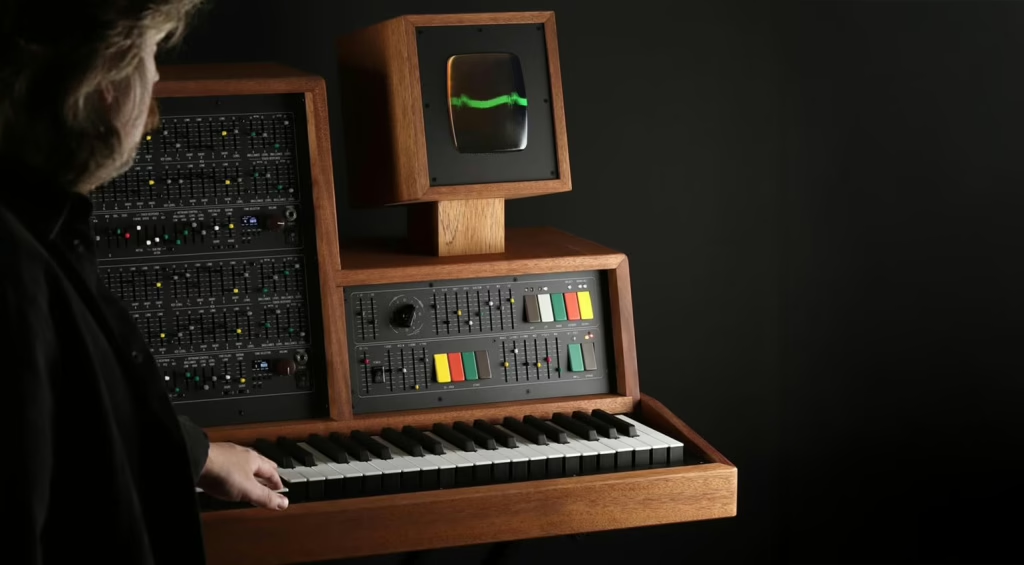
In the already very niche world of Yamaha CS-80 clones and high-end MPE synths, the Love Hultén Deckard’s Dream X2 is far more than just a “beautiful object”. It is a complete performance station, conceived as a single instrument rather than a simple stack of machines: two Deckard’s Dreams, an Expressive E Osmose MPE controller, two top-tier effects, an oscilloscope, and a custom chassis inspired by the Yamaha CS-50/CS-80.
The objective is clear: to recreate the sensory experience of a legendary large analogue synth, but with the precision, reliability and expressiveness of modern tools.
An instrument designed for expressive playing, not just collecting
On paper, the Deckard’s Dream X2 is a “simple” grouping of three synths and two effects in a custom enclosure. In practice, the choice of elements and how they are integrated reveals a very specific intention: to offer a modern, credible alternative to a full CS-80, both in terms of sound and playability.
- Two Black Corporation Deckard’s Dreams as the main sound engine, effectively a dual-layer CS-80 clone.
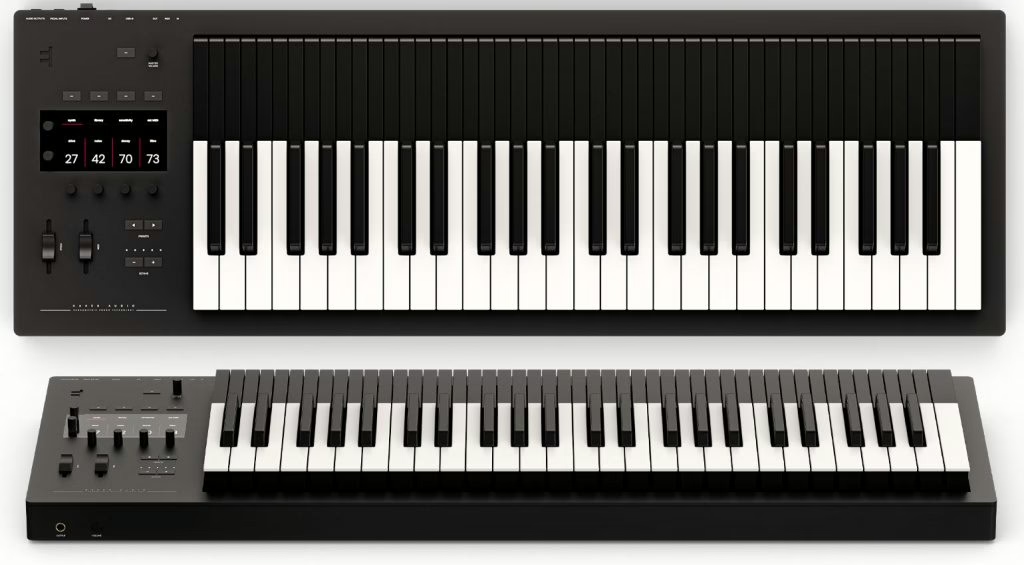
- An Expressive E Osmose as master keyboard, to fully exploit polyphonic aftertouch and MPE capabilities.
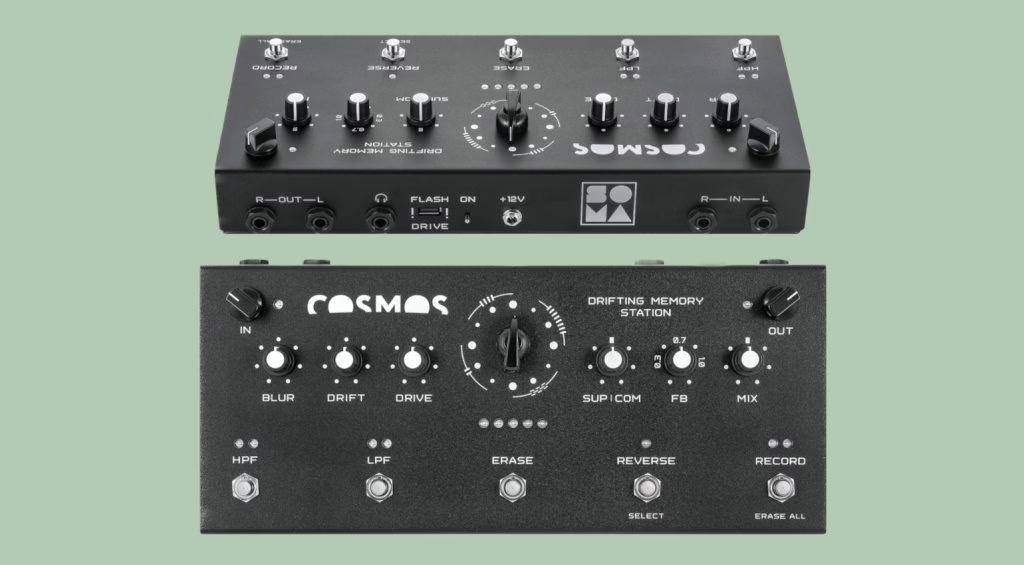
- A Meris Mercury 7 and a Soma Cosmos built in and re-housed to match the Yamaha CS look.
- An oscilloscope on a pedestal, a visual signature of Love Hultén.
It is therefore not just an Instagram-friendly “beautiful synth”: it is a fully optimised performance station for Vangelis-style cinematic sound design, expressive playing and huge, luxuriant analogue pads.
The heart of the system: two Deckard’s Dreams to recapture the excess of the CS-80
The sound foundation of the Deckard’s Dream X2 is two Deckard’s Dream units from Black Corporation. These racks are known as some of the most accomplished interpretations of the Yamaha CS-80: similar architecture, filters, envelopes, detune, and that famous ability to generate thick, expressive layers. Sonically, we are in the same family as the CS-50 and CS-80, but with:
- a rack format that is more reliable and easier to maintain than vintage CS units;
- modern features (MIDI, preset memories, thermal stability);
- native compatibility with poly-aftertouch and MPE controllers.
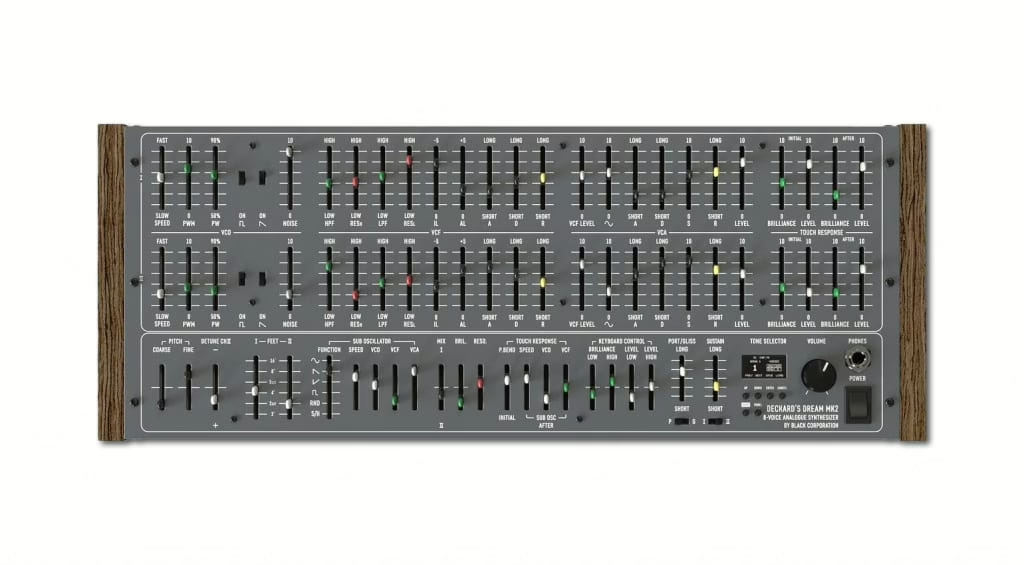
Two units mean:
- extreme bi-timbrality (two independent sounds, stacked or split);
- wider pads, with micro-offsets, detuning and cross-modulation;
- a true playground for Blade Runner-style layering: main pad + a layer of noise or brass, for example.
In market terms, this sits as an alternative both to the original CS-80 (unobtainable, unstable, astronomically expensive) and to modern recreations such as virtual GX-1 / CS plug-ins. Here, the approach is clearly high-end hardware: physical presence, sliders, immediacy. You sacrifice the total flexibility of software in order to regain a direct, instrument-like relationship.
Why the Osmose really changes the game for this type of synth
Choosing the Expressive E Osmose as the main keyboard is far from cosmetic. The Deckard’s Dreams truly come into their own when driven by polyphonic aftertouch or an MPE controller. Where an original CS-80 had pressure-sensitive keys and a ribbon, the Osmose goes much further:
- each note can have its own dynamics, its own aftertouch, its own pitch and timbre curves;
- vertical and lateral movements of the keys allow ultra-natural vibratos and bends;
- playing a pad with one hand instantly gains an “expressive” character that is impossible with a standard MIDI keyboard.
In practice, this brings the performance station even closer to the spirit of the CS-80: an instrument you “play” like a violin or a saxophone, not just like an electric piano. For a film-score composer, ambient musician or sound designer, it offers a huge qualitative leap in nuance and liveliness.
Integrated effects: a turnkey cinematic pad machine
Beyond the synths, Love Hultén has integrated two effects that, in themselves, embody the project: Meris Mercury 7 and Soma Cosmos. They are not just screwed onto a pedalboard — they are opened up, reconfigured, and their controls are brought to the front panel with sliders and colour-coded toggle switches in the Yamaha CS spirit.
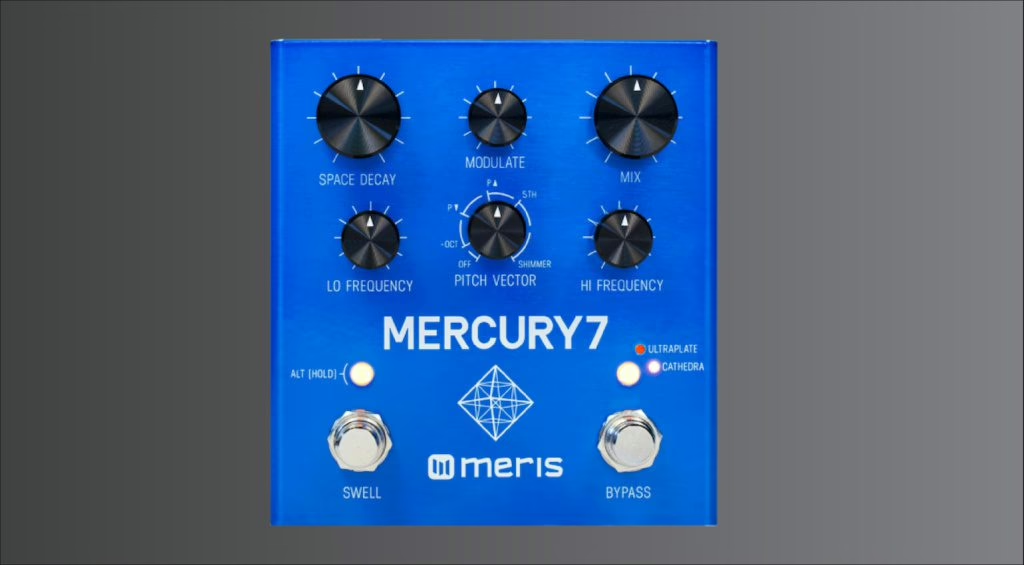
Meris Mercury 7: this is a direct reference to the Blade Runner soundtrack. This reverb was designed from the outset for vast cinematic spaces, atmospheric pitch-shifts and infinite tails. Compared with a “classic” reverb such as a Lexicon PCM or a Valhalla plug-in, Mercury 7 has a very dense, musical character — perfect for CS-80/Deckard’s Dream pads.
Soma Cosmos: this is the more experimental counterpoint. A “drifting memory station” looper, it allows you to create ever-evolving pads and quasi-modular textures without patch cables. Where a simple guitar looper records and plays back, the Cosmos warps, stretches and feeds the signal back into shifting clouds — ideal for slow intros, ambient interludes and soundscapes.
Integrating both effects into the panel, with sliders matching the Deckard’s Dreams and CS-50/CS-80-style toggles, means these treatments become an integral part of the instrument, rather than peripheral add-ons. It evokes a modular synth console as much as a traditional digital piano.
Design inspired by the Yamaha CS line: more than a tribute, an ergonomics choice
Love Hultén is known for his ability to transform existing gear into coherent, almost museum-grade objects. Here, the Yamaha CS-50 serves as the aesthetic template: wood, angular lines, expansive control panels, and those iconic colour rocker switches that gave so much personality to the CS series of the era.
We also find a recurring element of his creations: the oscilloscope mounted on a small pedestal. Beyond the retro nod, it is a practical tool for visualising waveforms, modulations, or simply providing visual feedback to a live audience. In a studio context, it also adds a kind of “scientific instrument” feel that fits well with the analogue imaginary.
Who does this kind of machine actually make sense for?
The Love Hultén Deckard’s Dream X2 is a one-off, built to order for a client. It is not aimed at everyone, even if you could commission an equivalent. In practice, this type of installation makes sense if you are:
- A film or TV composer: you are looking for an “atmosphere machine” with a direct workflow, capable on its own of covering ambient, dramatic, sci-fi, romantic and more.
- A live artist or audiovisual performer: a visually striking, instantly recognisable object with an emblematic CS-80 sound and expressiveness on par with an acoustic instrument.
- A high-end studio / active collector: you are not just buying a synth, but a signed, unique instrument that can become a central part of your sonic and visual identity.
Conversely, if your priority is versatility, total DAW recall and a rational budget, a plug-in combo (Arturia CS-80 V, Cherry Audio GX-80, etc.) plus a good poly-aftertouch keyboard will get you part of the way there for a fraction of the cost.
Budget and realistic alternatives to get close to this setup
The price of this Deckard’s Dream X2 has not been disclosed: it is 100% custom, and you need to contact Love Hultén for a quote. But we can estimate the order of magnitude by adding up the “stock” components:
- 2× Black Corporation Deckard’s Dream MkII: around €4,949.00 each, so nearly €10,000 already.
- 1× Expressive E Osmose: around €1,769.00.
- 1× Soma Cosmos: around €669.00.
- 1× Meris Mercury 7: around €349.00.
Just for the “raw” gear, we are already well above €12,000, without counting:
- the custom furniture, internal wiring and industrial design labour;
- physical modification of the pedals and interfaces;
- integration of the oscilloscope and custom panels.
We can therefore reasonably imagine an overall budget comparable to that of a serviced CS-80 or a high-end concert piano. However, nothing stops you from recreating the spirit of this system in a more modular way:
- a single Deckard’s Dream MkII;
- an Osmose or any other poly-aftertouch/MPE keyboard;
- a Mercury 7 and/or a Cosmos kept in pedal format;
- a well-designed studio desk or rack to bring it all together.
You will lose the aesthetic uniqueness, but you will keep the essentials: the Deckard’s Dream tone, the expressiveness of the Osmose, and the character of the effects.
FAQ section
Does the Deckard’s Dream X2 really sound like a Yamaha CS-80?
The dual Deckard’s Dream comes very close to the CS-80 in terms of tone, filter behaviour and modulation richness. It is not a 1:1 clone — none of them are — but it is clearly among the best of the modern recreations. With two units and a good poly-aftertouch controller, you get a more convincing sonic experience than with most current hardware alternatives.
Do I need the Osmose to get the most out of a Deckard’s Dream?
No, the Deckard’s Dream works with any MIDI keyboard, but a controller like the Osmose or any other poly-aftertouch/MPE keyboard really unlocks its potential. Without polyphonic aftertouch, you get the CS-80 tone, but not the full note-by-note expressiveness that provides the magic of this type of instrument.
Is this kind of setup worthwhile compared with modern plug-ins?
If your priority is the features-to-price ratio, CS-80 plug-ins are unbeatable. However, for live performance, physical feel, spontaneous sound design and visual impact, a hardware station like this Deckard’s Dream X2 offers an experience that cannot be fully reproduced in a DAW. It is a choice of “instrument” more than of tool.
Can you order an identical Deckard’s Dream X2 from Love Hultén?
The model shown is a custom-built piece for a specific client. For a similar project, you will need to contact Love Hultén directly to define a specification and obtain a quote. The concept is reproducible, but each creation is generally unique in its design, finish, and sometimes its exact configuration.