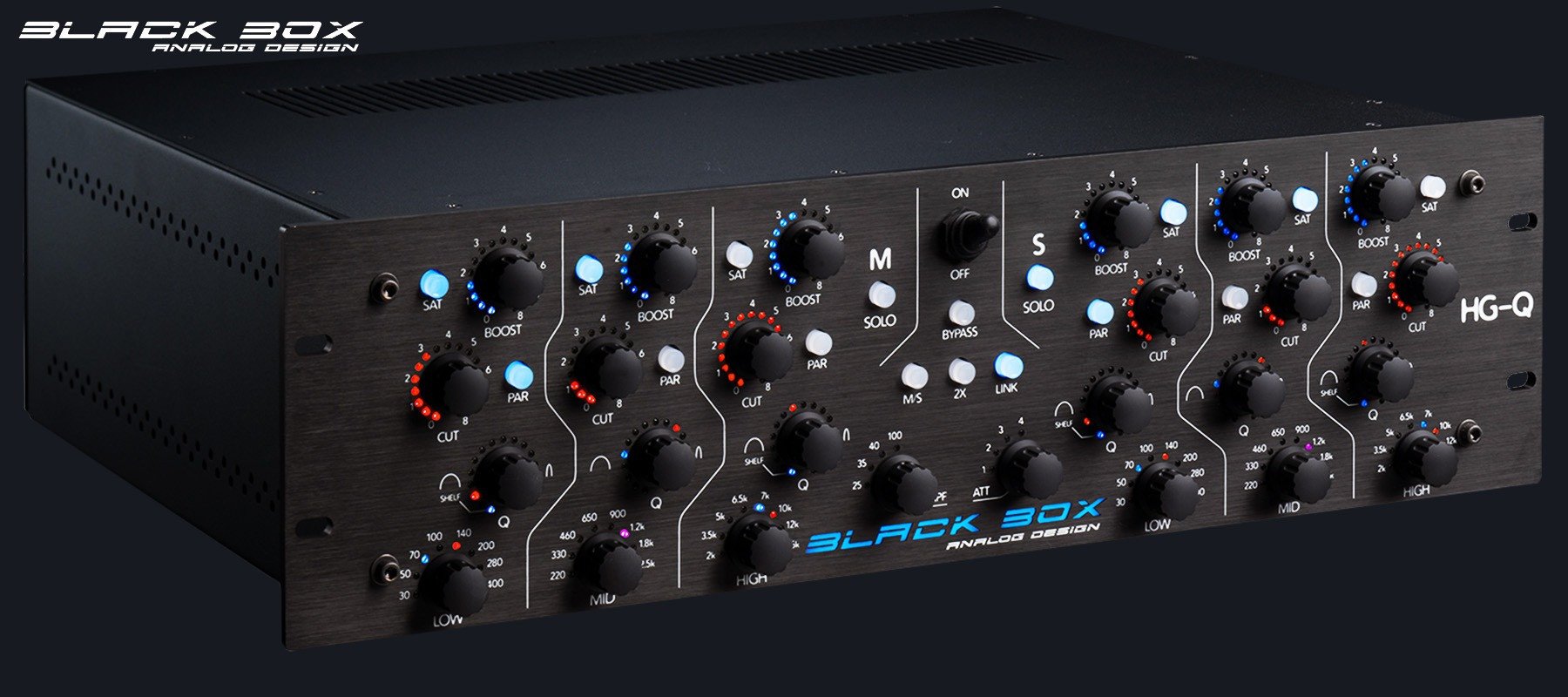
Unveiled around NAMM 2025, the Black Box Analog Design HG-Q is a 3U analogue equaliser and saturator controllable via plug-in, designed for studios that want to combine the colour of valve hardware with the flexibility of DAW automation. This 2025 piece of studio outboard positions itself as a modern hardware equaliser, conceived as genuine analogue saturation gear for mix bus hardware and mastering in hybrid workflows.
Black Box Analog Design: a boutique manufacturer focused on valve processing
Black Box Analog Design presents itself as a boutique hardware manufacturer specialising in valve-based processing for the studio. The brand first made a name for itself with the HG-2 saturation processor, later released as a plug-in in collaboration with Brainworx and Plugin Alliance, before extending this partnership with the HG-Q.
On its official website, the manufacturer describes the HG-Q as a boutique hardware equaliser and saturator designed to reshape and enhance sound in ways that traditional equalisers do not offer. Specialist retailers (Floating Point Audio, Funky Junk, Audiofanzine) clearly position it in the high-end processor category aimed at professional studios and advanced home studios.

HG-Q: 6-band equaliser and 3U analogue saturator
Overall architecture and circuits
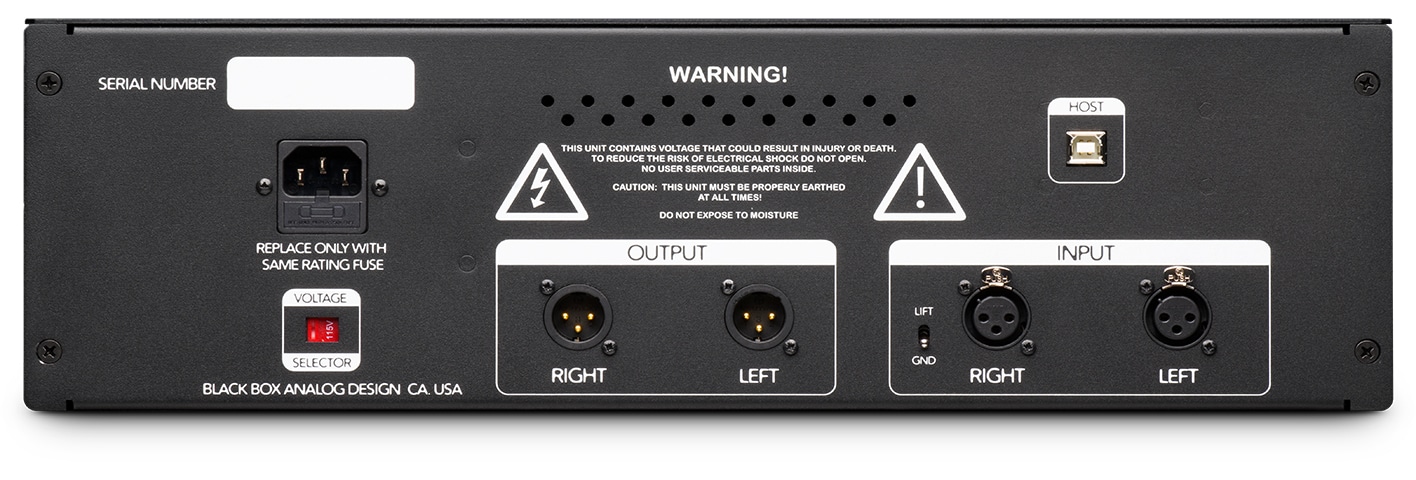
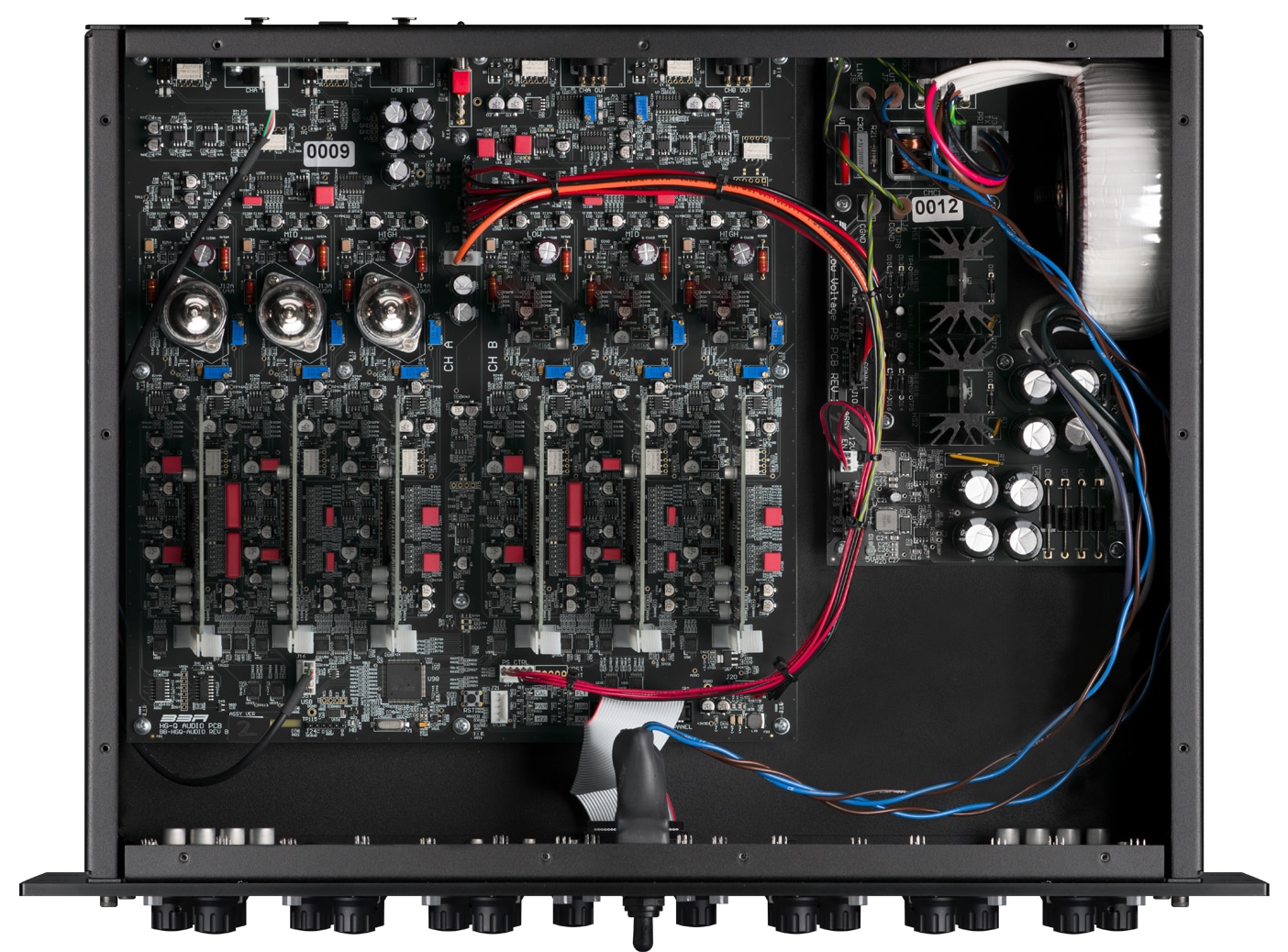
The Black Box HG-Q combines six-band equalisation and valve-based analogue saturation in a 3U rackmount chassis. The features highlighted by the manufacturer and product sheets are as follows:
- 6-band EQ per channel, with dual mono, stereo and Mid-Side operation.
- For each band, separate boost and cut circuits with independent controls for gain, Q factor and centre frequency.
- Analogue topology with dynamic phase interactions between bands.
- Built-in valve saturation stages in the boost circuits to add rich harmonics and density.
- Solid-state cut filters to maintain clean, precise attenuation.
- 2X mode allowing the boost/cut range to be doubled (up to ±16 dB per band) with more intense saturation.
- Processing options in stereo, dual mono, mono and M/S to suit different mixing and mastering scenarios.
The per-band integrated saturation makes it possible to add targeted harmonic content without smearing transients or compromising the overall clarity of the mix. The equaliser therefore presents itself as a tonal enhancement tool capable of reinforcing perceived density while preserving articulation, whether on individual tracks, mix buses or mastering chains.
Topology, routing and operating modes
At the heart of the HG-Q is a topology where the EQ bands interact with each other, creating more complex frequency responses and phase interactions than on a conventional equaliser. Several points stand out from the technical documentation:
- Ability to combine boost, cut and saturation on the same band.
- Series/parallel mode per band: in series mode, cut comes before boost; in parallel mode, boost and cut receive the same full-range input signal.
- 2X mode that extends the gain range from ±8 dB to ±16 dB, with reinforced harmonic saturation.
- Adjustable high-pass filters (HPF) with the option to link or unlink the channels.
- Adjustable output attenuation in 1 dB steps (from 0 to -4 dB) to adapt the level after processing.
- Mid-Side mode with Mid Solo and Side Solo functions to listen separately to the centre and side components.
- Link function to tie the left and right channel parameters together and adjust them simultaneously.
This combination of six independent bands, integrated valve saturation and flexible routing modes is intended to provide an EQ and tonal enhancement tool that can be used both in a subtle way and for more radical approaches.
Front panel controls
The HG-Q’s front panel is particularly detailed. According to the manufacturer and retailer descriptions, it includes in particular:
- A power switch.
- For each band:
- A Boost control that toggles between gain boost and saturation level, with an LED ring indicating the active mode.
- A Cut control for attenuation, with band bypass via a simple press and visual feedback from the LEDs.
- A Q control that can separately adjust boost Q, cut Q or a ganged mode (with colour coding on the LEDs).
- A Frequency selector offering eight centre frequency positions, with independent switching for the boost and cut sections.
- A Sat switch to enable or disable valve saturation on each boost circuit.
- A Parallel Mode switch to flip the band from series to parallel configuration.
- An HPF (high-pass) control with cutoff frequency selection and channel-link option.
- An Output Attenuation control (0 to -4 dB) with a ganged mode to link both channels.
- The Mid Solo, Side Solo, Bypass, M/S mode, 2X Mode and Link switches.
Everything is housed in a 3U rackmount chassis, said to be built to high manufacturing standards for long-term integration in mix and mastering control rooms.
Analogue saturation gear designed for hybrid workflows
Digital control of the hardware via plug-in
One of the things that sets the Black Box HG-Q apart from a traditional analogue equaliser is its deep integration with its companion plug-in. The manufacturer and retailers highlight several aspects:
- The HG-Q hardware communicates with a dedicated control plug-in that lets you adjust all parameters from within the DAW: create, save and recall presets, and automate settings.
- The plug-in is not just a controller: it is presented as a full modelling of the hardware’s behaviour, usable on its own when the physical unit is not available.
- The plug-in offers extended functionality compared with the hardware panel:
- High-resolution display of the EQ curve.
- Spectrum analyser to visualise the impact of boosts and cuts.
- Extended control view with a dedicated knob or button for each function and parameter.
- Targeted listening functions such as Auto-Listen and Band-Listen to isolate a frequency band.
This architecture allows the HG-Q to slot neatly into a hybrid workflow: the audio signal is processed in the analogue valve chain, while recall, session memory and automation are handled in the digital domain.
HG-Q plug-in version: emulation and entry point
Alongside the hardware, an HG-Q plug-in version is distributed via Plugin Alliance. Thomann’s product page details a software emulation of the Black Box Analog Design HG-Q analogue hardware equaliser, with:
- A 6-band design (3 boost bands and 3 cut bands) with series or parallel routing options.
- Dynamic phase interaction between bands, mirroring the analogue topology.
- Valve saturation stages in the boost bands.
- Solid-state circuits in the cut bands for cleaner processing.
- A 2X mode that doubles the boost and cut range up to ±16 dB.
- Stereo, dual mono, mono and Mid/Side editing modes.
- A resizable interface with curve display, Auto-Listen and Band-Listen.
- Support for AAX 64-bit, AU 64-bit, VST2 64-bit and VST3 64-bit formats on Windows (from Windows 10) and macOS (from macOS 11).
The plug-in is supplied as a download with online activation and the option to authorise several machines at once. In 2025, Thomann lists it at around €28 on promotion, making it a far more accessible entry point than the hardware while still aligned with the product’s sonic philosophy.
Price positioning and target market in France and Europe
In terms of pricing, the Black Box HG-Q clearly sits in the upper range of hardware equalisers intended for mixing and mastering:
- Audiofanzine mentions a recommended retail price of $5,995 for the hardware.
- European retailers such as Floating Point Audio indicate a price of around €6,290 including VAT (approximately €5,242 ex VAT).
- Other specialist shops announce comparable prices including VAT, sometimes with pre-orders or availability from spring 2025.
This positioning makes it more suitable for mastering studios, professional mix rooms and high-end production studios, as well as very well-equipped home studios looking to invest in a modern hardware equaliser geared towards bus processing and analogue colour. On the French and wider European market, the Black Box HG-Q therefore sits among premium analogue outboard units designed to remain at the heart of a processing chain for many years.
Why the Black Box HG-Q appeals to hybrid studios
The official descriptions and product sheets converge on several points that explain why the HG-Q is attractive in a hybrid studio environment:
- Dual role equaliser + saturator: the HG-Q combines a full 6-band equaliser (with simultaneous boost and cut) and integrated valve saturation in the boost circuits. This combination makes it both a corrective and a creative tool.
- Per-band processing: having saturation controllable per band means you can precisely target the frequency areas you want to enrich with harmonics, while keeping other bands in a more neutral register.
- Stereo, dual mono and M/S modes: the ability to work in Mid-Side and to solo Mid and Side separately makes the HG-Q relevant for stereo image work, whether on a mix bus or in a mastering context.
- Interactive topology and 2X mode: the way the bands interact with each other, combined with 2X mode, provides a range of complex curves that are hard to reproduce with a conventional digital equaliser.
- Plugin/hardware integration: plug-in control, preset recall and the option to use a software emulation all fit the needs of hybrid studios that want to keep tight control over their workflows while benefitting from the character of hardware.
In a modern studio, the Black Box HG-Q can therefore be positioned as a central processor on the mix bus, mastering chain or specific subgroups (drums, score mix, etc.), following a mix bus hardware approach that is easy to integrate in a DAW-driven session.
Advantages and limitations in studio use
Key strengths highlighted
- Modern 6-band hardware equaliser with stereo, dual mono and Mid-Side operation.
- Integrated valve saturation in the boost circuits, designed to increase density and detail without compromising transients.
- Interactive topology with the ability to combine boost, cut, saturation and series/parallel routing.
- 2X mode providing ±16 dB of headroom per band when more drastic settings are required.
- Digital control via a dedicated plug-in, plus full software emulation for 100% in-the-box use when needed.
- Boutique build quality, with a robust 3U chassis for fixed installation in the control room.
Objective constraints to bear in mind
- Budget: with a list price of around $5,995 and European street prices above €6,000 including VAT, the HG-Q remains a major investment compared with the much more affordable plug-in version.
- Space: the 3U form factor takes up a significant amount of rack space, which makes it especially suitable for studios that already have a structured outboard setup.
- Learning curve: the wealth of controls (six bands, separate boost/cut, saturation, series/parallel, M/S, 2X, etc.) means it takes time to fully get to grips with the unit and unlock its full potential.
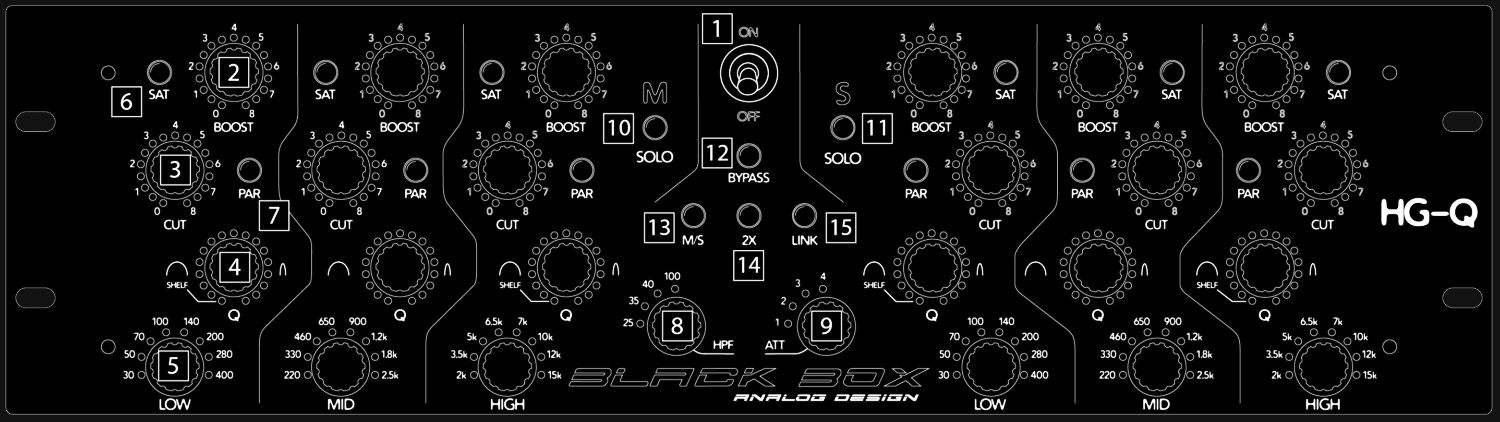
Controls
1. Power switch: On/Off position
2. Boost: This multi-function knob toggles between BOOST [gain] (solid blue LED ring) and SAT [level] (single red/purple LED) when pressed.
3. Cut: Turn to adjust the CUT [gain] of each band. Pressing the CUT knob toggles the band into Bypass, indicated by the active/inactive LED rings.
4. Q: Sets the Q factor of the boost and/or cut circuit. When pressed, this multi-function knob toggles between Q [boost] (blue LED), Q [cut] (red LED) and Ganged Mode (purple LED when both are active) to configure the Q of the filters. The LOW and HIGH bands on each channel also offer additional low-shelf/high-shelf filters.
5. Frequency: Selects one of eight centre frequencies in each band. Clicking this multi-function knob toggles between boost frequency (blue LEDs), cut frequency (red LEDs) and Ganged Mode (purple LED when both are active).
6. Sat: Engages/disengages additional valve saturation in each boost circuit independently.
7. Parallel Mode: When engaged, the band’s cut and boost circuits are reconfigured from series (with cut before boost) to parallel, where cut and boost are both fed from the same full-range input.
8. HPF: Select the cutoff frequency of the high-pass filters. Click the knob to choose the left or right channel and Ganged Mode to link both frequencies while preserving their offset.
9. Output Attenuation: Defaulted to 0 dB attenuation, the output level can be reduced down to -4 dB in 1 dB steps. Click the knob to select the left or right channel, and Ganged Mode to link both gains while preserving their offset.
10. Mid Solo: Isolates the mid (sum) signal being processed.
11. Side Solo: Isolates the side (difference) signal.
12. Bypass: True bypass, hard-wires the input and output connections together.
13. M/S mode: Disengages/engages M/S processing. When active, the left channel processes the Mid (sum) of both channels, and the right channel processes the Side (difference) of both channels.
14. 2X Mode: Engaging 2X Mode changes the gain ranges of the boost and cut controls from 8 dB in 0.5 dB steps to 16 dB in 1 dB steps.
15. Link: Enables or disables parameter linking between channels. When LINK is active, all left-channel parameters are immediately mirrored to the right channel. In LINK mode, both channels’ controls move together, regardless of which channel you are adjusting.
FAQ: Black Box HG-Q, analogue equaliser and saturator
What is the Black Box Analog Design HG-Q?
The Black Box HG-Q is a boutique analogue equaliser and saturator in a 3U rack format. It provides six interactive EQ bands per channel, valve saturation stages integrated into the boost circuits, solid-state cut filters and several operating modes (stereo, dual mono, mono and Mid-Side), with digital control via a dedicated plug-in.
How is the HG-Q different from a classic hardware equaliser?
Unlike a more conventional analogue EQ, the HG-Q combines, at the same time: separate boost and cut per band, valve saturation controllable per band, an interactive topology between filters, series/parallel mode and a 2X mode that extends the gain range up to ±16 dB. It can also be controlled by a plug-in, which lets you recall presets, automate parameters, and visualise the EQ curve and spectrum.
What is the difference between the HG-Q hardware and the HG-Q plug-in?
The hardware version processes the audio signal in an analogue chain of valves and solid-state components, with the specific behaviour of the physical unit and substantial headroom. The HG-Q plug-in, distributed via Plugin Alliance, is a software emulation that reproduces the hardware’s behaviour and adds extra functions such as a spectrum analyser, detailed EQ curve display and focused listening tools. The plug-in also acts as a remote control for the hardware in a hybrid workflow.
How much does the Black Box HG-Q cost?
Audiofanzine mentions a recommended retail price of around $5,995 for the hardware. European retailers list the HG-Q at around €6,290 including VAT (roughly €5,242 ex VAT), with availability announced from spring 2025. The HG-Q plug-in, by contrast, is offered at a much lower price, with a promotional price of around €28 including VAT at Thomann at the end of 2025.
What type of studio is the Black Box HG-Q best suited for?
Given its technical features and price, the HG-Q is primarily aimed at mix and mastering studios that want a modern hardware equaliser focused on colour and tonal enhancement, with deep DAW integration. It can also find a place in advanced home studios that already have a substantial outboard rack and are looking for an analogue EQ and saturation processor to sit at the centre of their bus or mastering chain.