With the UDO DMNO, the British brand unveils a hybrid analogue–digital synth conceived as a true 2025 binaural synth. This 8‑voice / 2‑part multitimbral instrument brings together two independent synths under a single panel, with a binaural architecture and Play Modes that can reconfigure the audio path in one move. Shown at the Machina Bristronica show in Bristol, this keyboard positions itself as a high‑end hybrid flagship, reported at around $3,500 by several specialist sources.
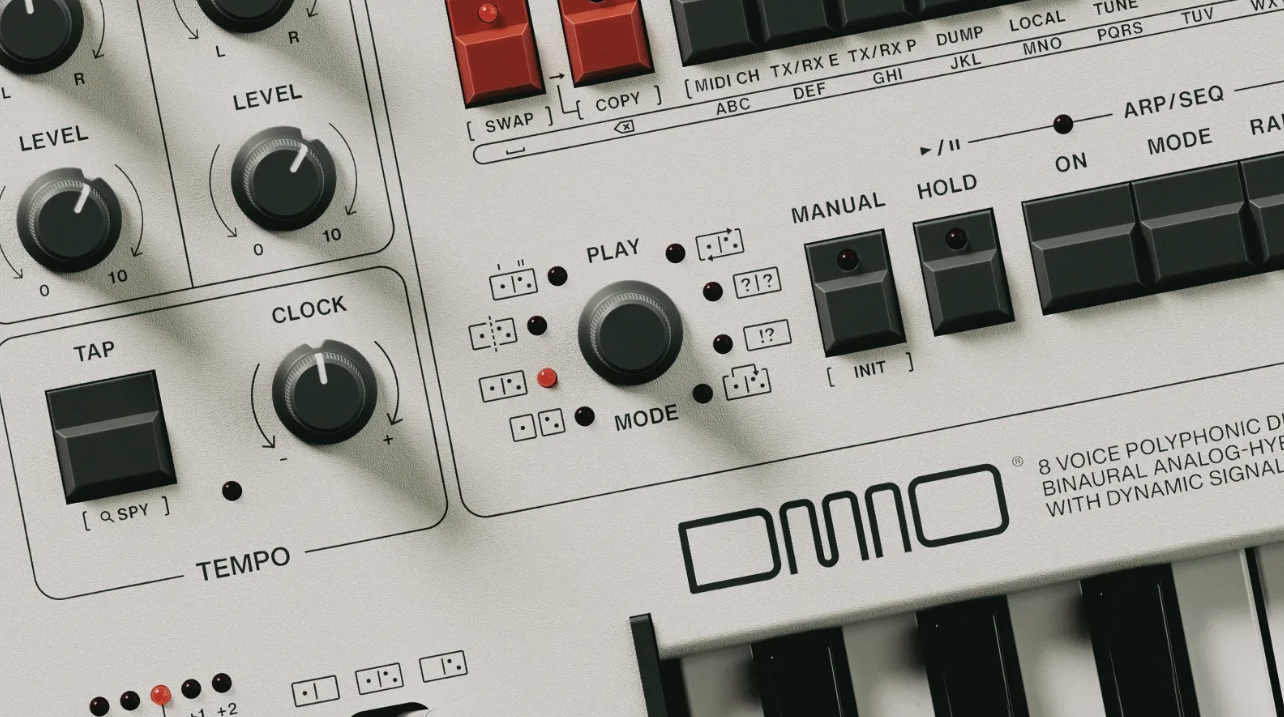
DMNO in a nutshell: two independent synths in a single chassis
The UDO DMNO is an 8‑voice hybrid synth with 2‑part multitimbrality and a very flexible internal architecture. The core idea is to combine two complete hybrid analogue synths (DMNO 1 and DMNO 2), each with its own dedicated front‑panel controls, in a single keyboard. Where the Super series (Super 6, Super 8, etc.) adopted a Jupiter‑style layout, the DMNO goes for an organisation reminiscent of an Oberheim Two‑Voice: two identical sections side by side, each driving a full engine.
Two 4‑voice engines, multitimbral, FPGA + analogue filter hybrid
At the heart of the instrument are two hybrid synthesis engines, each offering 4 voices of polyphony, for a total of 8 voices in standard mode. Each engine is built around:
- Two high‑resolution digital oscillators driven by FPGA, with classic waveforms and the DDS waves already familiar from other UDO synths.
- A mixer per engine with Q‑drive to reinforce character and saturation before the filter.
- One Dynamic Multi‑Core Stereo VCF analogue filter per voice, configurable in series, in parallel or in stereo, with several filter modes ranging from classic types to more experimental configurations.
This architecture extends the UDO sonic signature, based on a dual hybrid synthesis engine, while offering two full multi‑core stereo filter paths, one per part, each with its own envelopes, LFOs and effects.
44‑note Fatar keyboard with aftertouch and performance controls
The DMNO is equipped with a 44‑key Fatar keyboard featuring monophonic aftertouch, adding expressiveness by modulating the sound after the keys are pressed. UDO also includes a Roland‑style joystick that can be assigned, plus a dedicated control section around the display with:
- a VFD (Vacuum Fluorescent Display) glass electroluminescent screen with high contrast and long service life,
- dedicated encoders around the display to control sequencer, voicing, filter and effects parameters.
The chosen approach is to keep deep menus to a minimum: most parameters remain accessible on the front panel, with a few additional functions handled by the screen, in order to preserve an instrument designed first and foremost for playing and a performance‑led workflow.

The Play Modes: why UDO talks about “kick the door down”
UDO describes the DMNO as an instrument that “kicks the door down”, whereas the Super Series synths “knock politely”. This difference is largely down to the Play Modes system, which lets you instantly reconfigure the internal architecture and the way the two timbres interact.
Classic modes: Single, Dual, Split
Several Play Modes cover more traditional playing needs:
- Single: only one engine (DMNO 1 or 2) is played, like on a classic polyphonic synth.
- Dual: both engines play simultaneously, allowing you to create thick layers or combinations of complementary timbres.
- Split: the keyboard is split between DMNO 1 and DMNO 2, each occupying a distinct key range.
These modes cover live or studio configurations that require simple splits or layered sounds without complex routing.
Creative modes: One‑Two, Cycle, Random, Chaos, Series
The DMNO also offers modes that play with note allocation and the engines’ internal connection:
- One‑Two: the first note triggers DMNO 1, the following notes are played by DMNO 2.
- Cycle: notes alternate between DMNO 1 and 2 in a regular cycle.
- Random: each note is sent randomly to DMNO 1 or DMNO 2.
- Chaos: a combination of random timbre allocation and randomised notes, to generate evolving textures.
- Series: the audio output of DMNO 1 is fed back into the oscillator mixer of DMNO 2, effectively turning the first engine into a complex oscillator for the second.
These Play Modes turn the DMNO into a sound‑design laboratory: you can move from a traditional split to semi‑modular‑style routing (Series) or random timbre distribution (Random, Chaos) without ever leaving the control surface.

Sound architecture: FPGA oscillators, binaural and multi‑core filter
Sonically, the DMNO picks up the ingredients of the Super series while adding a more flexible architecture and pushing the binaural dimension and stereo control much further into the foreground.
FPGA oscillators and a wide stereo image
Each engine is powered by two ultra‑high‑frequency digital oscillators driven by FPGA. This approach delivers a precise, alias‑free sound from basic waveforms (saw, square, etc.) and importable DDS wavetables. The oscillators offer:
- tuning, PWM and sync controls,
- an oscillator mod section to modulate detune, shape/PWM or pitch on one or two oscillators,
- interaction designed to generate wide stereo textures when binaural mode is engaged.
In binaural mode, each ear gets a full voice: you can detune and phase‑shift oscillators, amplitude and filter independently on the left and right channels, which lets you directly shape stereo width and a sense of depth.
Dynamic Multi‑Core Stereo VCF: series, parallel, stereo
The Dynamic Multi‑Core Stereo Filter is one of the DMNO’s key features. Each engine has its own multi‑core analogue stereo filter offering different topologies:
- Series connection: stacking multiple filter stages to reinforce character or saturation.
- Parallel connection: blending multiple filter types.
- Stereo mode: processing the left and right channels differently.
According to descriptions, the filter offers a wide palette of modes, with low‑pass, high‑pass, band‑pass behaviours and more experimental configurations, while keeping a distinctly musical response. Classic parameters (cutoff, resonance, modulation) remain on the front panel for each engine.
LFOs, envelopes, arpeggiator and 64‑step sequencer
On the modulation side, each DMNO part includes:
- one multi‑wave LFO per engine, with speed and delay controls,
- an additional global LFO, located near the joystick, for cross‑engine modulation,
- two loopable ADS envelopes per engine, with inversion available.
These sources feed a modulation matrix managed via the VFD screen. They can be supplemented by an envelope follower and a gate generator derived from the external audio input.
For performance, the DMNO offers:
- a multimode arpeggiator with Smart Hold,
- a 64‑step sequencer controlled from the screen, designed for melodic sequences or rhythmic modulation.
A 32‑bit digital effects engine rounds off the audio chain with delay, reverb, EQ, overdrive / distortion and chorus. The effects are designed to handle anything from subtle processing to more pronounced treatments, while remaining usable in a musical context.
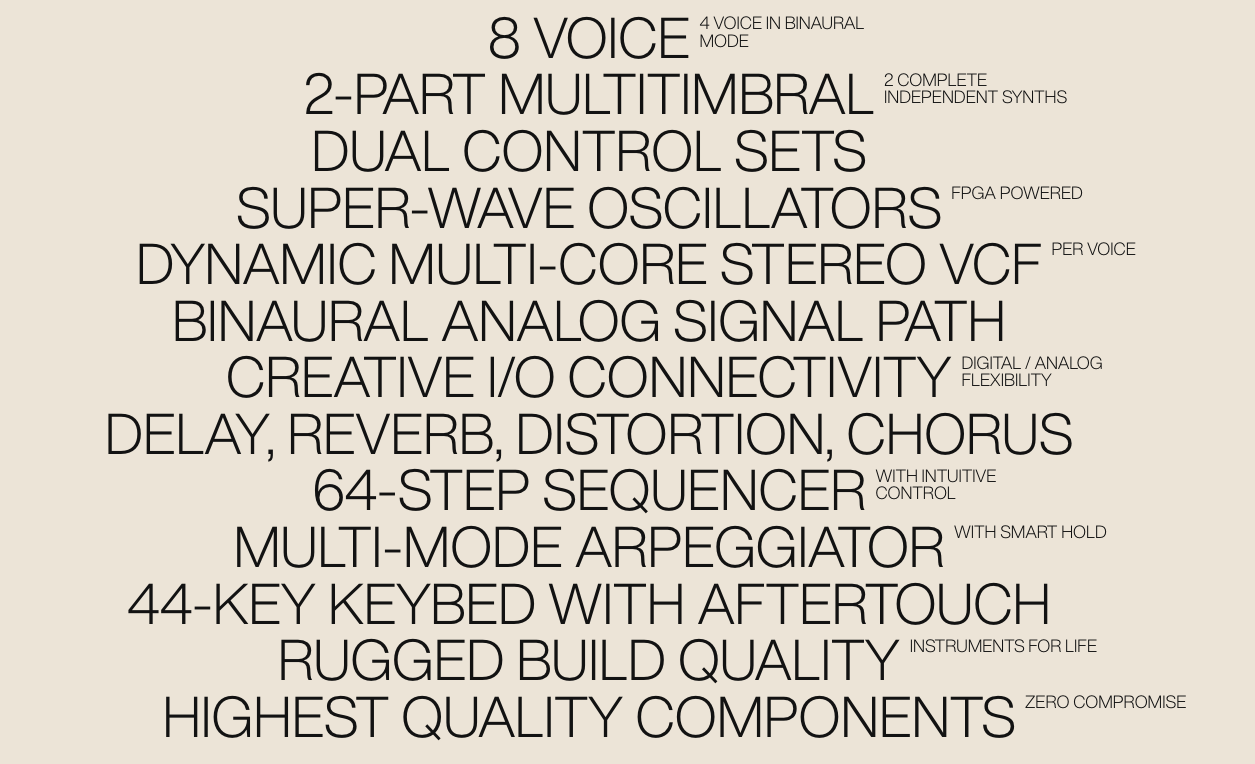
DMNO in a modern studio setup
Beyond synthesis, UDO has designed the DMNO as a studio hub, able to integrate smoothly into a modern setup, whether that’s a home studio or a more professional rig.
Built‑in 2‑in / 2‑out USB audio interface
The DMNO includes a 24‑bit 2‑in / 2‑out USB audio interface, class‑compliant. It can therefore connect directly to a computer or DAW to send and receive digital audio. The signal can be routed to the internal effects bus or used as the main digital output alongside the analogue outputs.
For a hardware‑synth‑focused home studio, this feature lets you record the DMNO without an extra interface while still being able to slot it into an existing audio chain.
External audio input, CV/Gate and auxiliary outputs
The rear connectivity is designed with hybrid setups in mind:
- Stereo audio input with a variable‑gain preamp, tied to a gate generator and an envelope follower, both integrated into the modulation matrix.
- Two assignable CV and gate/clock outputs on 3.5 mm mini‑jacks, for driving Eurorack modules or other analogue synths.
- Main stereo mix output and an auxiliary stereo output assignable to DMNO 1, DMNO 2, the USB stream or the effects bus.
- Full MIDI connectivity (USB and 5‑pin DIN) and pedal inputs (volume, expression, single or dual switch).
Audiofanzine points out that this configuration makes the DMNO both versatile in the studio and compatible with a modular or CV/Gate environment.
A “flagship” for advanced producers and studios
With a reported price of around $2,969 at some dealers, the DMNO is clearly aimed at advanced producers, sound designers and studios looking for a hybrid analogue–digital synth in the flagship category. On the r/synthesizers forum, several users highlight the instrument’s playability, its robust build and its positioning as a “keep for the long haul” instrument, even if the price can be hard to justify for purely casual use.

DMNO versus other hybrid flagships
The high‑end hybrid synth segment already includes several major manufacturers (Sequential, Waldorf, ASM, etc.). Reactions on r/synthesizers suggest that the DMNO stands out thanks to an approach seen as more structurally original than many recent, more conservative releases.
A “two synths in one” philosophy inspired by the Oberheim Two‑Voice
Synth Anatomy stresses that the DMNO sets itself apart from previous UDO models with a front panel split into two independent sections, inspired by the Oberheim Two‑Voice, rather than Jupiter‑type layouts. Whereas many flagships simply stack voices, the DMNO offers:
- two full engines with dedicated controls,
- advanced handling of binaural processing in the analogue path,
- a Play Modes system that restructures how the two timbres interact.
This layout makes it an instrument designed as much for live performance as for studio sound design, with the option to treat each side as a standalone synth or as one stage in a more complex routing (particularly in Series mode).
What the binaural dimension changes in a mix
From a mixing perspective, the binaural approach means that in binaural mode each voice is made up of two complete channels (left and right), each with its own oscillator / filter / amplitude chain. UDO emphasises the ability to:
- detune and de‑phase the left and right oscillators independently,
- vary phase and filtering per channel,
- shape stereo width directly by combining these parameters.
In practice, this lets you create sounds that occupy a wide stereo field without always reaching for external effects. In return, binaural mode reduces the number of available voices to 4 “super‑voices” instead of 8 standard voices, which means you need to manage polyphony carefully, especially for slow pads or extended chords.
FAQ: UDO DMNO in practice
Can the UDO DMNO replace a UDO Super 6 or Super Gemini?
Available sources indicate that the DMNO retains the hybrid analogue–digital architecture that defines UDO, but with a different approach. It offers two full engines with dedicated controls, a Dynamic Multi‑Core Stereo VCF per part and a very advanced Play Modes system.
The Super 6, Super 8 and Super Gemini remain centred on a different workflow and a different way of organising polyphony. In practice, the DMNO is better seen as an alternative or a complement for users who want a dual synthesis engine in a single chassis, rather than a strict replacement for existing models.
Is the DMNO’s USB audio section enough to use it as the main interface in a home studio?
The DMNO includes a 24‑bit 2‑in / 2‑out USB audio interface, class‑compliant. This interface allows you to:
- connect the synth directly to a computer or DAW,
- send and receive digital audio without a dedicated audio interface,
- use the internal effects bus or the analogue outputs in parallel.
The sources don’t go into detail on latency or drivers beyond class‑compliant mode, but they do confirm that this feature is sufficient to use the DMNO as a simple audio interface in a synth‑centred home studio. For more demanding needs (multiple mic inputs, complex monitoring), a dedicated interface will still be preferable.
Are eight voices (four in binaural mode) enough for stereo pads?
According to the documentation, the UDO DMNO offers:
- 8 polyphonic voices in standard mode,
- 4 “super‑voices” when binaural mode is engaged, each super‑voice corresponding to two conventional voices (left and right).
For very dense binaural pads, you therefore need to take this reduced polyphony into account. In return, user feedback and the spec sheet both stress the richness of the binaural stereo field and the DMNO’s ability to produce wide, detailed pads with a moderate number of notes, provided you manage sustain and releases appropriately.
Is the DMNO suitable for a home studio, or is it more for pro studios?
The technical features (2‑in / 2‑out USB interface, input with preamp, CV/Gate, aux outputs, full effects engine) show that the DMNO was designed to fit just as well into a modern home studio as into a professional studio.
Its reported price, around $2,969 at some dealers, clearly puts it in the high‑end flagship category. For a home studio, it’s primarily suited to users looking for an inspiring main synth rather than a first, entry‑level instrument.
What is the price of the UDO DMNO and when will it be available?
Information from Synth Anatomy, Audiofanzine and discussions on r/synthesizers all point to a price of around $3,500. Synth Anatomy mentions availability in early 2026, while Audiofanzine already lists the DMNO at some of the brand’s dealers.
Depending on region and sales channel, it’s therefore likely that pre‑orders and first shipments will overlap between late 2025 and early 2026.