Monitors designed from the ground up for surround and immersive audio
ATC is launching a new range of passive studio monitors, the SSM (Studio Surface Monitor) series, clearly created for multichannel control rooms, Dolby Atmos and other immersive formats where wall and ceiling integration is becoming the norm. The idea: to offer the ATC signature in a shallow‑depth format that is easy to recess or mount flush to walls without sacrificing accuracy.
The range consists of two passive wall/ceiling monitor models, the SSM12i Pro and SSM25i Pro, along with a dedicated four‑channel power amplifier, the R4-150 Pro. All three products are already available.
Wall integration: what shallow depth really changes
For studios deploying 7.1.4, 9.1.6 or more, speaker depth is no longer a minor detail: it affects both the ergonomics of the control room and compliance with the recommended coverage angles (Dolby, ITU, EBU…). While many studios improvise with standard nearfields mounted on stands, ATC is offering speakers designed from the outset to be mounted flush to the wall or ceiling.
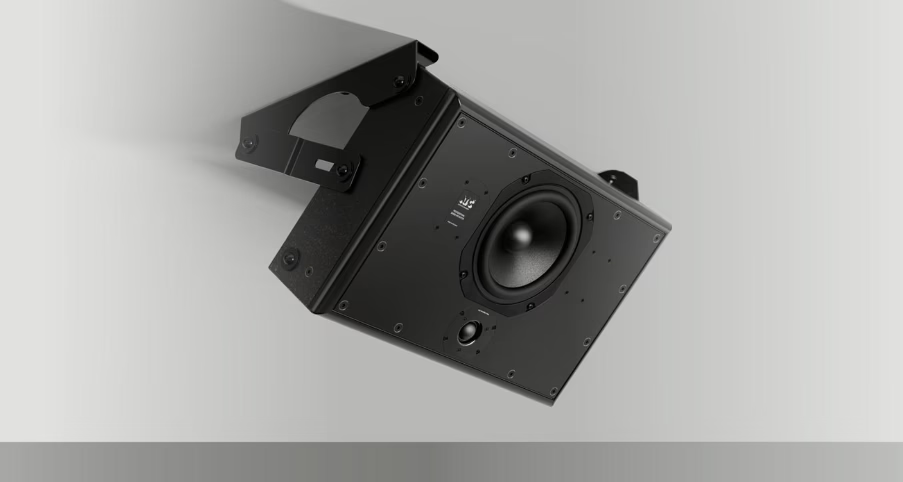
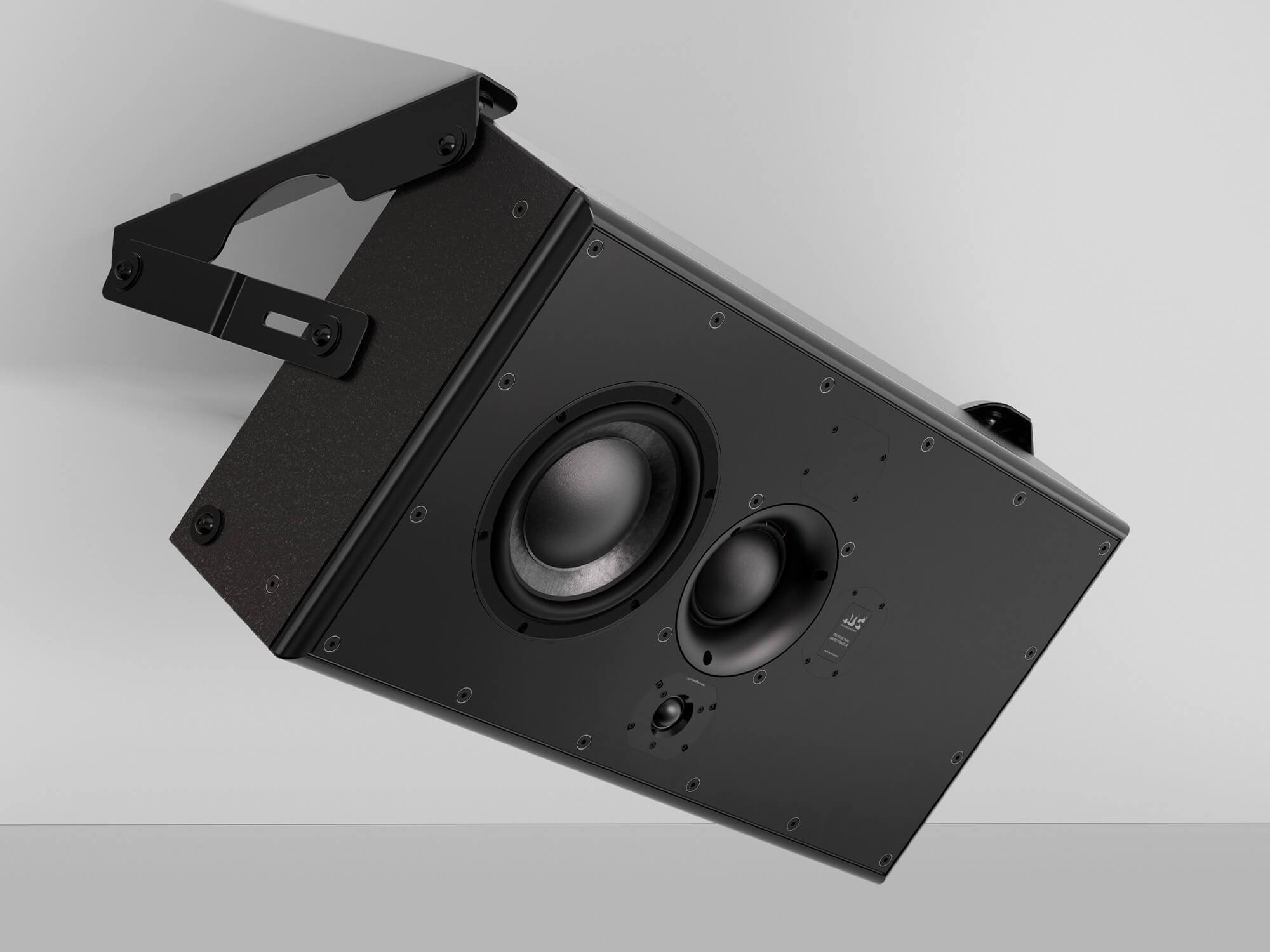
The SSM12i Pro uses a very shallow 147 mm (5 13/16”) cabinet, while the SSM25i Pro comes in at 198 mm (7 13/16”), which is still compact for a three‑way system. Both models can be mounted vertically or horizontally, using a proprietary bracket that sits flat against the wall or ceiling but allows the cabinet to rotate so you can aim it precisely at the listening area.
In practice, this brings these SSMs close to what high‑end in‑wall systems offer, but with one key advantage: they remain self‑contained, sealed cabinets that can be moved, without needing to treat the wall itself as an integrated acoustic part of the system. For a professional studio that may evolve (new premises, Atmos reconfiguration), that’s far from trivial.
SSM12i Pro: a compact 2‑way for surround and ceiling channels
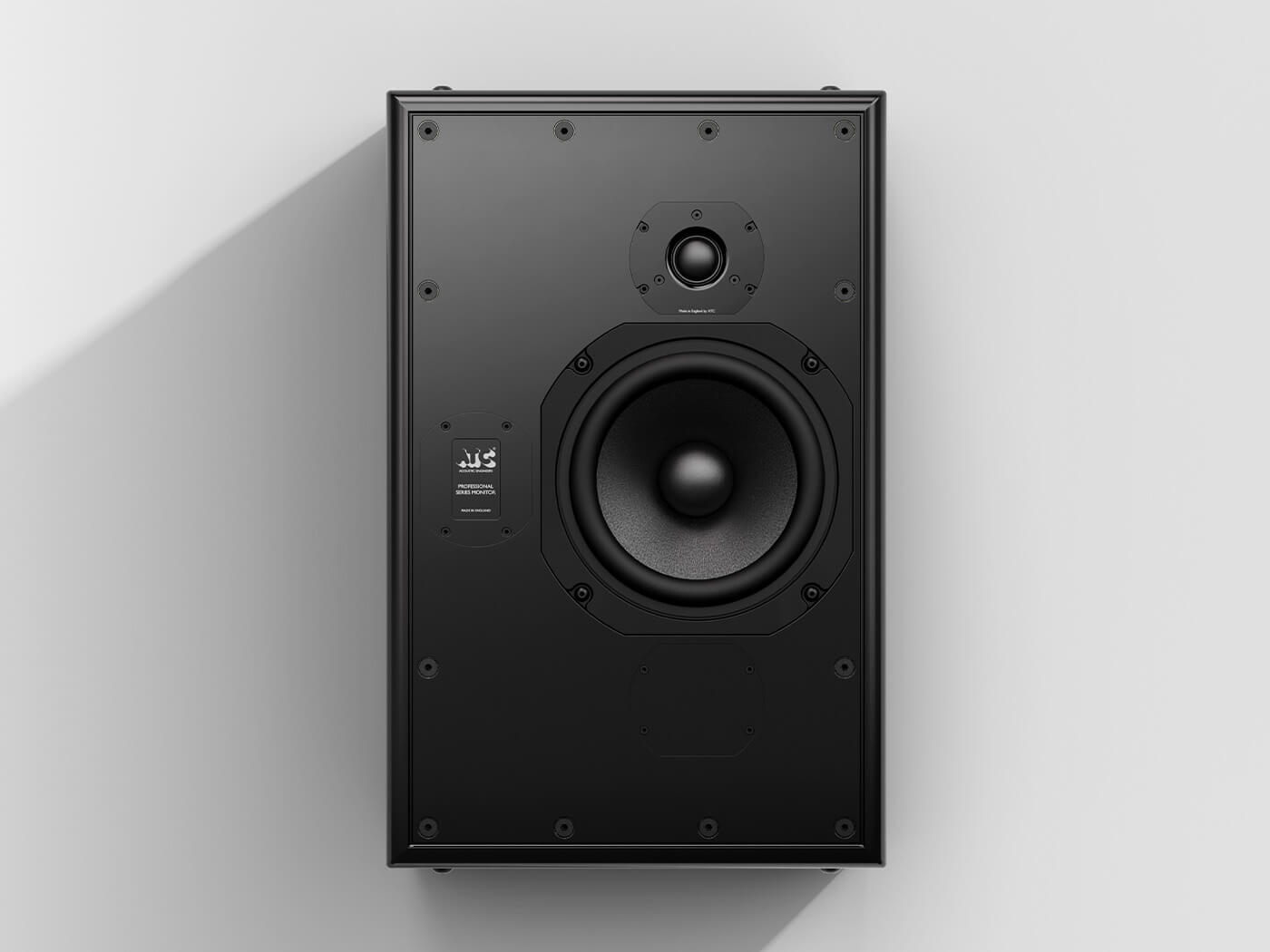
The SSM12i Pro is conceived as a compact monitor, ideal for surround and overhead channels in small to medium control rooms, or as a main system in more modest workspaces (sound editing, dialogue editing, sound design).
Technically, it stays faithful to ATC’s DNA:
- sealed cabinet for tight, predictable low‑end, particularly useful when the speaker is mounted flush to the wall,
- a 150 mm / 6” ATC SB45-150CLD low‑mid driver with a CLD (Constrained Layer Damping) cone designed to reduce cone breakup and distortion,
- a 25 mm / 1” ATC SH25-76 tweeter with dual suspension, handling everything above the 2.2 kHz crossover point.
The choice of a sealed enclosure and a proprietary 6″ driver with CLD cone places this model firmly in the reference monitor category rather than decorative in‑wall speakers. On the market, in terms of use case, it can be compared to solutions like Genelec’s in‑wall range or some PMC installation models, but with a philosophy even more heavily focused on neutrality and midrange control, typical of ATC.
What role does the SSM12i Pro play in a modern control room?
In a typical Atmos setup:
- as side and rear surround speakers, the compact form factor makes it easier to line them up precisely with the engineer without clashing with windows, doors or acoustic treatment,
- as ceiling speakers, the shallow depth reduces the visual and architectural impact while maintaining genuine monitoring capability,
- in a small stereo control room, the SSM12i Pro can perfectly well serve as a main monitor, with a subwoofer added if needed.
For studios hesitating between “consumer/install” loudspeakers and traditional studio monitors, this model offers a clear compromise: the rigour of a control monitor in a truly integratable form factor.
SSM25i Pro: a 3‑way for medium to large Atmos rooms
The SSM25i Pro plays in a different league: ATC positions it as an ideal solution for multichannel and immersive applications in medium to large control rooms, including those certified or aiming for Dolby Atmos certification.
Here you get three proprietary ATC drivers in a sealed cabinet:
- a 164 mm / 6.5” ATC SB50-164SC woofer with short voice coil / long magnetic gap and paper/carbon cone, covering roughly 47 Hz to 380 Hz for extended yet precise low‑end,
- a 75 mm / 3” ATC SM75-150 soft‑dome midrange, a true brand signature, widely praised for its vocal clarity and transient detail in the critical band,
- an ATC SH25-76S “S‑Spec” tweeter handling everything above 3.5 kHz.
This 3‑way topology, with the famous ATC midrange dome, brings the SSM25i Pro close to what the brand offers in its reference monitors used in mastering suites and cinema mix rooms. In other words: you have a loudspeaker designed for wall integration, but with the performance of a high‑end control monitor.
Why a dedicated 3‑way for immersive setups?
In immersive audio, image stability and tonal consistency across all speakers are crucial. A dedicated midrange dome allows for:
- better dialogue and voice‑over intelligibility,
- consistent rendering of moving audio objects as they travel from channel to channel,
- the ability to work for longer with less fatigue, thanks to a clean, non‑aggressive midrange.
In a professional Atmos control room, a very credible approach is to use SSM25i Pros for LCR (left, centre, right) and SSM12i Pros for surround and ceiling channels, while maintaining the same sonic family and reproduction philosophy.
R4-150 Pro: a 4‑channel amp tailored to multichannel
To power these passive monitors, ATC is introducing the R4-150 Pro, a four‑channel amplifier designed for multichannel configurations. Whereas you often have to stack several stereo amps to run a 7.1.4 or 9.1.6 system, a 4‑channel block simplifies cabling, cooling management and rack layout.
Without going into technical details (not provided here), it’s reasonable to see the R4-150 Pro as the safest way to get the maximum performance from the SSM12i Pro and SSM25i Pro in terms of available power, damping factor and load compatibility. For a studio, it is also a way to lock in system reliability: loudspeaker, drivers and amplification all come from the same manufacturer.
What kind of studios are these ATC SSMs aimed at?
With this SSM series, ATC is targeting primarily:
- post‑production studios (film, TV drama, streaming) working in Dolby Atmos or other immersive formats,
- music studios gradually moving towards 7.1.4 or larger rooms and wanting a reliable, long‑term calibrated solution,
- game audio studios and sound designers who need a lot of channels without filling the room with speaker stands,
- high‑end broadcast and corporate installations where visual integration is critical but control and neutrality cannot be compromised.
Compared with more turnkey active solutions (Genelec, Neumann, etc.), ATC’s approach here stays very much “traditional pro”: passive speakers, separate amplification, freedom to choose your monitoring controller, bass management and calibration tools. For advanced users and integrators who want full control (Trinnov, Dirac, official Dolby solutions, and so on), that’s a clear advantage.
Pricing, positioning and range cohesion
The quoted prices (ex. VAT) are:
- SSM12i Pro: £2,167 per pair,
- SSM25i Pro: £4,667 per pair,
- R4-150 Pro: £3,667 (amplifier only, cables not included).
Converted to euros and with VAT added, these clearly sit in the high‑end professional segment. For a studio needing to equip 12, 14 or 16 channels, the investment is substantial, but it’s in line with the brand’s positioning, already well established in demanding mastering and post‑production facilities.
Those looking for a “budget” immersive solution will look elsewhere. However, for control rooms targeting a service life of 10 to 20 years with a stable frequency response and long‑term support, this SSM series fills a gap: wall/ceiling‑mount monitors genuinely designed for critical monitoring, rather than simple sound reinforcement.
FAQ: choosing between SSM12i Pro, SSM25i Pro and R4-150 Pro
Is the SSM12i Pro sufficient for a full Atmos control room?
Yes, in a small control room or modest‑sized studio, an all‑SSM12i Pro system can work perfectly well for Atmos mixing, especially with one or more dedicated subwoofers. However, for the LCR front channels in a larger room, the SSM25i Pro will provide extra comfort in terms of dynamics, low‑end extension and midrange precision.
Do I absolutely have to use the ATC R4-150 Pro amp with these monitors?
No, that’s not mandatory: they are passive loudspeakers and you can drive them with other professional amplifiers of comparable quality. That said, using the R4-150 Pro guarantees optimal compatibility in terms of power, load handling and dynamic behaviour. For a critical system intended for certification and heavy daily use, the “ATC + ATC” combination remains the most coherent choice.
Don’t sealed cabinets restrict the low‑end too much for immersive work?
In practice, no, as long as you design the system the modern way: sealed speakers for control, and one or more properly calibrated subwoofers for the very low frequencies. A sealed cabinet provides tighter, more manageable low‑end when wall‑mounted; the subwoofer takes care of very low extension, following the bass management of the monitoring controller.
Are these monitors suitable for a straightforward stereo music studio?
Yes, provided the requirements justify them. If you are looking for a very high‑end stereo system built into a wall (baffle wall) or fully integrated into the architecture, the SSM12i Pro or SSM25i Pro make sense. However, if you are working in a more conventional control room where aesthetics matter less than flexibility, the brand’s active ranges (SCM, etc.) will often be easier to implement.
The SSM12i Pro is priced at £2,167 per pair, the SSM25i Pro at £4,667 per pair, and the R4-150 Pro at £3,667, all prices excluding VAT and cabling.
The post ATC’s new studio monitors offer shallow cabinet depths and “target surround and immersive audio installations” first appeared on MusicTech.